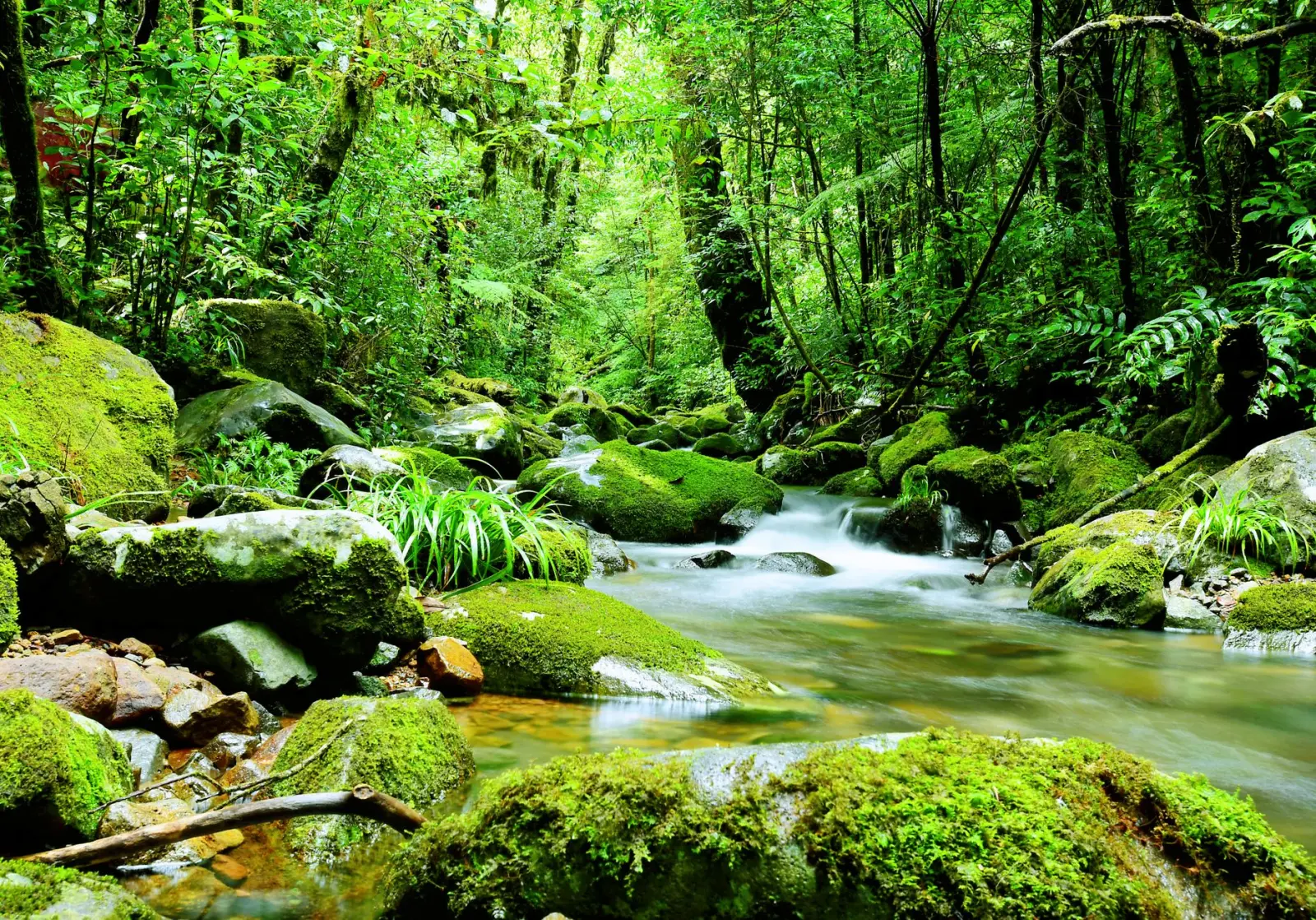
Spend enough time walking through rainforest adjacent to mountain streams, and you begin to notice patterns that don’t appear in the guidebooks. The forest here is not uniform. It’s shaped by the water itself – not just the presence of it, but the movement, the seasonal swings, the geology underneath. After years of moving through these environments, what struck me most was how dependent the entire system is on conditions that seem simple on the surface but operate with remarkable complexity.
The first thing any traveler or researcher encounters is the sheer density of vegetation near flowing water. Trees crowd closer together. Understory plants grow thicker. Moss and epiphytes coat branches more heavily. This isn’t random abundance. It’s a response to reliable moisture. In mountain streams, water moves constantly, and that movement creates a microclimate distinct from the surrounding forest. The air stays humid even during dry seasons. Evaporation from the stream surface and from the canopy keeps the relative humidity high enough that plants can absorb moisture through their leaves, not just their roots. This matters enormously in tropical regions where dry seasons can last months and water stress becomes the limiting factor for growth.
Water Access and Root Systems
Trees along streams don’t have to search as far for water. Their root systems can be shallower and more efficient. In deeper rainforest, away from streams, trees often develop extensive root networks that spread horizontally across the soil surface, competing fiercely for moisture and nutrients. Near streams, plants can afford different strategies. Some species develop roots that actively tap into the streambed itself, reaching down into the gravel and sand where water flows year-round. Others simply benefit from the elevated water table that streams maintain in surrounding soil.
I’ve observed that this accessibility changes forest composition. Species that require consistent moisture – and there are many in tropical regions – concentrate along streams. Palms with shallow root systems thrive here. Certain fern families that need constant humidity establish themselves on stream banks and in the splash zone. These plants would struggle or fail entirely in drier microhabitats just fifty meters away. The stream essentially creates a corridor of suitable habitat running through terrain that might otherwise be marginal for these species.
What often surprises visitors is how unstable stream banks actually are. The water isn’t gentle. During heavy rains, which occur frequently in mountain regions, streams swell dramatically. Banks erode. Large trees topple into the water. Sediment shifts. The forest here exists in a state of perpetual disturbance and recovery. Trees develop buttress roots or lean at angles, anchored by decades of wind and water pressure. Younger growth colonizes freshly exposed soil and gravel bars. Dead wood jams in bends, creating temporary dams and pools. This constant turnover maintains a younger, more dynamic forest than you’d find in stable terrain.
Soil and Nutrient Cycling
The soil near streams differs fundamentally from soil deeper in the forest. Stream water carries nutrients – dissolved minerals, organic matter from upstream, sediment. During floods, this material gets deposited on banks and in adjacent areas. Over time, this creates pockets of richer, more fertile soil than the typically nutrient-poor soils of tropical rainforests. It’s one reason why forest near streams often appears more lush and vigorous.
Decomposition rates also differ. The higher moisture and more stable temperatures near streams create conditions where organic matter breaks down efficiently. Leaf litter doesn’t accumulate as a thick, dry layer. Instead, it cycles through the system more rapidly. Fungi and invertebrates work faster in the humid environment. Nutrients released from decomposing material become available to plants more quickly. This accelerated nutrient cycling supports higher productivity and denser vegetation.
The stream itself functions as a nutrient highway. Fallen leaves, branches, and animal matter enter the water and travel downstream. Some gets trapped locally, creating nutrient hotspots. Fish and aquatic invertebrates process organic material and excrete nutrients back into the water column. When these organisms are eaten by birds or terrestrial predators, nutrients move back into the forest ecosystem. It’s a continuous exchange that keeps the system more fertile than it would be without the stream.
Microclimate and Canopy Structure
Temperature fluctuations near streams are notably smaller than in surrounding forest. The water acts as a thermal buffer. During the day, it absorbs heat. At night, it releases that heat slowly. This moderates temperature swings that would otherwise stress plants. In mountain regions where nights can be cool even in the tropics, this buffering effect allows species to persist that might not survive in more exposed locations.
The canopy structure along streams also tends to be different. Trees compete intensely for light in the humid, fertile conditions, but the stream corridor often remains narrower and more linear than the surrounding forest. This means the canopy here is frequently more open in some places and denser in others, creating a patchwork rather than uniform coverage. Gaps where trees have fallen into the water allow more light penetration. These gaps are quickly colonized by fast-growing pioneer species. The result is a forest that looks structurally more complex than the surrounding lowland rainforest, with more variation in tree size and age.
Moisture-loving plants exploit this environment relentlessly. Climbing plants and vines use the abundant water and structural support to grow rapidly. Bromeliads and orchids establish themselves on branches where moisture is constant. Lichens and liverworts carpet rocks and logs. The biodiversity per square meter is often higher here than in drier forest, even though the total forest area might be smaller. It’s concentrated richness rather than distributed abundance.
Seasonal Dynamics and Resilience
What determines whether a rainforest actually survives along a mountain stream is largely about what happens during dry seasons. In many tropical regions, even “rainforests” experience months with little rainfall. During these periods, the stream becomes the critical survival mechanism. Water flow decreases, but it rarely stops entirely. The water table remains elevated. The microclimate stays humid enough that plants don’t experience severe water stress. Species that would die in surrounding forest persist because they have access to this reliable moisture.
The stream also moderates fire risk. Tropical forests near streams are far less likely to burn during dry seasons because the vegetation remains too moist. This is significant because fire, even low-intensity fire, can reshape forest composition dramatically. Near streams, this risk is minimized, allowing fire-sensitive species to establish and persist.
Mountain streams themselves change over years and decades. Channels shift. Erosion patterns evolve. Large floods can dramatically alter stream geometry. The forest adapts to these changes, but it’s not a passive process. Trees that were once on stable banks find themselves in the splash zone. New banks emerge where sediment accumulates. Pioneer species colonize these new areas. The forest is constantly adjusting its composition and structure in response to stream dynamics. This resilience – the ability to persist through disturbance and adapt to changing conditions – is what allows rainforest to survive in these challenging, dynamic environments.