
The first time you stand beneath a rainforest giant – truly beneath it, with your neck craned back until your vision blurs into the canopy – the scale is difficult to process. These aren’t trees in the way most people understand them. A mature fig or kauri or emergent dipterocarp in the wet tropics operates at a different order of magnitude. The trunk alone can be wider than a small house is tall. The crown spreads across an area that would cover several suburban blocks. And the root system, invisible beneath the forest floor, extends outward in ways that take years of observation to even begin to understand.
What becomes apparent after spending time in these forests is that size alone doesn’t explain why these trees exist at all. The wet tropics are not uniformly hospitable to extreme height. Storms arrive with genuine force. Soil, despite the lush vegetation, is often shallow and chemically poor. The competition for light is relentless. Yet certain species have evolved the structural and physiological strategies to not just survive but to dominate, sometimes reaching heights of 60, 70, even 80 meters. Understanding how they manage this requires looking past the visible tree to the mechanics underneath.
Why Height Matters in a Crowded Forest
In a rainforest, light is the limiting resource. The canopy intercepts most of the incoming solar radiation before it reaches the understory. A seedling on the forest floor receives perhaps 1 to 2 percent of full sunlight. Growth is slow – sometimes agonizingly so. But a tree that can push its crown above the surrounding canopy gains access to unfiltered light. The energy payoff justifies the enormous investment in structural material and the physiological cost of moving water and nutrients up extreme distances.
The giants don’t grow tall immediately. Most spend decades or even a century in the understory, growing slowly, accumulating reserves, and developing the root architecture they’ll need later. When a gap opens in the canopy – from a fallen neighbor, storm damage, or disease – a suppressed tree that has been waiting can suddenly accelerate. It’s not a sprint to the top but a calculated, multi-generational strategy. The trees that reach the emergent layer are often among the oldest in the forest, not the fastest-growing.
Wood Structure and the Problem of Height
The wood of tropical giants is rarely what outsiders expect. Many assume that bigger trees have denser, harder wood. In reality, many of the tallest species have relatively light wood. This is deliberate. A tree that weighs less requires less structural support to stand upright and less energy to move water and nutrients vertically. Species like the Shorea and Dipterocarpus of Southeast Asia, or the Kapok trees of the Amazon, have evolved wood that is strong enough to resist bending and shear stress but not so dense that it becomes a liability.
The trunk itself is engineered for efficiency. As you move from the base upward, the diameter decreases, but not uniformly. The taper is calculated to distribute stress evenly along the length. The wood grain often spirals slightly, which adds torsional strength without adding weight. The bark can be surprisingly thick – sometimes 10 centimeters or more – which provides insulation, water storage, and protection from damage. These aren’t random features. They’re solutions to specific mechanical problems that only become apparent when you’re trying to support a structure 70 meters tall in a climate with high winds and heavy rainfall.
Root Systems and Lateral Support
The visible trunk is only half the story. Below ground, the root system of a giant rainforest tree is often as extensive as the crown above. But it’s not a simple anchor. In wet tropical soils, deep root systems would encounter waterlogging and poor aeration. Instead, many giants develop shallow, spreading root systems that extend far from the trunk. These lateral roots can reach 40, 50, or even 100 meters from the base of the tree.
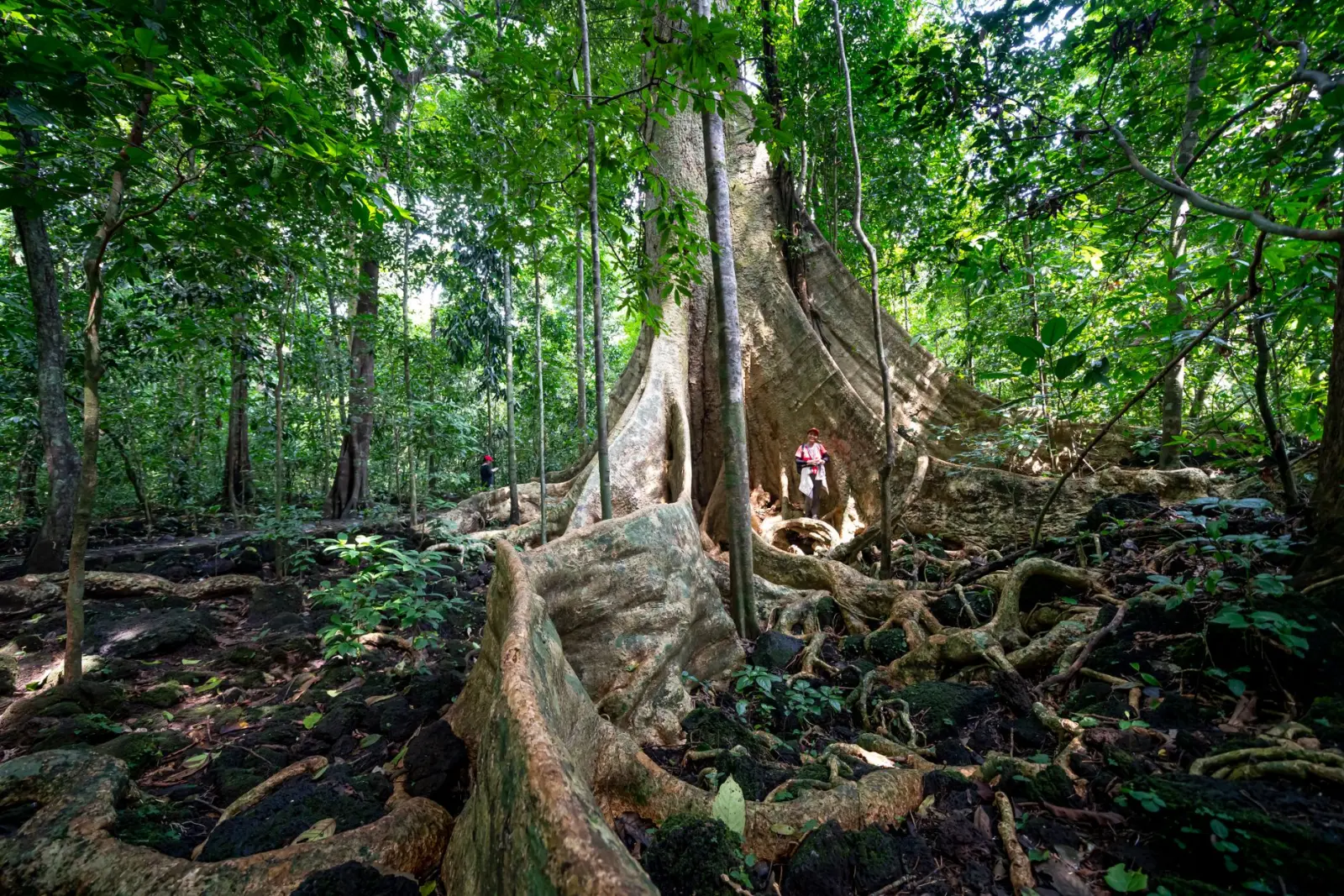
Buttress roots – the flared, wing-like extensions at the base of the trunk – are one visible manifestation of this strategy. They’re not purely structural; they also increase the surface area for nutrient and water uptake in nutrient-poor soils. But structurally, they do matter. They lower the center of gravity and distribute the weight of the trunk across a wider base. A tree with well-developed buttresses can resist wind stress that would topple a tree with a simple cylindrical base.
The lateral root network also creates a web of interdependence. Roots from neighboring trees sometimes graft together, creating shared nutrient pathways. A giant that has been established for centuries can draw resources not just from the soil directly beneath it but from a wider community. This is one reason why removing a single large tree can destabilize an entire forest patch – the loss isn’t just of one organism but of a node in a network.
Water Transport and Physiological Limits
Moving water from the roots to the crown of a 70-meter tree is a feat of physics and biology working together. The tree relies on capillary action, osmotic pressure, and the cooling effect of transpiration to pull water upward. But there are limits. As trees get taller, the water column becomes more prone to breaking under stress. Cavitation – the formation of air bubbles in the water-conducting vessels – can occur, disrupting flow. The tree’s wood has evolved to resist this, with vessel walls that can withstand negative pressure and pit membranes that prevent air from spreading between adjacent vessels.
Drought stress is a real threat, even in wet tropical forests. During dry seasons or during periodic drought cycles, the water table drops. A giant tree with a shallow root system can find itself suddenly unable to access water. The tree responds by closing its stomata (the pores that allow gas exchange), which reduces water loss but also halts photosynthesis. A prolonged drought can kill even the largest trees. This is why the tallest trees in the tropics are typically found in areas with reliable, year-round moisture – not just high total rainfall, but consistent moisture.
The Canopy Community
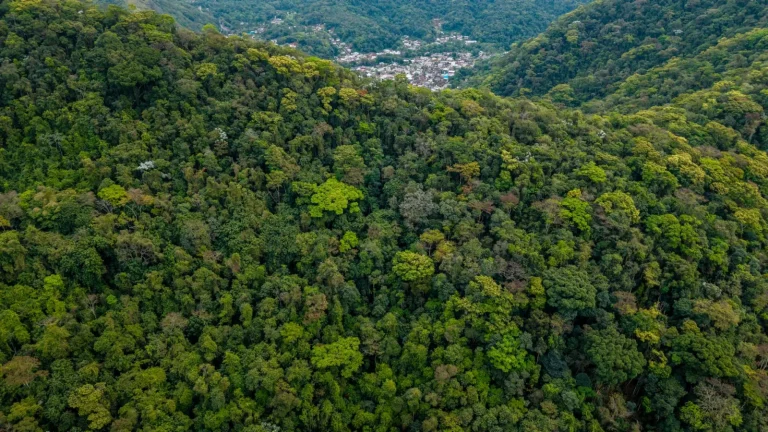
The crown of a giant rainforest tree is an entire ecosystem. Epiphytes – plants that grow on the branches without harming the host – can number in the thousands on a single large tree. Orchids, bromeliads, ferns, and mosses create a green layer that is sometimes 50 centimeters thick. This epiphytic community holds water, creates habitat for insects and small vertebrates, and adds significant biomass to the crown. Some estimates suggest that the epiphytic biomass on a large tree can equal or exceed the biomass of the tree itself.
Animals depend on these giants in ways that extend far beyond simple shelter. Fruiting patterns of large trees drive the seasonal movements of birds, primates, and other wildlife. A single large fig tree can feed hundreds of animals during its fruiting season. The flowers of emergent trees are sometimes the only food source available to certain species during lean periods. The loss of large trees isn’t just an aesthetic or timber issue – it’s an ecological collapse at multiple scales.
The giants also create microclimates. The dense crown modifies wind speed, humidity, and temperature. Rain that falls on the canopy is intercepted and drips slowly to the forest floor, reducing erosion. The shade cast by the crown keeps the understory cooler and more humid than it would be otherwise. These physical modifications create conditions that allow other species to persist. Remove the giants, and the entire microclimate shifts.
After years of working in and studying these forests, what strikes me most is how contingent everything is. A giant tree that has stood for 500 years is not invulnerable. A single storm, a disease, a shift in water availability – any of these can bring it down. Yet the forests persist, and new giants grow to replace the old. The system is robust at the ecosystem scale even if individual trees are fragile. Understanding this distinction matters when thinking about conservation and management. The goal isn’t to preserve individual giants but to maintain the conditions that allow giants to grow.