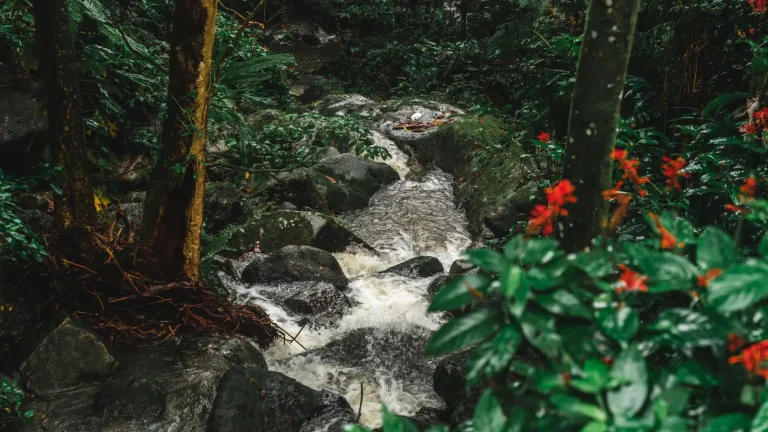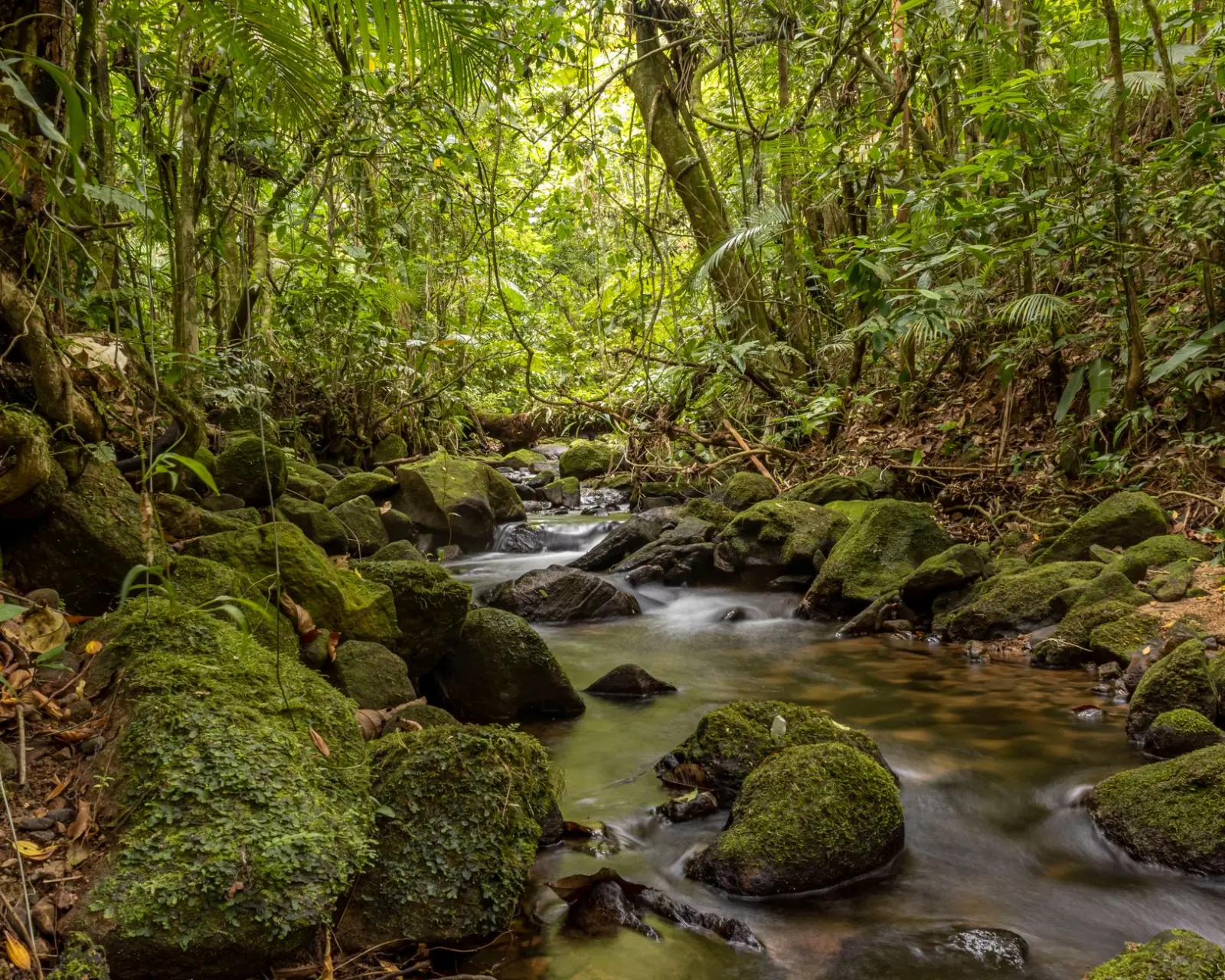
Spending time near rainforest creeks reveals something that initially seems counterintuitive. Heavy rain hammers the canopy, water rushes downslope, yet the creek remains clear enough to see the bottom. You’d expect the opposite – that the volume of water moving through the forest would churn up sediment and turn everything brown. But rainforest hydrology works differently than it does in temperate regions or degraded landscapes.
The clarity has nothing to do with the amount of rainfall. Rainforests receive enormous volumes of water, often 80 to 400 inches per year depending on location. The difference lies in what happens to that water before it reaches the creek channel. The forest floor acts as a massive filter and buffer system that most visitors never consider. When you’re hiking through the understory, you’re walking on layers of decomposing leaves, root networks, and organic matter that can be several feet deep. This isn’t just debris – it’s a functioning water management system that has evolved over millennia.
The Soil Structure Beneath the Trees
Rainforest soil is often surprisingly porous despite its reputation for being dense jungle. The high organic content creates a sponge-like structure. When rain falls, it doesn’t sheet off the surface the way it does on compacted ground or exposed hillsides. Instead, water infiltrates quickly into the organic layer, moving through the soil matrix rather than running across the top. This infiltration process removes particles through mechanical straining and biological processes. Fungi, mycorrhizal networks, and soil organisms actively process and stabilize organic matter, preventing fine sediment from becoming mobile.
The root systems add another layer of stabilization. Trees in rainforests develop dense, shallow root networks that bind soil particles together. These roots create pathways for water movement that are already established and stable. Water flowing through root channels doesn’t erode banks or disturb sediment the way it would in an open channel. I’ve noticed this repeatedly when crossing streams at different water levels – even when creeks rise significantly after rain, the water remains clear because the banks aren’t collapsing and the streambed isn’t being scoured by uncontrolled flow.
Vegetation as a Sediment Barrier
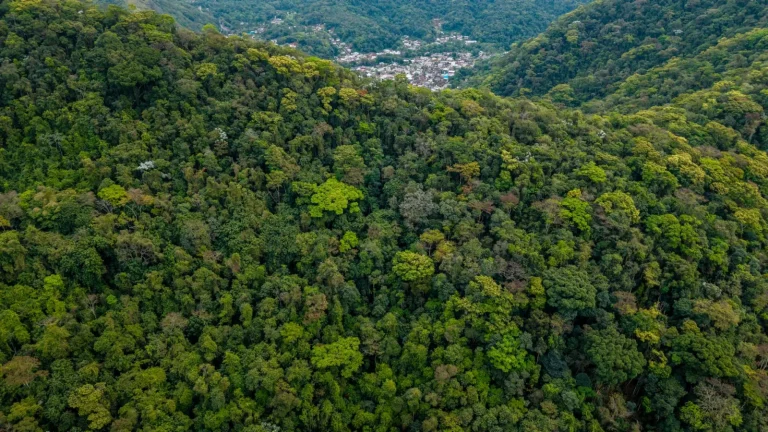
The dense understory vegetation acts as a physical barrier that intercepts water before it reaches the creek. Fallen logs, dense shrub growth, and herbaceous plants slow water movement across the forest floor. This reduction in velocity is crucial. Water moving slowly deposits particles; water moving fast carries them. By the time water reaches the creek channel, it has already lost most of its erosive energy. The vegetation also stabilizes banks and prevents slumping, which is one of the primary sources of sediment in streams.
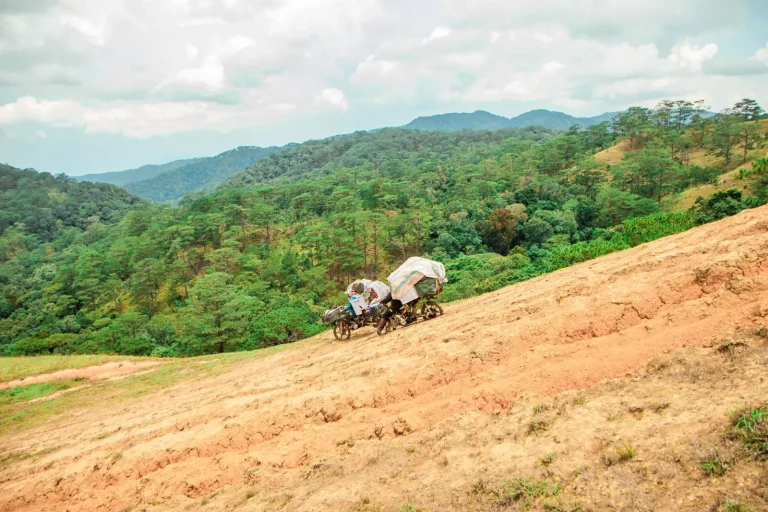
What’s often overlooked is how this vegetation pattern changes with land use. I’ve hiked through areas where selective logging or agricultural clearing has occurred upstream. In those sections, the same creek that runs clear in pristine forest becomes noticeably turbid. The difference isn’t rainfall – it’s the loss of that vegetation buffer and the exposure of bare soil to direct runoff. This makes clear water in undisturbed rainforest creeks less a property of the climate and more a property of intact forest structure.
Water Chemistry and Organic Processes
Beyond the physical filtration, rainforest water chemistry plays a role. The water that emerges from the soil is already slightly acidic due to organic acids from decomposing vegetation. This acidic environment, combined with tannins and other organic compounds, actually helps keep fine particles in suspension rather than allowing them to settle and cloud the water. The color of rainforest creeks – often tea-colored or amber rather than pure clear – comes from these dissolved organics, not from sediment. Many travelers mistake this color for turbidity, but if you fill a glass and let it sit, the water remains clear. True turbidity from sediment would settle out over time.
The biological activity in rainforest soil also processes organic matter more efficiently than in temperate forests. Higher temperatures and year-round moisture mean decomposition happens faster and more completely. This reduces the amount of loose organic debris that might otherwise wash into streams. The soil food web – bacteria, fungi, arthropods, and larger organisms – keeps the system in balance, preventing the accumulation of erodible material.
When Rainforest Creeks Do Turn Cloudy
The exceptions are instructive. Creeks run turbid when the forest structure is disrupted. After major landslides, which do occur naturally in steep terrain, water becomes brown temporarily. During the initial phase of forest recovery, before vegetation reestablishes, sediment loads increase. I’ve also seen creeks turn turbid during extreme weather events or after volcanic activity, both of which overwhelm the system’s capacity to filter water.
More commonly, human disturbance causes cloudiness. Mining, road construction, and large-scale clearing all remove the vegetation buffer and expose bare soil. Once you’ve seen a rainforest creek running clear next to a degraded area where the same creek runs brown, the relationship between forest integrity and water clarity becomes undeniable. It’s not about rainfall amount – it’s about the forest’s ability to process and filter that water before it reaches the channel.
Understanding why rainforest creeks stay clear changes how you read the landscape. Clear water isn’t a guarantee of pristine conditions – it’s an indicator of a functioning forest system where vegetation, soil structure, and biological processes are all working together. When you’re traveling through rainforest regions and encounter cloudy water, it’s worth investigating what’s upstream. The water quality tells you something real about the health of the forest you’re moving through.