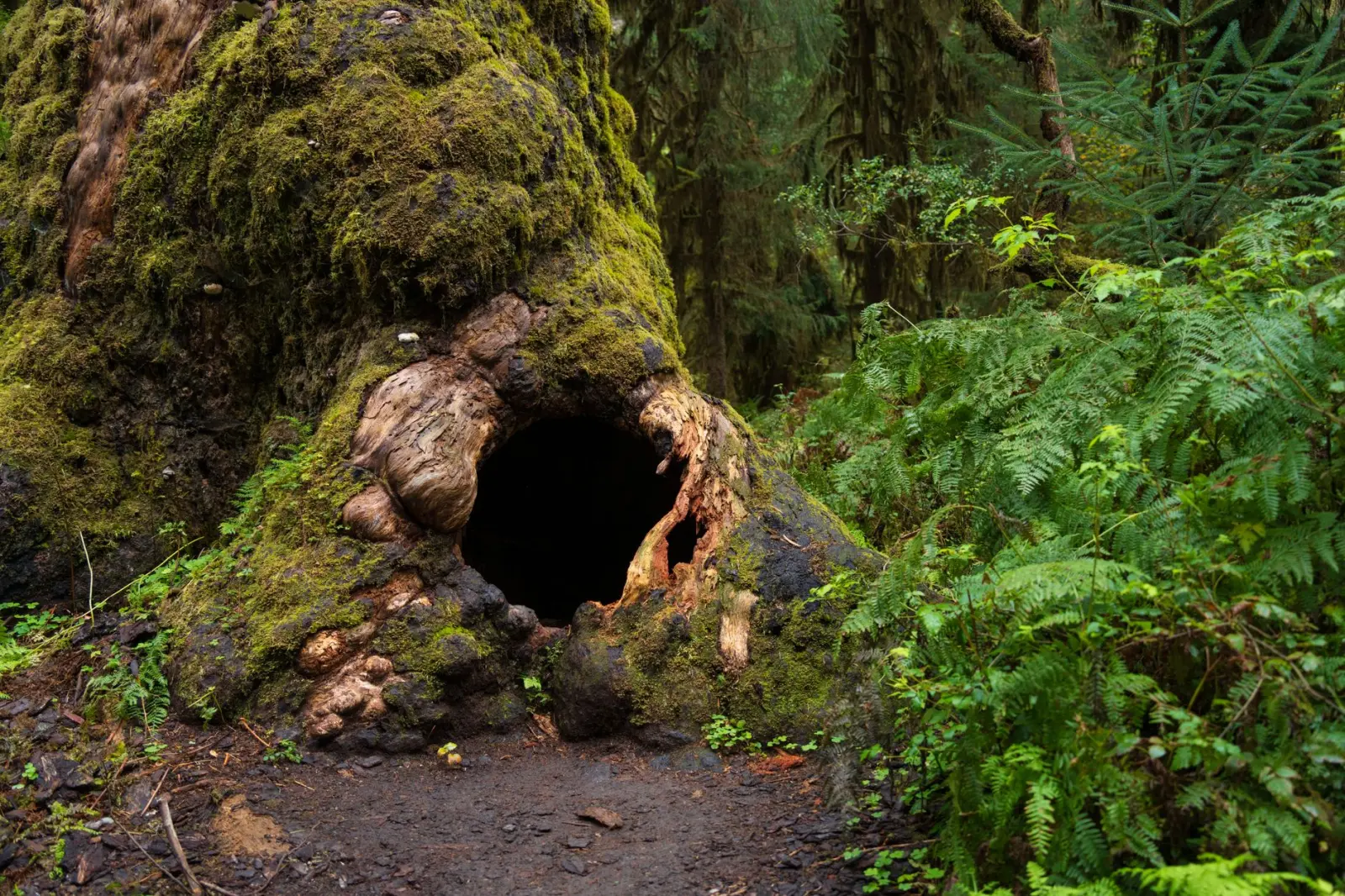
Spend enough time walking through a rainforest, and you’ll notice something that doesn’t make immediate sense: massive trees with trunks that sound hollow when you tap them, yet they’re still very much alive. The canopy spreads wide, leaves are green, and there’s no obvious sign of distress. This isn’t decay in the way a dead tree decays. It’s a slower, more selective process where the interior wood gradually disappears while the outer shell remains functional.
The mechanism behind this starts with damage. A branch falls, an animal strips bark, or a tree simply sheds a limb as part of normal aging. In a rainforest, where moisture is constant and temperatures stay warm, that wound doesn’t dry out and seal the way it might in a temperate forest. Instead, it becomes an entry point. Fungi and bacteria move in almost immediately. They don’t attack the entire tree uniformly. They target the heartwood – the inner, older wood that no longer transports water or nutrients. The sapwood, the living layer just beneath the bark, remains intact and continues to function.
The Role of Selective Decay
Heartwood is fundamentally different from sapwood. It’s composed of dead cells, often reinforced with antimicrobial compounds that the tree produced years or decades earlier. Despite these defenses, heartwood is still vulnerable to the right decomposers. In the rainforest, the right decomposers are everywhere. Fungi like Ganoderma and various polypores specialize in breaking down the lignin and cellulose that make up wood structure. They don’t need the tree to be dead to do this work – they simply work from the inside out, following the path of least resistance through the heartwood.
What’s critical to understand is that this process is slow and selective. A fungus colonizing heartwood doesn’t spread rapidly into the sapwood because the living cells there actively resist invasion. The tree is still producing antimicrobial compounds, still moving water and nutrients through those outer rings. The fungus respects that boundary, in a sense. It eats inward, creating cavities that can grow for years or even decades without killing the tree. I’ve seen trees with hollows so large you could fit a person inside, yet the tree continues to photosynthesize, produce seeds, and support wildlife.
Animal Activity Accelerates the Process
Animals play a more active role in hollowing than is often recognized. Woodpeckers don’t just peck at bark – they excavate into weakened wood, following the softer zones where decay has already begun. Their work opens new surfaces to fungal colonization and creates pathways for insects. Termites, carpenter ants, and wood-boring beetles enter through these gaps. Unlike fungi, they’re not selective about heartwood versus sapwood, but they tend to concentrate where the wood is already compromised. Larger animals – porcupines, coatis, even jaguars – claw and strip bark, exposing wood to moisture and spores.
In some cases, animals create the initial hollow intentionally. Cavity-nesting birds and mammals enlarge natural weak points or fungal cavities to make dens. Once the interior is opened up, the hollowing accelerates. More surface area is exposed to moisture and air. Fungi and insects colonize faster. The tree’s defensive response is localized – it may wall off the cavity with a boundary layer of special cells – but it can’t reverse the damage already done.
Why the Tree Stays Standing
The structural integrity of a hollow tree depends entirely on the thickness and strength of the remaining sapwood and bark. A tree with a small central cavity and thick outer wood can remain stable for a very long time. The sapwood, even if it’s only a few inches thick, is still living and still strong. It continues to transport water and support the crown. The bark, though thin, provides some lateral support. The tree is no longer a solid column, but it functions as a hollow tube – and hollow tubes are mechanically efficient. They distribute stress along their perimeter rather than throughout a solid mass.
I’ve observed that the real danger comes from wind. A hollow tree with a thick sapwood layer can withstand normal weather. But a severe storm, especially one with lateral wind gusts, puts enormous stress on the remaining wood. The tree may snap or topple. However, in a dense rainforest where neighboring trees provide mutual support and wind speeds are often moderated by the canopy structure, even hollow trees can persist. Some of the oldest hollow trees I’ve encountered have been standing for what appears to be 50 to 100 years or more, based on the size of the cavity and the thickness of the remaining wood.
The decay process itself eventually reaches a limit. Once the fungi have consumed most of the available heartwood, they slow or stop. The boundary between living sapwood and dead heartwood becomes a stable interface. The tree may remain hollow but stable indefinitely, assuming it avoids catastrophic damage. In some cases, the tree compartmentalizes the cavity by producing a thick boundary layer of specialized wood that resists further decay. This is the tree’s immune response – not a cure, but a containment strategy.
Moisture and Temperature Drive the Timeline
The speed at which a tree hollows depends heavily on local conditions. In the wettest parts of the rainforest, where moisture is near saturation year-round, fungal activity is constant. Decay can progress noticeably within a few years of initial damage. In slightly drier areas or during seasonal dry periods, the process slows. Fungi need moisture to grow, but they also need oxygen. A completely waterlogged cavity may actually slow decay because fungi struggle in anaerobic conditions. The sweet spot for rapid hollowing is high moisture with good air circulation – exactly what you get in a cavity that’s open to the forest air.
Temperature is less variable in the rainforest, but it still matters. Fungi are most active in warm conditions. In cooler montane rainforests, decay is slower than in lowland tropical forests. This is one reason why some high-altitude trees, even when damaged, remain solid for longer than their lowland counterparts.
The practical reality is that hollowing is a normal part of rainforest tree aging. It’s not a pathology or a sign of environmental stress. It’s an ecological process that has been happening for millions of years. Hollow trees provide habitat for countless species – insects, birds, mammals, fungi, and microorganisms. They’re not dying trees; they’re mature trees in a particular stage of life, still productive and still integral to the forest ecosystem. Understanding this process changes how you read the forest. A hollow tree isn’t a failure of nature. It’s nature working exactly as it should.