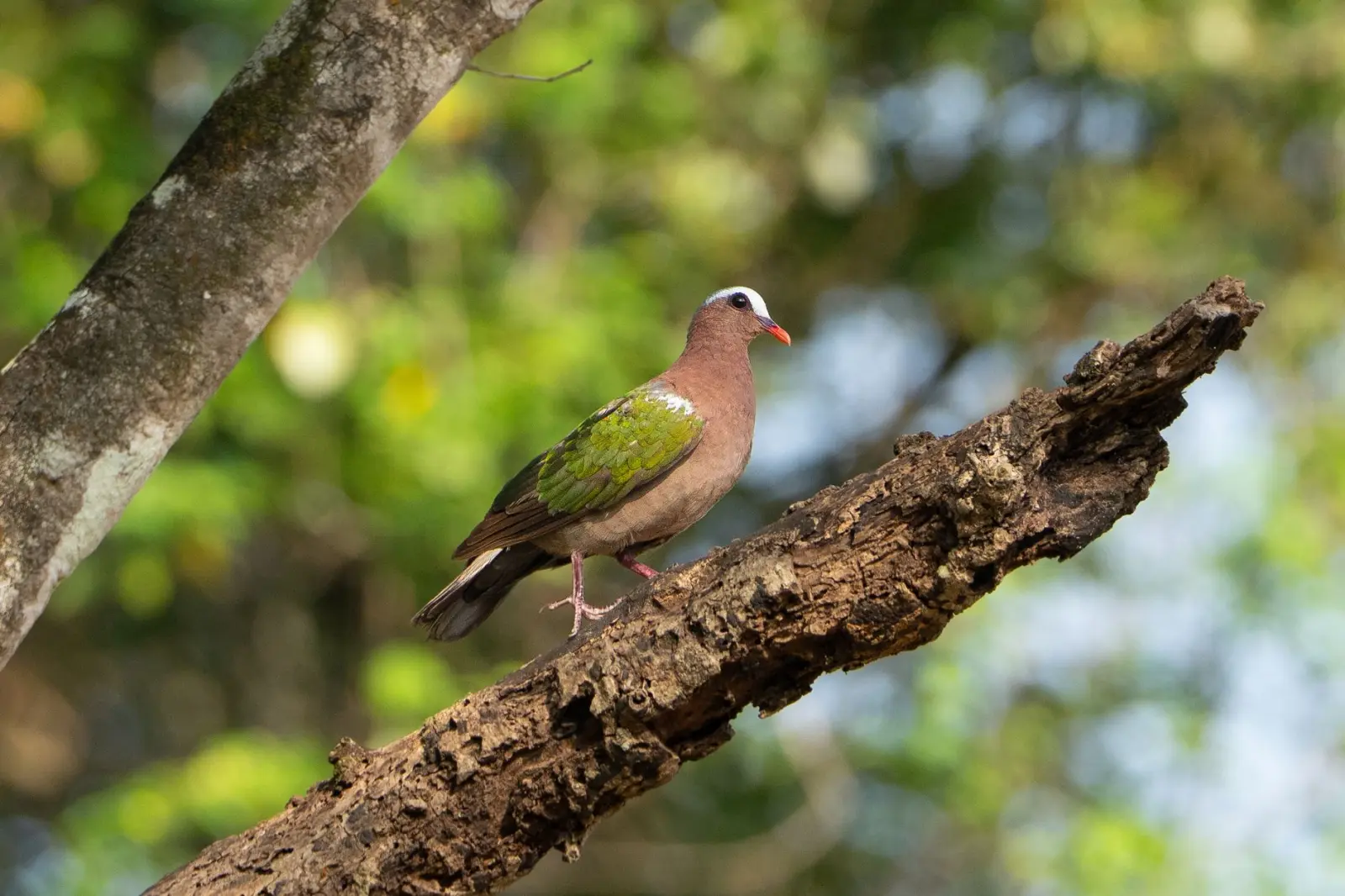
Emerald doves are small, iridescent pigeons that inhabit the rainforests of northern Australia, and after spending considerable time in these environments, I can tell you they are far less visible than their striking appearance might suggest. The birds themselves are unmistakable when you do see them – metallic green and bronze plumage that catches light in ways that seem almost artificial. But that visual appeal masks a fundamental challenge: they spend most of their time on or very close to the forest floor, and they move with a deliberate, quiet manner that makes casual observation difficult.
The emerald dove’s preference for ground-level activity shapes everything about how and where you encounter them. They forage among leaf litter and low vegetation, picking at seeds and fallen fruit. This behavior keeps them hidden beneath the canopy structure for most of the day. Unlike many rainforest birds that advertise their presence through calls or conspicuous perching, emerald doves tend toward silence and concealment. You might spend hours in suitable habitat and see nothing, then catch a brief glimpse as a bird flushes from underfoot and disappears into dense scrub within seconds.
Movement and Daily Patterns
The birds follow fairly predictable daily rhythms, though “predictable” is relative when working with wildlife in complex rainforest terrain. Early morning and late afternoon tend to be when they’re most active, moving between roosting sites and feeding areas. During the heat of midday, they settle into shaded spots and become even less mobile than usual. This isn’t random behavior – it’s a direct response to temperature and humidity fluctuations in the rainforest microclimate.
What I’ve observed repeatedly is that emerald doves rely heavily on established pathways through the understory. They tend to move along the same routes day after day, following gaps in vegetation and natural corridors. If you’re patient enough to identify these pathways, your chances of seeing the birds improve significantly. The challenge is that these routes can shift seasonally as vegetation grows or falls, or when disturbance occurs. A cyclone or heavy storm can alter the understory structure enough to redirect their movement patterns for weeks or months.
Habitat Requirements and Distribution
Emerald doves are strictly rainforest birds in Australia. They don’t tolerate open woodland, cleared land, or heavily degraded habitat. This makes them useful as an indicator species for rainforest quality, but it also means their distribution is fragmented and localized. They’re found in pockets of suitable rainforest from the Wet Tropics of Far North Queensland down to parts of coastal New South Wales, but within that range, they’re absent from vast areas that look superficially suitable to the untrained eye.
The specificity of their habitat requirements comes down to several interconnected factors. They need dense ground cover for foraging and shelter. They need adequate moisture and the associated invertebrate and seed populations that come with it. They need the structural complexity that mature or regenerating rainforest provides. A rainforest that has been selectively logged, even if trees remain standing, often loses the understory density that emerald doves require. Similarly, rainforest fragments smaller than a certain threshold – roughly 50 hectares in my experience – rarely support stable populations.
Breeding and Nesting Behavior
Unlike their ground-feeding habits, emerald doves nest in trees, typically at modest heights of 2 to 8 meters. The nest is a simple platform of twigs, almost skeletal in construction. During breeding season, which varies slightly depending on latitude but generally spans spring through early summer, the birds become slightly more visible as they make repeated trips to and from nest sites. Even then, they move with purpose and speed, minimizing the time they spend exposed.
I’ve found that locating nests requires understanding the birds’ preferred nesting trees. They favor trees with particular structural characteristics – typically those with horizontal branching patterns and moderate density of foliage for concealment. Palms and certain fig species appear in nests more often than random chance would suggest. Once a suitable nesting tree is identified in an area, the same tree or nearby trees in that location may be used repeatedly across years. This site fidelity is useful for monitoring populations, though it also means that loss of key trees can have outsized impacts on local breeding success.
Clutch size is small – usually just two eggs – and incubation and fledging periods are relatively short compared to many other pigeons. The investment per breeding attempt is modest, which allows emerald doves to attempt multiple broods if conditions permit. However, predation rates on eggs and nestlings are significant, and I’ve observed that nesting success varies dramatically year to year depending on weather, food availability, and predator populations.
Diet and Seasonal Availability
Emerald doves are primarily seed eaters, supplemented by fallen fruit and occasionally invertebrates. Their diet shifts seasonally based on what’s available in the rainforest. In months when certain fruiting trees are productive, the birds concentrate in those areas. When fruit becomes scarce, they rely more heavily on seeds from the forest floor. This dietary flexibility is important for their survival, but it also means their abundance and visibility in any given location can fluctuate significantly across the year.
The relationship between fruit availability and dove populations is not simple. A productive fruiting season doesn’t automatically translate to increased dove sightings. The birds may concentrate in specific patches where food is abundant, leaving other apparently suitable habitat empty. Conversely, when food is dispersed and scarce, the birds spread out more widely but become even more difficult to locate because they’re searching rather than feeding intensively in one area.
I’ve noticed that emerald doves respond to disturbance events in ways that affect their visibility. After a cyclone or severe weather event, when the forest structure is damaged and food sources are disrupted, the birds often become more conspicuous as they search for resources in less-sheltered locations. This increased visibility is typically temporary, lasting only until the immediate post-disturbance period ends and normal patterns resume.
Practical Considerations for Observation
If you’re attempting to observe emerald doves in Australian rainforests, patience and timing matter far more than technique. Early morning walks through suitable habitat, moving slowly and stopping frequently to listen, offer the best chance of encounter. The birds’ soft, low calls – often described as a gentle cooing – can alert you to their presence before you see them. Learning to recognize these vocalizations dramatically improves your success rate.
Ground disturbance can flush birds, so moving carefully through the forest is important. Wearing neutral colors and avoiding sudden movements helps, though honestly, the birds’ wariness is ingrained and situational awareness matters more than camouflage. Many sightings occur when you’re stationary or moving very slowly, and the bird simply walks into view before detecting you.
The reality of emerald dove observation is that it remains unpredictable despite their regular presence in suitable habitat. You can spend days in prime rainforest without seeing one, then encounter several in a single morning. This unpredictability reflects the birds’ ecology – they’re cryptic, ground-based, and adapted to avoid detection. Understanding this isn’t frustrating once you accept it as fundamental to their survival strategy. The emerald dove’s elusiveness is precisely what allows them to persist in rainforests where other species might struggle with predation or disturbance.