Spend enough time in rainforest canopies, and you notice something counterintuitive: lichens don’t always thrive when the air gets cleaner. This runs against what most people assume. We know that lichens are sensitive to pollution, that sulfur dioxide and nitrogen oxides damage their tissues, and that lichen diversity collapses in industrial zones. Yet in places where air quality has genuinely improved over decades – whether through regulation, industrial decline, or remote geography – rainforest lichens don’t automatically flourish. Sometimes they stagnate. Sometimes populations that were stable begin to shift. The relationship between clean air and lichen health is far more complex than a simple cause-and-effect story.
The core issue lies in what lichens actually need beyond just low pollution. Rainforest lichens, particularly the foliose and fruticose species that dominate the canopy, have evolved under conditions of chronic, low-level atmospheric deposition. They’re accustomed to a steady trickle of nitrogen and other nutrients arriving via dust, sea spray, and yes, even some industrial fallout. When air becomes genuinely clean – when that atmospheric nutrient supply dries up – lichens face a different kind of stress. It’s not acute toxicity. It’s chronic nutrient scarcity in an environment where they’ve come to depend on atmospheric inputs to supplement what the host tree provides.
The Nutrient Dependency Problem
Lichens are composite organisms, but they’re not independent of their surroundings. The fungal partner can absorb minerals directly from rainwater and dust settling on the surface. The algal or cyanobacterial component needs nitrogen to build proteins and nucleic acids. In polluted air, this nitrogen arrives as ammonium or nitrate particles. In clean air, it doesn’t. The lichen doesn’t suddenly die from this absence – it’s not like a plant losing access to soil nutrients. But growth rates slow. Reproduction becomes less reliable. Competitive ability against moss and other epiphytes declines.
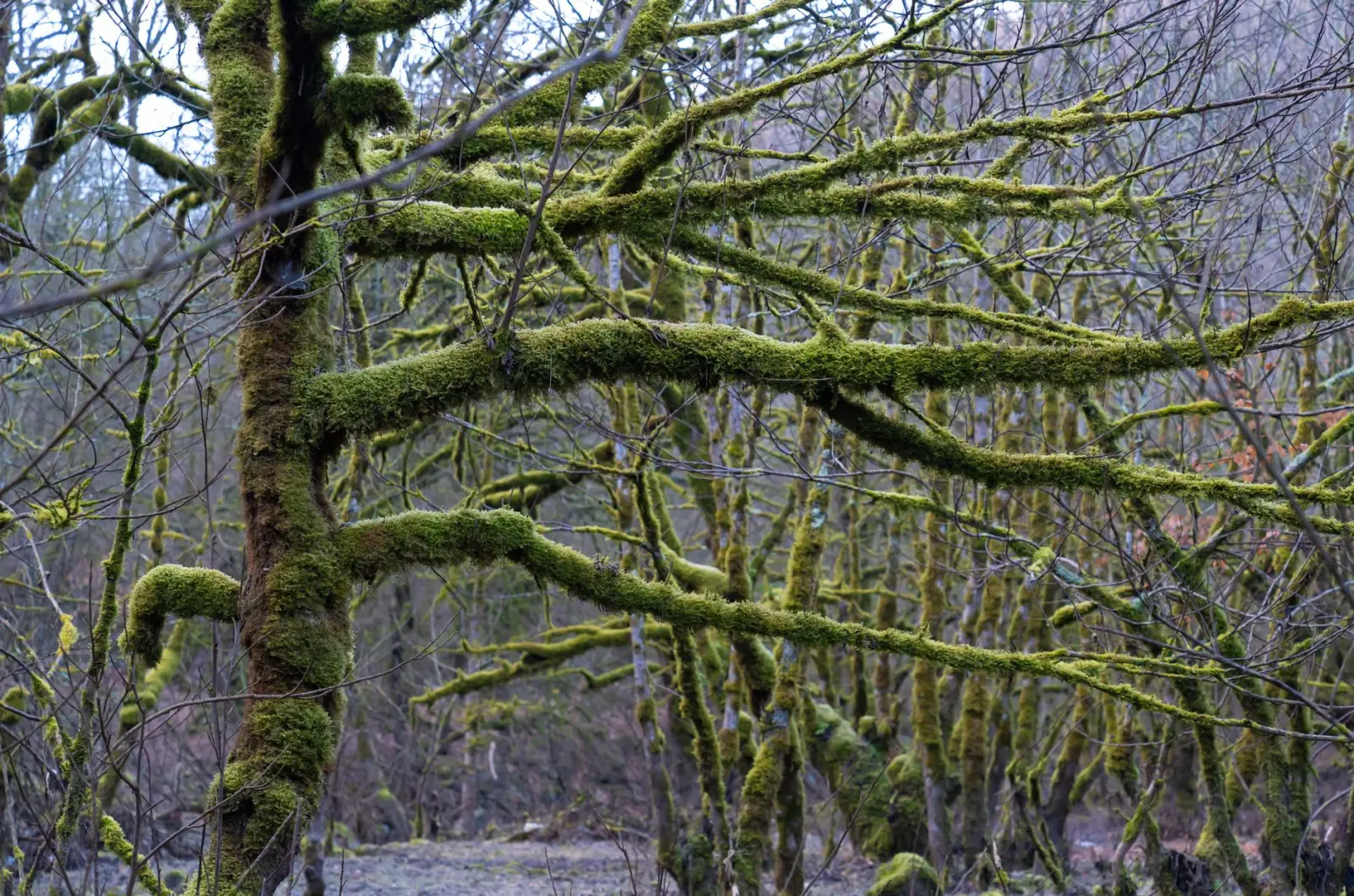
I’ve observed this most clearly in protected rainforest areas where air quality has improved substantially over the past 20 to 30 years. In some cases, lichen species that were once common have become patchier. Their coverage on host trees remains, but the density is lower. New recruits – young thalli establishing on previously bare bark – appear less frequently. This isn’t because the air is toxic. It’s because the lichens are operating closer to their minimum nutrient threshold. They can persist, but they’re not expanding the way they would if atmospheric nitrogen were available at the levels they evolved with.
Substrate and Host Tree Dynamics
The host tree itself matters enormously, and clean air changes this relationship in ways that aren’t always obvious. Trees in rainforests accumulate their own nutrient loads from leaf litter, from nitrogen-fixing epiphytic plants, and from the slow weathering of bark. When air pollution was higher, lichens benefited from additional nutrient inputs that also benefited the tree. The bark surface became more nutrient-rich overall. Now that the air is cleaner, the tree’s nutrient budget hasn’t necessarily improved – it’s just that the atmospheric supplement has vanished. Lichens that relied on that boost find themselves competing more directly with mosses and liverworts for what the host tree and local rainfall provide.
This is where tree species composition becomes relevant. In rainforests where the canopy is dominated by nutrient-poor host trees – species with smooth, acidic bark that naturally supports fewer epiphytes – the loss of atmospheric nutrient input hits lichens harder. In forests with more nutrient-rich host trees, the effect is less pronounced. I’ve worked in regions where a shift toward cleaner air coincided with a subtle shift in the lichen community structure. The most sensitive species didn’t disappear, but they redistributed toward the most favorable microsites: where bark is richest, where moisture is most stable, where competition is lowest.
Moisture and the Secondary Effect
Clean air often correlates with reduced atmospheric haze and aerosol load. This sounds beneficial, but it has a side effect: reduced light scattering in the atmosphere means more direct solar radiation reaches the forest floor and canopy. In tropical rainforests, this can actually increase evaporative stress on epiphytic communities. Lichens are poikilohydric – they don’t regulate internal water content. They dry out and rehydrate passively. When atmospheric aerosol load decreases, the microclimate becomes slightly drier, and lichen activity windows become narrower. They have fewer hours per day when moisture levels are high enough for photosynthesis and growth.
This effect is subtle and varies with local topography and canopy structure. In coastal rainforests with persistent fog, the impact is minimal. In inland or higher-elevation forests where moisture already varies seasonally, cleaner air can push the system toward drier conditions during critical growth periods. Lichens don’t fail outright. But their annual productivity drops, and this compounds the nutrient limitation problem. A lichen that’s both nutrient-limited and water-stressed will grow more slowly and reproduce less reliably than one operating under either constraint alone.
What Recovery Actually Looks Like
The practical reality is that lichen communities in rainforests with improving air quality don’t show simple recovery patterns. What we typically see is a period of transition lasting 10 to 20 years or longer. Initially, the most pollution-sensitive species may increase slightly as the most toxic conditions abate. But then a plateau arrives. The community stabilizes at a new equilibrium that reflects the combined effects of lower pollution, lower atmospheric nutrient input, and shifts in competitive dynamics with other epiphytes.
In some cases, we’ve observed a slow increase in lichen diversity as air quality improves, but total lichen biomass or coverage remains stable or even declines slightly. This isn’t failure. It’s a rebalancing. The lichen community becomes less dominated by a few pollution-tolerant generalists and more diverse in composition, but it doesn’t necessarily become “richer” in the sense of more abundant or more productive. The forest canopy looks different, but not necessarily better in ways that simple metrics capture.
The takeaway from years of observation is that clean air is necessary for lichen health, but it’s not sufficient. Rainforest lichens evolved in an atmosphere that carried a baseline load of nutrients and particles. When that load disappears, we’re not simply removing a toxin – we’re removing a resource that these organisms had come to integrate into their survival strategy. Managing for lichen conservation in rainforests means thinking beyond just air quality regulation. It means understanding that nutrient cycling, host tree health, and microclimate stability all interact with atmospheric conditions in ways that aren’t always intuitive. Clean air is a starting point, not a destination.