
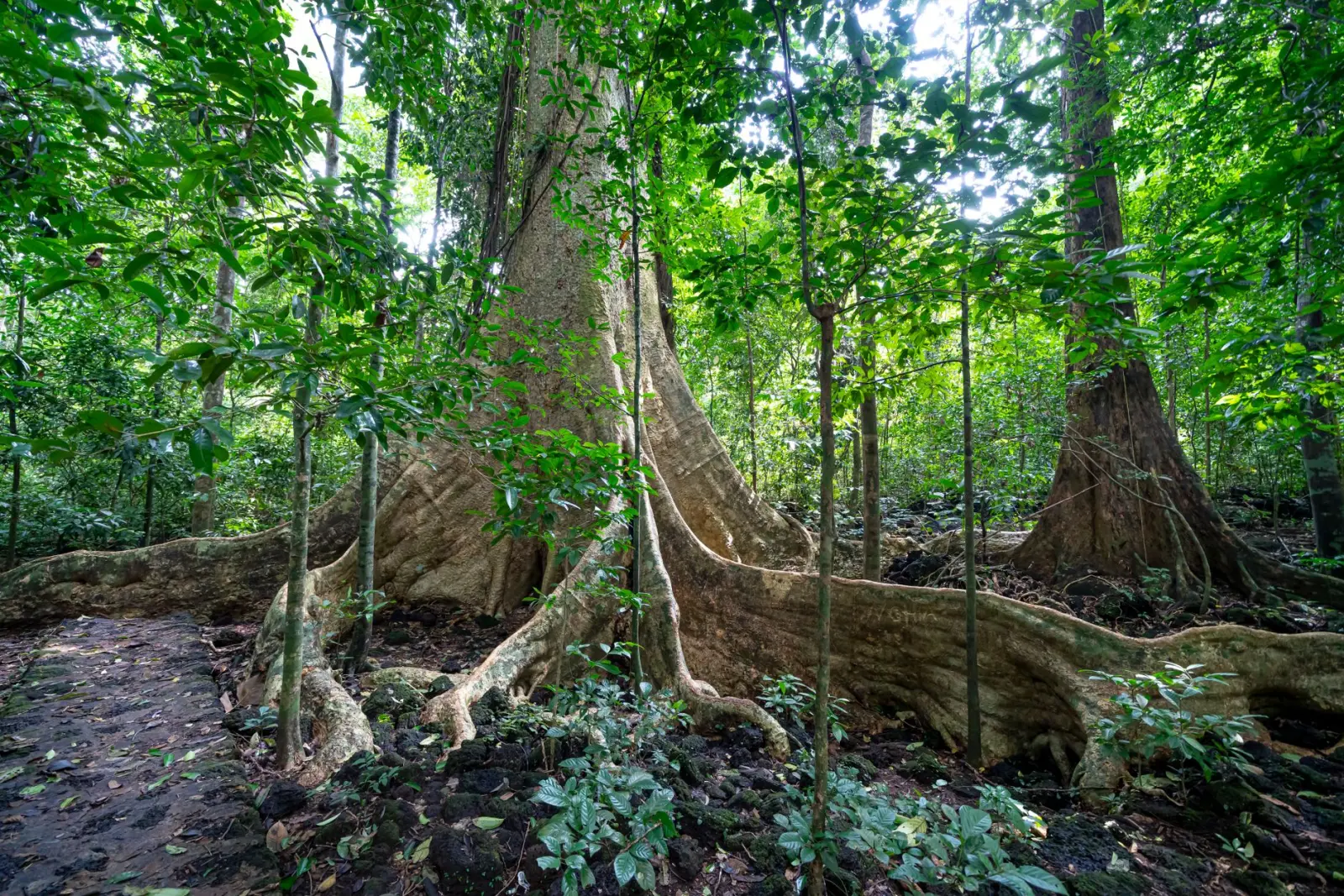
Spend enough time walking through a mature rainforest, and you stop noticing the buttress roots. They become as ordinary as the canopy itself. But the first time you see one – that massive, wing-like formation spreading out from a tree’s base like architectural bracing – it registers as something deliberate, something engineered. It’s not. These structures emerge from the same pressures that shape every organism in the forest, and understanding them requires looking at what the soil actually does, not what we imagine it should do.
The most immediate reason buttress roots exist has to do with the fundamental weakness of rainforest soil. Tropical soils are notoriously shallow and poor. The dense organic layer on the forest floor breaks down rapidly in warm, wet conditions, and nutrients leach away almost as soon as they’re released. What remains is often laterite or clay – compacted, nutrient-depleted, and structurally unstable. A tree cannot sink a deep taproot into this. It has nowhere to go. Instead, trees spread their root systems horizontally, staying in the nutrient-rich upper layers where decomposing matter and mycorrhizal networks concentrate. But horizontal roots alone create a problem: they don’t anchor well. A tree with shallow, lateral roots needs additional support against wind, against its own weight, against the simple physics of standing tall in a saturated substrate.
The Structural Reality of Tropical Anchorage
Buttress roots solve this by extending the base of the tree into a series of thick, flattened ribs that spread outward and downward. They’re not roots in the traditional sense – they’re modified root tissue that functions as both anchor and support structure. The buttresses increase the surface area of contact with the soil, distributing the tree’s weight across a wider footprint. They also create mechanical resistance to lateral stress. When you look at a buttressed tree from the side, you see why: the roots form a kind of tripod or multipod system, each buttress angling slightly outward and down, creating triangulation that resists movement in multiple directions.
What’s worth noting is that buttress roots don’t develop uniformly across all rainforest trees. You see them most prominently on the largest emergent trees – the ones that break through the canopy and face the full force of wind. Smaller understory trees rarely develop them, or develop them only minimally. This is telling. The buttresses appear where the mechanical demand is highest: where a tree is tall enough to act as a sail, where wind leverage is greatest, and where the soil is least capable of providing deep anchoring.
I’ve observed that buttress development also correlates with soil saturation. In areas where the water table is consistently high or where seasonal flooding occurs, buttresses tend to be more pronounced. Waterlogged soil loses cohesion. It becomes plastic, almost fluid. A tree standing in such conditions cannot rely on friction and compaction to hold it in place. The buttresses, in effect, become a mechanical solution to a hydraulic problem. They keep the tree upright not through deep penetration but through sheer structural geometry.
Growth Patterns and Environmental Response
The development of buttress roots isn’t predetermined in a tree’s genetic code the way a seed’s germination pattern might be. Instead, it’s a response to conditions encountered during growth. Young trees don’t have obvious buttresses. As a tree grows taller and heavier, and as it experiences wind stress, lateral root growth accelerates in certain directions. The roots thicken and flatten, and the base of the trunk itself begins to flare. Over decades, this produces the characteristic buttressed form. Trees growing in protected microsites – in valleys, behind ridges, or in particularly dense forest – sometimes develop smaller buttresses or none at all, even if they reach considerable size. The structural demand simply isn’t there.
This adaptive quality is important because it reveals something about how tropical trees actually function. They’re not rigidly following a blueprint. They’re responding to real, immediate pressures. A tree that experiences consistent wind stress will develop differently than one in a sheltered location, even if they’re the same species growing in the same forest. The buttresses are the visible record of that stress history.
There’s also a secondary function that becomes apparent when you examine buttress roots closely: they serve as pathways for water and nutrient uptake. The flattened surfaces of buttress roots have high surface area relative to their volume, and they’re positioned to intercept water running down the trunk during heavy rain. In a rainforest, where moisture is constant but nutrient availability is the real constraint, this matters. The buttresses channel water and any dissolved nutrients directly to the root system. They’re not just structural; they’re also hydraulic and nutritional features.
Variation Across Species and Locations
Not all buttress roots look the same. In some species, they’re thin and numerous, creating a delicate lattice around the base. In others, they’re thick and few, forming massive wing-like formations. Some trees develop buttresses that extend several meters up the trunk; others have them only at ground level. These variations reflect different evolutionary solutions to the same basic problem. A tree with thin, numerous buttresses distributes stress across many points. A tree with thick, few buttresses concentrates support in fewer, more robust structures. Both strategies work; they’re just different ways of solving the anchorage problem.
I’ve noticed that buttress development also varies with forest type. In lowland rainforests with deep, waterlogged soils, buttresses tend to be more exaggerated. In montane forests with better-drained soils and stronger wind exposure, buttresses can be less pronounced even on very large trees, because the soil itself provides more stability. In swamp forests, where trees literally stand in water, buttresses are often extreme – almost grotesque in their size and spread. The form follows the actual conditions the tree faces.
One detail that often gets overlooked is that buttress roots don’t make a tree immune to falling. Large rainforest trees do topple, sometimes spectacularly, even when they have well-developed buttresses. What the buttresses do is reduce the probability and shift the failure mode. Instead of a tree uprooting entirely, it might snap higher up the trunk, or it might lean rather than fall completely. The buttresses buy time and stability, but they don’t eliminate risk. In a forest where wind speeds occasionally exceed what any root system can resist, and where soil saturation can reach near-fluid states, some trees will always fail. The buttresses simply make it less common.
After years of observing these structures in the field, the buttress root becomes less mysterious and more pragmatic. It’s a straightforward mechanical solution to the problem of standing tall in shallow, unstable soil. The tree doesn’t “decide” to grow buttresses; instead, the stresses it experiences during growth shape its form. In this sense, buttress roots are less about adaptation in the evolutionary sense and more about the immediate, physical response of living tissue to loading and stress. They’re what happens when a tree has to grow tall, has to stay stable, and has nowhere deep to go.