
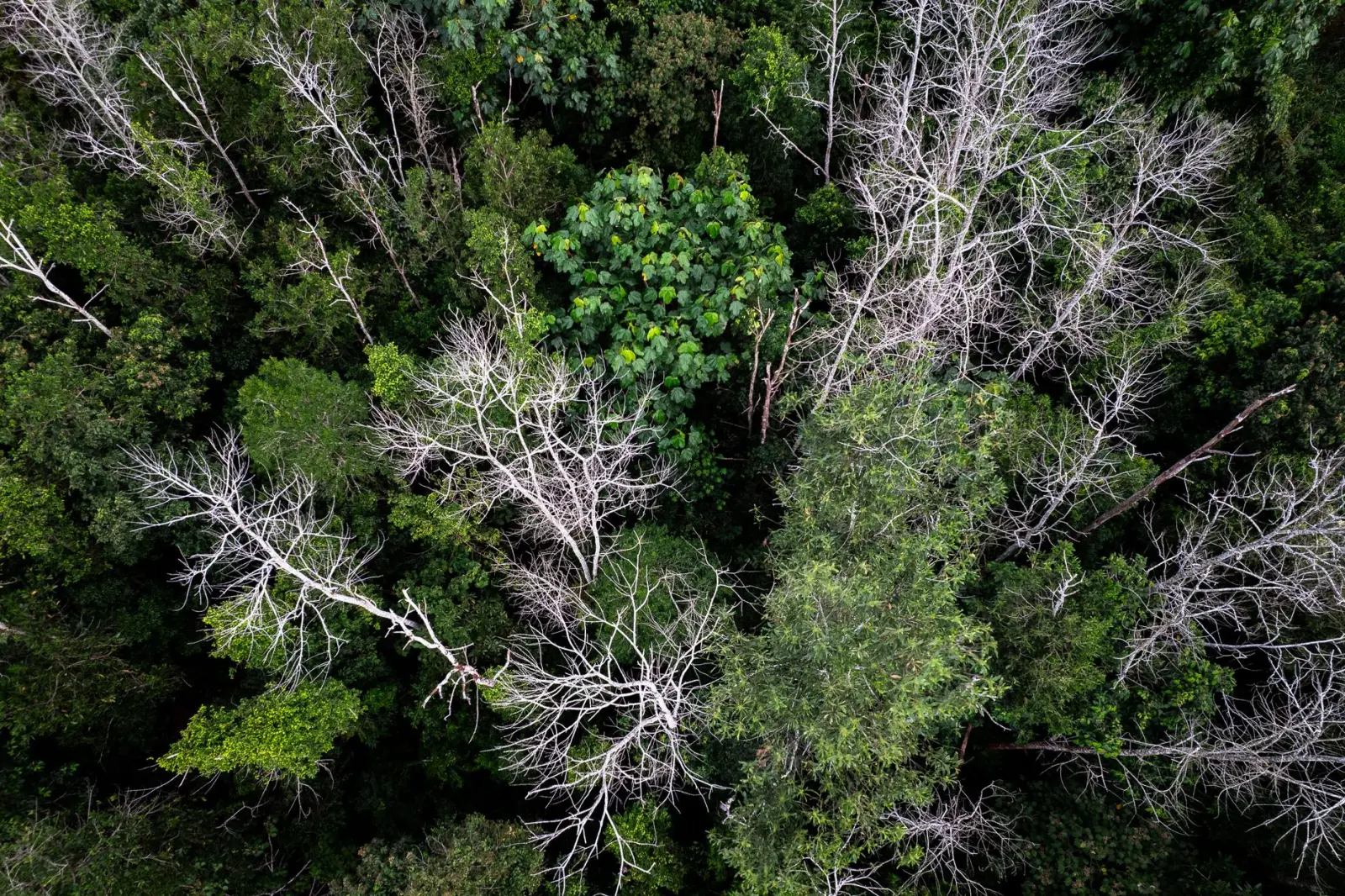
Spend enough time in tropical rainforests during a dry season, and you begin to notice something that contradicts the popular image of endless moisture and lush abundance. The forest doesn’t simply carry on. It shifts. Trees that seemed indifferent to weather patterns suddenly show stress. Leaves curl. Some species drop foliage entirely. Others appear almost unchanged. This variation isn’t random – it reflects different survival strategies that have evolved over millions of years, each calibrated to specific conditions and life histories.
The rainforest is not a monolith. Canopy trees, understory species, and smaller plants all experience drought differently. A tree 40 meters up in full sun faces water stress that a shaded sapling beneath it never encounters. This vertical complexity means that drought response varies dramatically depending on where a tree sits in the forest structure. What looks like a unified ecosystem from the ground is actually a layered collection of microhabitats, each with its own water availability and stress tolerance.
Most people assume rainforest trees are shallow-rooted because the soil is thin and the water table high. In reality, many deep-rooted species exist throughout tropical forests. These trees send roots down 10, 15, even 20 meters or more to access groundwater reserves that remain stable even when surface soil dries. The investment in deep roots is metabolically expensive – a tree must allocate significant energy and resources to maintain them – but the payoff during drought is substantial. Species like certain fig trees and some hardwoods rarely show visible stress during dry periods because they’re tapping into water sources that surface-rooted trees cannot reach.
Leaf Strategy and Water Loss
The most visible response to drought is leaf behavior. Some trees simply shed leaves, reducing the surface area from which water evaporates. This seems straightforward until you consider the cost. A tree that drops its canopy loses its ability to photosynthesize and produce energy. In a rainforest where the growing season is year-round, this is a significant metabolic sacrifice. Only trees that can afford this loss – typically those with stored reserves or those that know a drought will be brief – employ this strategy regularly.
Other species keep their leaves but change them. Leaf thickness increases. Waxy coatings become more pronounced. Stomata, the tiny pores through which plants exchange gases and lose water, close more frequently or tighter. I’ve observed leaves on drought-stressed trees become noticeably different in texture and color within weeks. They’re literally restructuring their surface to minimize water loss. This isn’t an instantaneous change; it reflects a physiological adjustment that takes time and energy to execute.
Some trees take a middle path. They don’t shed all their leaves but reduce leaf area by dropping older foliage or smaller branches. This allows them to maintain some photosynthetic capacity while reducing water demand. The species that do this well tend to have flexible, indeterminate growth patterns – they can adjust their canopy structure throughout the year rather than committing to a fixed form.
Hydraulic Constraints and Xylem Function
Water moves through a tree via the xylem, a network of tubes that runs from roots to leaves. During drought, as soil water becomes scarcer, the water column in these tubes experiences tension. If tension becomes too great, the water column can snap – a process called cavitation. When this happens, air enters the xylem, blocking water transport and potentially killing the branch or the entire tree. Different species have different thresholds for cavitation. Some can tolerate extreme tension; others fail at relatively mild stress levels.
Trees with smaller xylem vessels tend to be more resistant to cavitation. The physics is straightforward: smaller tubes can sustain higher tension before air breaks the water column. But smaller vessels also conduct water more slowly, so a tree with this adaptation sacrifices hydraulic efficiency for safety. Larger-vessel trees are more efficient but more vulnerable. In a stable, wet climate like a rainforest, this trade-off favors efficiency. But when drought arrives, the efficient trees often suffer first.
I’ve seen this play out in mixed-species plots. During a severe dry season, certain fast-growing pioneer species with large vessels showed dieback in their upper canopies, while slower-growing hardwoods with dense wood and small vessels remained intact. The pioneers had optimized for rapid growth and water transport in wet conditions. When conditions changed, that optimization became a liability.
Osmotic Adjustment and Internal Chemistry
Beyond structural changes, trees modify their internal chemistry during drought. They accumulate solutes – sugars, amino acids, and other compounds – in their cells. This lowers the water potential inside the tree, allowing it to extract water from soil that would otherwise be unavailable. It’s an active metabolic process that requires energy, but it keeps cells hydrated and functional even as external water becomes scarce.
This osmotic adjustment isn’t instantaneous. It takes days or weeks for a tree to build up sufficient solute concentrations. Trees that experience frequent, predictable dry seasons often maintain elevated baseline solute levels year-round, essentially pre-positioning themselves for stress. Trees in regions with rare droughts may lack this capacity entirely, making them extremely vulnerable when drought does arrive.
The timing and intensity of a drought relative to a tree’s phenology – its growth and flowering cycle – matters enormously. A drought that arrives during active leaf expansion is far more damaging than one that arrives during a natural growth pause. Some species have evolved to time their growth flushes to coincide with the wettest parts of the year, minimizing overlap with dry periods. Others are more flexible, adjusting their timing based on rainfall patterns.
Species-Specific Drought Tolerance
Not all rainforest trees respond equally. Some species are drought-deciduous, shedding leaves entirely during dry seasons. Others are semi-evergreen, dropping some foliage but retaining a partial canopy. Still others are fully evergreen, maintaining leaves year-round. These aren’t random categories – they reflect different evolutionary solutions to the same problem. A drought-deciduous species invests heavily in deep roots and can afford to lose its canopy because it will regrow it when rains return. An evergreen species has invested in leaf durability and water-conserving physiology instead.
Edge effects and microhabitat variations create pockets where different species thrive. In a forest gap where soil dries quickly and light is intense, drought-tolerant species with small leaves and deep roots dominate. In a shaded understory where soil remains moister and light is limited, shade-tolerant, shallow-rooted species persist. During a severe drought, the gap species barely notice while the understory species suffer. During a wet year, both thrive. The forest’s diversity is partly a reflection of this spatial variation in drought stress.
Repeated droughts select for certain traits. In regions where droughts occur every few years, the tree community shifts toward drought-tolerant species. In regions where droughts are rare, more drought-sensitive species persist because they’re more efficient in wet conditions. The Amazon has experienced increasing drought frequency in recent decades, and this is already shifting species composition in some areas toward more drought-tolerant communities. It’s not a sudden change but a gradual reshuffling of competitive advantage.
The rainforest’s response to drought is ultimately a story of trade-offs. Trees that excel in wet conditions often struggle in dry ones. Trees that survive drought efficiently may grow slowly in wet years. There’s no single optimal strategy – only different solutions suited to different circumstances. Understanding these responses requires looking past the image of the rainforest as a static, unchanging system and recognizing it as a dynamic community constantly adjusting to variation in water availability.