
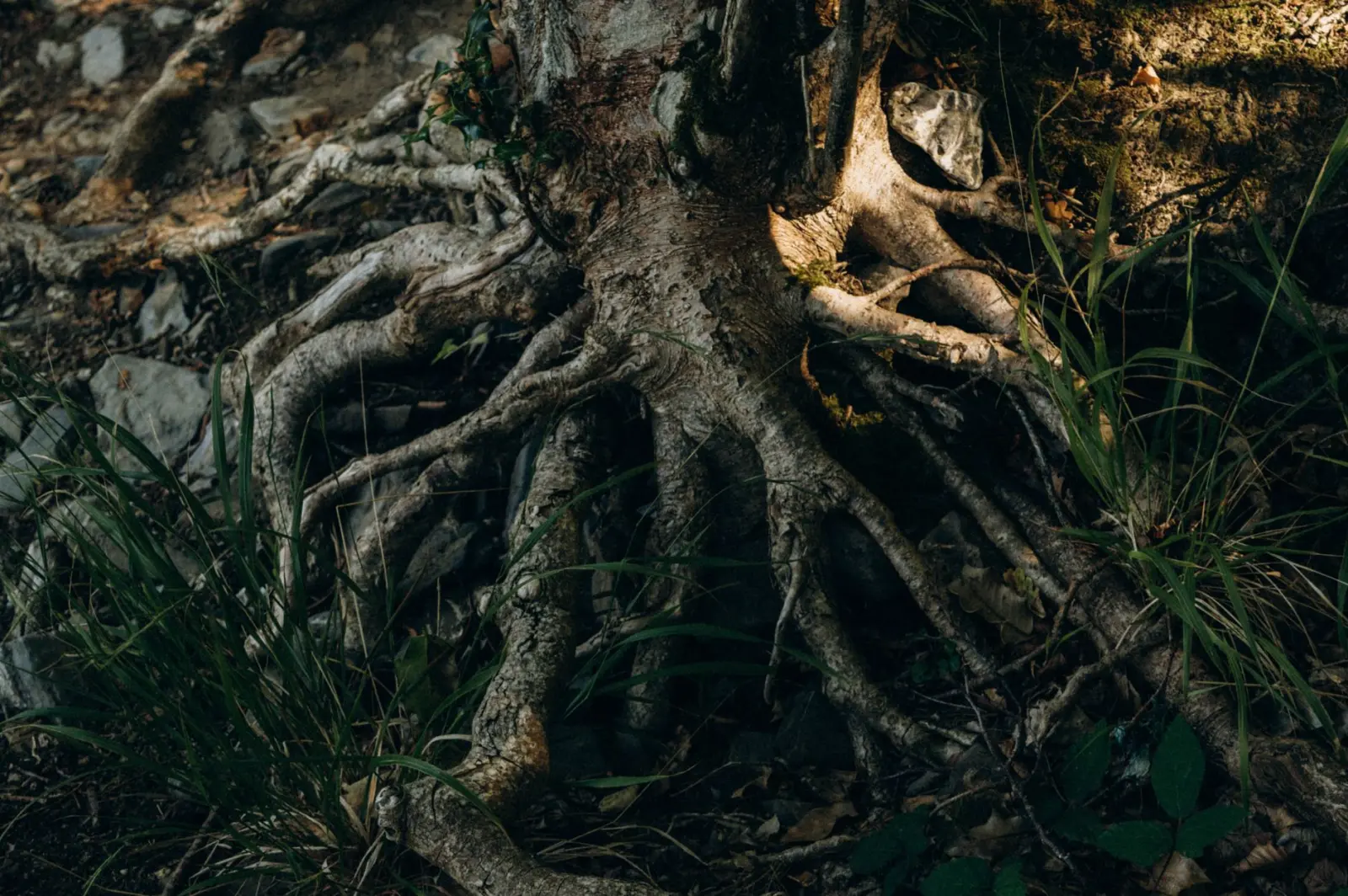
Spend enough time in a rainforest and you start to notice the trees aren’t actually separate organisms. They’re connected. Not visibly, not obviously, but the connection is there beneath your feet in the soil, woven through the leaf litter and root systems in ways that took decades of serious research to confirm. I’ve walked through rainforests in Central America, Southeast Asia, and the Congo Basin, and the more I’ve learned about what’s happening underground, the more the forest itself seems less like a collection of individual trees and more like a single, distributed organism.
The mechanism that makes this possible is fungi. Specifically, mycorrhizal fungi – organisms that form associations with tree roots. These aren’t parasites. They’re partners. A fungal filament, called a hypha, penetrates the root tissue of a tree and establishes a relationship where both parties benefit. The tree provides the fungus with sugars produced through photosynthesis. The fungus, in return, extends its thread-like network through the soil and delivers water and nutrients – particularly nitrogen and phosphorus – back to the tree. This exchange happens at a scale so small it’s invisible to the naked eye, but the cumulative effect shapes entire ecosystems.
The Wood Wide Web and Resource Transfer
The popular term “wood wide web” emerged from research that showed something remarkable: trees connected through fungal networks don’t just exchange resources with their direct fungal partners. They exchange resources with each other. A mature tree can send carbon compounds down through its roots to the fungal network, and that network can deliver those compounds to a seedling struggling in the shade. A tree that’s been damaged or defoliated can receive sugars from its neighbors. A tree infected with pests can send chemical warning signals through the network to alert nearby trees to bolster their own defenses.
I’ve observed this most clearly in old-growth rainforests where the canopy is dense and the understory is dark. Young trees down there aren’t getting much direct sunlight. By all logic, they should be starving. Many do, of course. But some persist, and their persistence often correlates with proximity to larger, established trees. The fungal network appears to be subsidizing their survival. This isn’t charity in any conscious sense – it’s biochemistry. But the effect is real.
The research that documented this came primarily from studies using isotope tracers. Scientists would introduce radioactively labeled carbon or nitrogen into one tree and track where it moved. The results consistently showed movement between trees through fungal pathways. Some of the most compelling work came from experiments in boreal forests and temperate zones, but the principle applies in rainforests too, where the fungal diversity is even higher and the networks potentially more complex.
Complexity and Variability in Rainforest Networks
What makes rainforest fungal networks different from those in temperate forests is sheer diversity and redundancy. A single rainforest soil sample can contain hundreds of fungal species. A single tree root can be colonized by dozens of different mycorrhizal partners simultaneously. This creates a system that’s far more intricate than the simplified diagrams often shown in textbooks.
Not all fungal associations work the same way. Arbuscular mycorrhizal fungi form small branching structures inside root cells and are generalists – they associate with a huge range of plant species. Ectomycorrhizal fungi wrap around the outside of roots and tend to be more selective about their partners. In rainforests, you find both types, often in the same tree, and the balance between them varies by soil type, moisture, and nutrient availability. This variation matters because different fungal types have different efficiencies at mobilizing different nutrients.
I’ve noticed that in rainforests with poor, acidic soils – which is common in tropical regions with high rainfall – the fungal networks seem more active and more essential to tree survival. The fungi are essentially doing the work that soil chemistry can’t do. They’re breaking down organic matter, mobilizing locked-up nutrients, and moving them to trees that would otherwise be nutrient-starved. In richer soils, the fungal networks are still present and active, but the trees have more alternatives. They can get nutrients directly from the soil. The fungi become less critical, though still beneficial.
Chemical Communication and Defense
Beyond nutrient transfer, the fungal networks facilitate chemical communication. When a rainforest tree is attacked by insects or infected by pathogens, it produces defensive compounds. These compounds can move through the fungal network to neighboring trees, triggering them to upregulate their own defenses before they’re even attacked. This is a form of early warning system.
The specificity of these signals is still being worked out. It’s not like the tree is sending a text message saying “aphids incoming.” Rather, volatile organic compounds and other chemical signals move through the fungal network, and receiving trees interpret those signals based on their own physiology and environmental context. Some trees respond more strongly than others. Some may not respond at all, depending on their genetic makeup and current stress levels.
I’ve observed this in rainforests where insect outbreaks are localized. You’ll see a cluster of trees heavily damaged by a particular pest, but nearby trees of the same species remain relatively untouched. The difference often correlates with fungal network connectivity. Trees that are well-connected through fungi tend to suffer less damage overall, presumably because they’re receiving earlier warning signals and mounting defenses faster.
What Disrupts These Networks
The fragility of fungal networks becomes apparent when you see what happens when they’re damaged. Logging, even selective logging, disrupts the fungal networks. The disturbance to soil, the removal of large trees that are key hubs in the network, the changes in light and moisture – all of these stress the fungi. Replanted trees in degraded rainforest areas often struggle not because the soil is depleted, but because the fungal network infrastructure is gone. A seedling planted in isolation, even in nutrient-rich soil, doesn’t have access to the network that would normally subsidize its growth and protect it from pests.
Fungicides and some broad-spectrum pesticides used in agricultural areas adjacent to rainforests can also suppress fungal populations. Soil compaction from heavy equipment damages fungal filaments. Monoculture plantations, even if they’re planted with rainforest species, lack the fungal diversity of natural rainforest, so the networks are simpler and less resilient.
Climate change introduces a different kind of stress. Rainforest fungi are adapted to specific moisture and temperature ranges. As those ranges shift, some fungal species decline while others expand. The networks reorganize, but during the transition, trees may lose connectivity or find themselves partnered with fungi that aren’t as efficient at providing the resources they need. This is still playing out, and we won’t fully understand the consequences for years.
What I’ve come to understand from years of observing rainforests is that the trees themselves are almost secondary to the fungal networks that support them. The forest’s resilience, its ability to recover from disturbance, its capacity to move resources to where they’re needed most – all of this depends on intact, diverse fungal networks. When we talk about rainforest conservation, we’re often focused on the trees and the animals. But the real infrastructure, the thing that holds everything together, is invisible. It’s in the soil, in the fungi, in the networks that connect one tree to another across distances we can barely measure.