
Australian rainforest pythons occupy a particular niche in the reptile world that most people misunderstand. They’re not aggressive or dangerous in the conventional sense, but they’re not docile either. After years of observing these snakes in both captive and wild settings, I’ve learned that their reputation tends to swing between two extremes: either they’re treated as delicate, temperamental creatures that should never be handled, or they’re approached with the kind of casual confidence people reserve for carpet snakes. Neither assumption holds up well in practice.
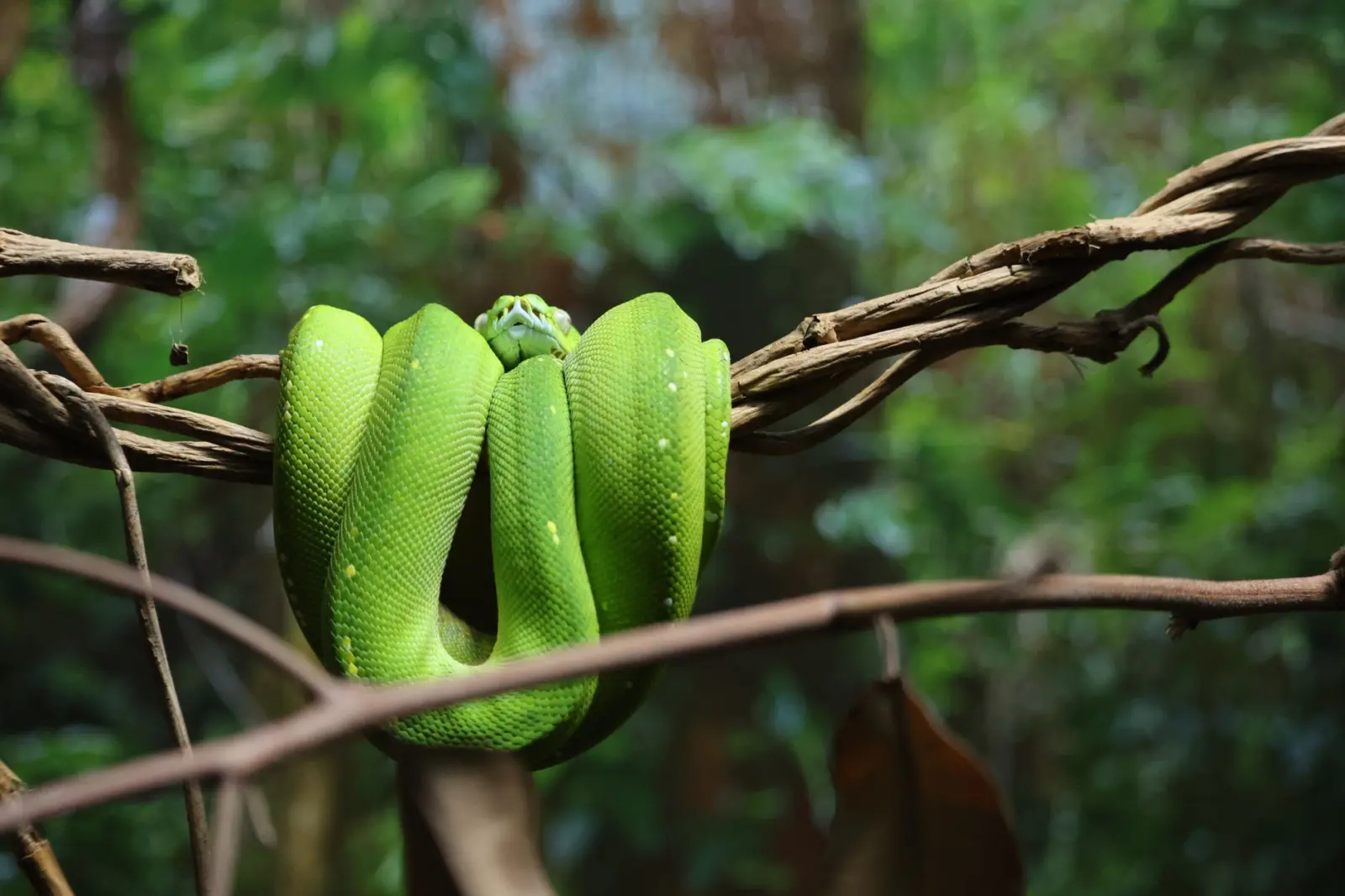
The green morph is what most people picture when they think of Australian rainforest pythons. That brilliant lime-green coloration is real, and it’s genuinely effective camouflage in the canopy. What’s less obvious is how much that color can vary. Some individuals shift toward a yellowish tone, others lean slightly blue-green. Age matters. Hatchlings emerge in either yellow or brick-red, and the transition to green takes weeks or months. I’ve seen animals that never quite settled into a pure green – they maintain a mottled appearance their entire lives. This isn’t abnormal; it’s just variation that doesn’t make it into the standard descriptions.
Temperament and Handling Reality
The temperament question comes up constantly, and it’s worth addressing directly. Rainforest pythons have a reputation for being “bitey,” and there’s a grain of truth there, but the context matters enormously. A wild-caught adult is far more likely to strike than a captive-bred juvenile. A snake that’s been handled regularly from a young age behaves differently than one that’s been left alone for months. Stress levels, feeding schedules, and even the time of year influence how defensive they become. I’ve worked with individuals that were genuinely placid and others from the same breeding that would strike at shadows. The difference often came down to early socialization and consistent, gentle handling rather than anything inherent to the species.
What I’ve noticed repeatedly is that people often misinterpret their behavior. A rainforest python in a coiled, elevated posture with its head tucked isn’t necessarily aggressive – it’s a resting position. They spend much of their day this way in the branches. When they do become defensive, the strike is usually preceded by a clear warning: the head pulls back, the body tenses, and there’s a moment where intervention is still possible. The snakes that cause problems are typically the ones people approach without reading these signals, or animals that have learned through repeated rough handling that striking is their best option.
Feeding Behavior and Digestion
Feeding these snakes reveals a lot about their nature. They’re ambush predators, and in captivity they typically take frozen-thawed or live prey without hesitation. The feeding response is quick and deliberate. They strike, constrict, and swallow with purpose. What’s interesting is how much their feeding behavior can tell you about their overall health and stress level. A snake that refuses food for extended periods isn’t necessarily sick – sometimes it’s just a response to environmental changes, incorrect temperature, or recent handling. I’ve seen animals go off feed for weeks after a move to a new enclosure, then resume eating normally once they’ve settled.
Digestion timing varies more than people expect. In warmer conditions, a rainforest python might digest a meal in five to seven days. In cooler enclosures, it can stretch to two weeks or longer. This is why temperature management matters so much. These are tropical snakes, and they perform poorly in cool environments. I’ve observed animals kept at temperatures below 24°C (75°F) that became lethargic, refused food, and developed respiratory issues. The species doesn’t thrive in cool conditions – it merely survives, and often poorly.
Habitat Needs Beyond the Basics
Most care sheets describe the basic requirements: a vertical enclosure, branches, humidity, and warmth. Those are correct, but they don’t capture what actually makes these snakes comfortable. Rainforest pythons are arboreal specialists. They’re not just “in trees” – they’re adapted to a specific microhabitat. In the wild, they occupy the mid-canopy, moving between branches at night to hunt and returning to favored resting spots during the day. In captivity, they need vertical space that’s meaningfully utilized. A tall enclosure with a single branch doesn’t cut it. Multiple branches at varying heights, positioned so the snake can move between them without dropping, makes a tangible difference in behavior and stress levels.
Humidity is another area where people often get the basics right but miss the nuance. These snakes come from rainforests, so humidity should be high – typically 70 to 90 percent. But constant, stagnant humidity leads to respiratory issues just as surely as humidity that’s too low. Air movement matters. A well-ventilated enclosure with high humidity is different from a sealed box with high humidity. I’ve seen snakes develop fungal issues in the latter and thrive in the former, despite identical humidity readings.
Breeding and Seasonal Shifts
Breeding season brings noticeable changes in behavior. Males become more active and more defensive. They’ll pace enclosures and strike more readily. Females gravid with eggs become sluggish and often refuse food for weeks. These aren’t signs of illness – they’re normal reproductive behavior. What matters is recognizing the shift and adjusting handling accordingly. A gravid female stressed by excessive handling can abandon eggs or lay them in poor condition. Males in breeding condition need space and minimal disturbance.
Clutch size for rainforest pythons typically ranges from four to twelve eggs, though I’ve encountered both smaller and larger clutches. Incubation temperature significantly affects development speed and hatchling viability. Temperatures around 28 to 30°C (82 to 86°F) work well. Cooler incubation extends the timeline and can reduce hatch rates. Warmer temperatures speed things up but increase the risk of developmental issues. The sweet spot seems to be consistent, moderate warmth rather than extreme heat.
What strikes me most about rainforest pythons, after all this time, is how much of their care comes down to understanding their natural context. They’re not difficult snakes, but they’re not forgiving of neglect or poor conditions either. They communicate their needs clearly if you’re paying attention – through feeding response, activity levels, shedding quality, and behavior. The animals that thrive are the ones where people have taken time to create an environment that actually mirrors what these snakes evolved to inhabit, not just one that checks boxes on a care sheet.