
Spending time in Australian rainforests teaches you quickly that parrots are not what postcards suggest. The noise is real – that part is accurate. But the birds themselves move with a deliberateness and caution that catches most visitors off guard. You’ll hear them long before you see them, and often you won’t see them at all, despite standing directly beneath the canopy where they’re calling. This gap between sound and visibility shapes every encounter with rainforest parrots and lorikeets.
The rainforests of northeastern Australia – particularly around the Wet Tropics – hold a concentration of parrot species that exists nowhere else on the continent. The King Parrot, Rainbow Lorikeet, Black Cockatoo, and several smaller species move through these forests in patterns governed by food availability, time of day, and season. What matters to understand is that these birds are not stationary subjects. They’re mobile, often in small groups or pairs, and they shift their location based on what’s fruiting or flowering on any given week.
The physical reality of watching rainforest parrots involves significant fatigue and patience. The canopy sits high – often 30 to 40 meters above the forest floor. Your neck aches within twenty minutes of looking upward. The humidity makes binoculars fog. The understory is dense enough that even when a bird is only 15 meters away, vegetation obscures most of your view. You see a flash of red or blue, hear the distinctive call, and then nothing. The bird has moved deeper into the canopy or shifted position among the branches in a way that breaks your sightline entirely.
Why Lorikeets Behave Differently Than Other Parrots
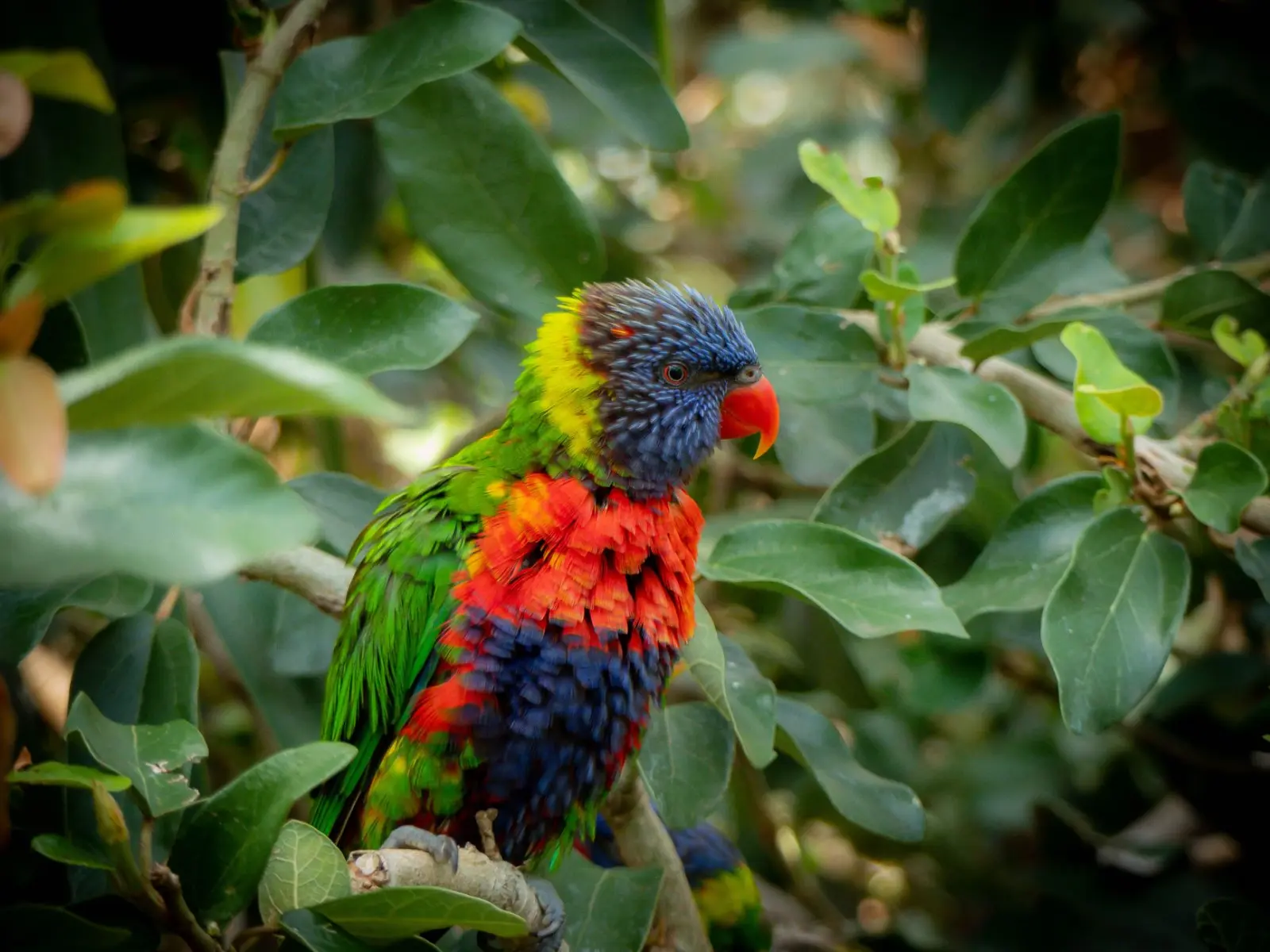
Lorikeets operate on a different schedule and with different feeding strategies than larger parrots. They’re smaller, more agile, and they move in tighter flocks. A Rainbow Lorikeet flock can number anywhere from three or four birds to twenty or more, and they move through flowering trees with a kind of controlled chaos. They land, feed for seconds, then shift position. They’re vocal constantly – screeching, calling, communicating position to other birds in the group. This makes them easier to locate by sound, but harder to photograph or observe in detail because they rarely stay still.
The feeding behavior of lorikeets is specialized. They’re drawn to flowers with nectar, particularly eucalypts, but also to native rainforest trees like the Umbrella Tree. They use their brush-tipped tongues to extract nectar, and this feeding style means they need to visit flowers frequently throughout the day. You’ll notice lorikeets are most active in early morning and late afternoon, when flowers are at peak nectar production. Midday activity drops significantly. This isn’t random – it’s a direct response to food availability.
Black Cockatoos present a different pattern entirely. They’re larger, slower-moving, and far more wary. The Black Cockatoo species found in rainforests – primarily the Palm Cockatoo in far north Queensland – feeds on seeds and nuts, particularly from rainforest palms. They move deliberately, often in pairs or small family groups. They’re also considerably noisier than lorikeets, with a loud, harsh call that carries across the forest. But they’re also more likely to flee if they sense human presence. Getting close to a Black Cockatoo requires patience, early morning positioning, and acceptance that you may hear them repeatedly without seeing them clearly.
Seasonal Shifts and Predictability
The timing of your visit matters enormously. During the Australian wet season (November through March), flowering and fruiting patterns shift. Some trees that produce heavily in the dry season reduce their output during the wet. Parrots respond by moving to different areas or changing their daily routes. A location where you reliably see Rainbow Lorikeets in June might be quiet in February. This isn’t a failure of the location – it’s a reflection of how these birds track food resources across the landscape.
The dry season (May through September) tends to concentrate parrots in fewer locations because flowering is more predictable and localized. Certain trees come into flower reliably during specific months, and parrots learn these patterns across generations. If you’re planning to observe parrots, understanding what’s flowering during your travel dates is more useful than any general advice about “where to see parrots.” A local guide or a quick check of flowering calendars for the specific rainforest you’re visiting will tell you far more than generic recommendations.
Movement and Group Dynamics
Parrots in rainforests rarely move alone. Even species that appear solitary often have a partner nearby. They communicate constantly through calls, and these vocalizations serve multiple purposes – maintaining contact with partners, alerting the group to threats, and coordinating movement between feeding sites. The acoustic environment of a rainforest is dense with sound, but once you learn to distinguish parrot calls from other birds and animals, you can track movement even when visibility is poor.
Group size varies by species and season. King Parrots typically move in pairs or small family groups of three to five birds. Rainbow Lorikeets form larger flocks that can be noisy and visible. Smaller species like the Scaly-headed Parrot move in quieter groups and are easier to miss entirely. The dynamics of how these groups navigate the canopy – who leads, who follows, how they handle obstacles – reveal something about their social structure. A flock of lorikeets hitting a flowering tree is organized chaos; they’re not randomly landing but taking turns, with some birds feeding while others perch nearby.
Fatigue affects observation more than people anticipate. After two hours of rainforest birdwatching, your attention narrows. You miss subtle movements. Your ears become less attuned to distinguishing calls. This is a physical reality, not a personal failing. The combination of humidity, uneven ground, constant upward gazing, and the mental effort of pattern recognition exhausts you faster than you’d expect. Most productive parrot observation happens in focused bursts – an hour or ninety minutes – rather than extended sessions.
What Disrupts Normal Behavior
Parrots respond to human presence, though not uniformly. Some habituated birds in areas with regular tourist traffic show reduced wariness. Others flee at the first sign of movement. Loud noise disrupts their communication, which can scatter groups. Sudden movement in the canopy – even from other animals – causes them to shift position or flee entirely. If you’re watching a flock of lorikeets feeding and someone crashes through the understory nearby, the entire group will depart within seconds.
Weather changes affect activity dramatically. Heavy rain drives parrots to shelter, and you’ll see little movement during downpours. Wind makes feeding in the canopy more difficult and dangerous, so birds reduce activity during gusty periods. Cooler mornings see more movement as birds warm up and feed actively. By mid-afternoon, activity often slows. These patterns aren’t absolute, but they’re consistent enough that timing your observation around weather and time of day improves your chances significantly.
The reality of Australian rainforest parrots is that they’re wild animals moving through complex, dense habitat. They’re not performing for observers. They’re feeding, communicating, moving between roosting sites, and managing their daily survival. The observer’s job is to position themselves in likely locations at likely times and then accept that visibility will be limited and unpredictable. The reward isn’t always a clear sighting – sometimes it’s the call echoing through the canopy, the flash of color, or the knowledge that you’ve been close to something genuinely wild.