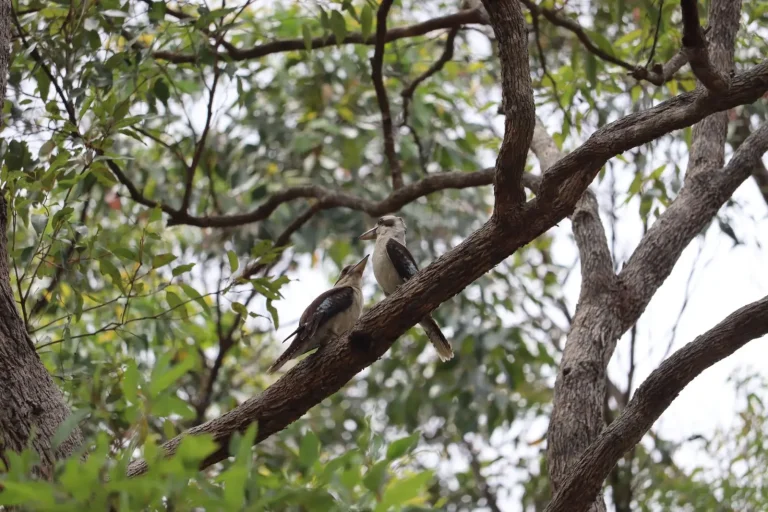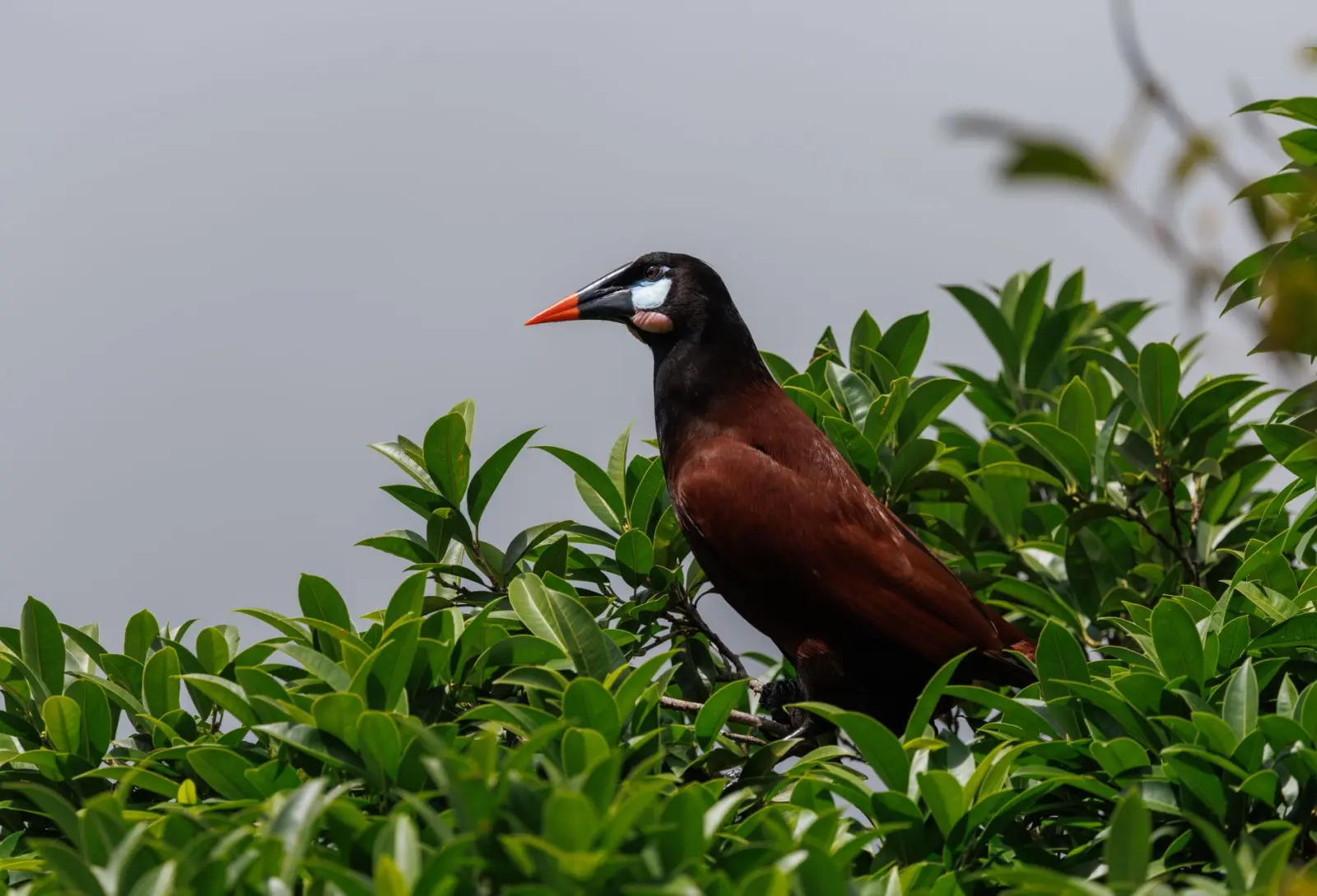
Spend enough time in a rainforest and you stop hearing it as a single acoustic environment. The sound landscape fractures. High-pitched calls come from somewhere above the canopy proper. Middle frequencies occupy the dense crown layer. Lower, resonant calls drift from the understory. This vertical separation of sound is not random. It reflects a fundamental truth about rainforest bird ecology: different species occupy different heights, and they do so because the forest itself is stratified into distinct ecological zones with different resources, light levels, and competitive pressures.
The classic model divides the rainforest into four layers: the emergent layer, the canopy, the understory, and the forest floor. But this is a simplification useful for teaching. In practice, the boundaries blur and shift depending on local topography, tree species composition, and seasonal changes. What matters more than the names is understanding that birds have sorted themselves into preferred altitude ranges, and those preferences are driven by specific ecological needs rather than random distribution.
Canopy Specialists and Light Availability
The upper canopy, where the tallest trees break through and create a relatively open, sun-exposed environment, hosts a distinct guild of birds. Tanagers, parrots, and various honeycreepers spend most of their time in this zone. The light is intense, food is often abundant but dispersed, and visibility is good. These birds tend to be relatively small to medium-sized, agile, and capable of sustained flight across open gaps. They feed on fruits high in the crown, insects that congregate in the brightest, warmest parts of the canopy, and flowers that bloom in full sun.
The upper canopy is also where you see the most movement and activity. Birds here are often in flocks or mixed-species associations, moving rapidly between fruiting trees. This makes sense from an energetic standpoint. If your food source is scattered and seasonal, you need to cover distance efficiently. A large, slow bird would exhaust itself. The birds that thrive here are built for speed and maneuverability, even if it means they are smaller and have higher metabolic demands.
The Middle Canopy: Density and Concealment
Below the emergent layer, the canopy becomes denser. Light penetrates less evenly. Tree crowns overlap and interlock. This middle zone hosts a different community. Here you find flycatchers, wrens, various warblers, and smaller tanagers. These birds are often less conspicuous than their upper-canopy cousins, and for good reason. The denser foliage provides cover but also makes finding food harder. Insects are less visible. Fruits are less abundant. The birds that work this zone tend to be methodical, moving through dense branches with precision, gleaning insects from leaf surfaces and small twigs.
The middle canopy is also where you encounter the most territorial behavior. Because the vegetation is dense, sight lines are short. A bird defending a territory can do so effectively in a relatively small area. You hear more singing, more calling, more vocal assertion of space. The birds here are often paired or in small family groups rather than in the loose flocks common above. This reflects both the structure of the habitat and the distribution of food.
Understory: Darkness and Specialization
Drop another 20 or 30 meters and light becomes scarce. The understory, the zone between the lower canopy and the forest floor, is dim even at midday. Humidity is high. Air movement is minimal. The birds here are often darker, with less conspicuous plumage. Antbirds, ground-tanagers, and various wrens dominate this zone. Many of them are insectivores, working through dead leaves, low branches, and the spaces between stems where insects shelter.
What strikes anyone who spends time watching understory birds is how deliberate their movements are. They are not zipping between trees. They are working through a complex three-dimensional maze of vegetation, stopping frequently, examining surfaces, probing into crevices. A single bird might spend an hour in a small area, thoroughly working every branch and leaf cluster. This is not inefficiency. It is adaptation to an environment where food is cryptic and requires patient searching.
Understory birds also show different social patterns. Many are solitary or in pairs. Some participate in mixed-species flocks, but these flocks move slowly and deliberately compared to canopy flocks. The flocks often include a core of insectivores that work the vegetation systematically, with other species joining in and benefiting from the disturbance that the core species create as they forage.
Body Size and Vertical Distribution
One of the clearest patterns in rainforest bird ecology is the relationship between body size and preferred height. Larger birds tend to occupy the upper canopy and emergent layer. Smaller birds tend to occupy the understory and lower canopy. This is not absolute, but it is consistent enough to be predictive. The reasons are ecological and physical. Larger birds need more space to maneuver. They also have lower wing-loading, meaning they can sustain flight more easily in open spaces. Smaller birds are more agile in dense vegetation and can exploit food resources that larger birds cannot access.
There is also an energetic component. A small bird foraging in dense understory vegetation might find enough insects to fuel itself, but only if it moves efficiently through that vegetation. A large bird attempting the same foraging strategy would expend more energy than it could recover. Conversely, a small bird in the open upper canopy would be vulnerable and would lack the power to make long flights between fruiting trees. The match between body size and habitat is not coincidental.
Competition and Niche Partitioning
The vertical stratification of rainforest birds is fundamentally about competition. In a habitat with hundreds of bird species, some mechanism must reduce direct competition for the same resources. Vertical separation is one such mechanism. Two species that eat similar insects but at different heights are not competing as intensely as they would if they occupied the same zone.
But the partitioning goes deeper than just height. Species also differ in the specific types of vegetation they prefer, the size of insects they target, the time of day they forage, and their social structure. A flycatcher in the canopy might hunt by sallying out from a perch to catch flying insects. A wren in the understory might glean insects from leaf surfaces. Both are insectivores, but their foraging techniques are distinct. This allows many species to coexist in the same forest.
What is often overlooked is that this partitioning is not static. It shifts seasonally. During fruiting seasons, birds move vertically to follow the fruit. During breeding season, birds may occupy different heights than they do during the non-breeding season. A species might be common in the understory in one month and rare there two months later. The vertical structure of the forest provides the framework, but the birds move within that framework in response to changing resource availability.
After years of working in rainforests, the most consistent observation is that the forest is not a uniform environment. It is a series of distinct microhabitats stacked vertically, each with its own community of birds, each shaped by light, vegetation structure, and food availability. Understanding this stratification is essential to understanding how rainforests support such extraordinary bird diversity. The birds are not randomly distributed. They are precisely sorted into niches that reflect millions of years of ecological evolution.