
After spending years observing flowering plants in tropical rainforests, you begin to notice patterns that don’t show up in textbooks. The relationship between a rainforest flower and its pollinator isn’t a simple transaction – it’s a negotiation shaped by the forest’s unique constraints. Visibility is poor. Sound travels strangely through dense vegetation. Humidity alters how scents disperse. Yet flowers still manage to attract the right visitors with remarkable consistency.
The first thing that strikes you when walking through a rainforest is how little light reaches the understory. This creates an immediate problem for flowers trying to be noticed. In open meadows, bright colors work because light is abundant and pollinators can see from a distance. In the rainforest, a flower might have only a few meters of clear visibility around it, and even that depends on the angle of the rare sunlight filtering through the canopy. Flowers have adapted to this constraint in ways that seem almost counterintuitive at first.
Many rainforest flowers are not the vivid reds and oranges you might expect. Instead, they tend toward deep purples, dark reds, and even near-black hues. These colors stand out against the green background of leaves in low-light conditions far better than bright pastels would. A hummingbird or bee in the understory isn’t looking for the brightest flower in the forest – it’s looking for something that contrasts sharply with its immediate surroundings. Dark red flowers against dark green foliage create that contrast. This is why you’ll often find that the most successful understory flowers are not the ones that would win a beauty contest in a botanical garden.
Scent as the Primary Signal
Color matters, but in the rainforest, scent is often the dominant communication channel. This is where the real sophistication emerges. Flowers don’t just smell good – they produce specific chemical blends that travel through humid air and trigger responses in particular pollinators. A flower pollinated by bats produces a musty, fermented scent that carries well in still, humid air and appeals to a bat’s olfactory system. A flower pollinated by hummingbirds often produces little scent at all, because hummingbirds rely primarily on vision and have a poor sense of smell.
The chemistry of rainforest scents is complex. Humidity affects how volatile compounds disperse. In dry conditions, scent molecules can drift far on air currents. In the rainforest, where moisture is constant, scent plumes tend to stay closer to the flower. This means the flower’s scent signal needs to be stronger and more concentrated to reach pollinators at useful distances. You’ll notice that flowers pollinated by insects in the rainforest often smell quite intense – almost overwhelming to human senses. That intensity isn’t accidental. It’s a necessary adaptation to the forest’s humid conditions.
Different pollinators are attracted to different scent profiles. Orchids pollinated by specific bee species produce scents that mimic the pheromones of female bees, triggering a mating response in males. These scents are so specific that a bee will ignore flowers with slightly different chemical signatures. Over time, this creates a tight coupling between flower and pollinator – each depends on the other’s presence. In the rainforest, where plant diversity is enormous, this specificity reduces competition. A flower doesn’t have to outcompete every other flower in the forest; it only has to appeal to its particular pollinator.
Shape and Landing Platforms
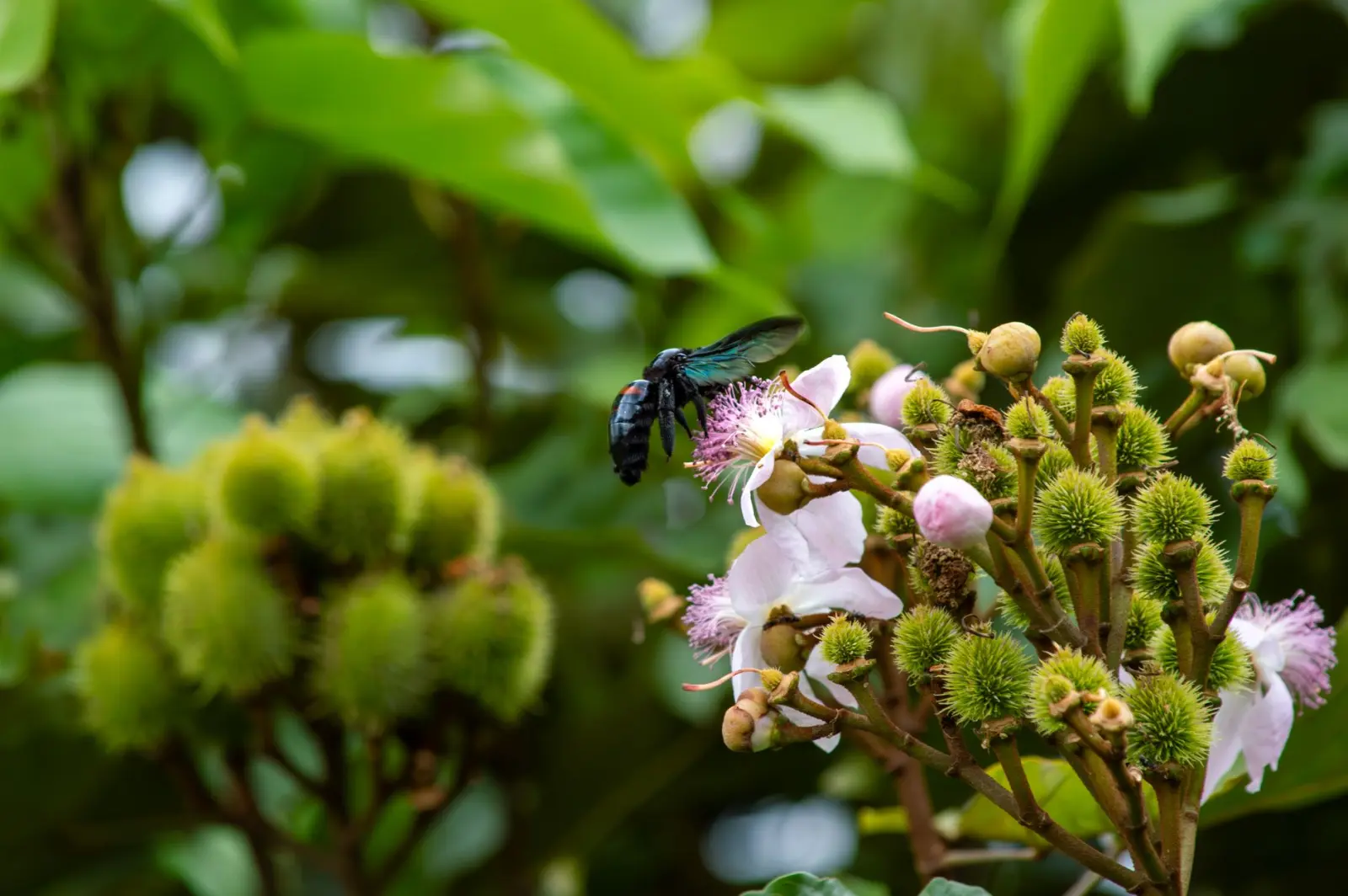
The physical structure of a rainforest flower is rarely random. Many flowers have evolved shapes that function as landing platforms or guides for their specific pollinators. A flower pollinated by large carpenter bees might have a broad, sturdy lip that can support the bee’s weight. A flower pollinated by hummingbirds often has a narrow, tubular shape that forces the bird’s beak into contact with the flower’s reproductive structures. These shapes aren’t just aesthetic – they’re functional mechanisms that ensure pollen transfer happens efficiently.
In dense rainforest vegetation, accessibility matters enormously. A flower that hangs from a branch on a long, flexible stem might be doing so not for beauty but because it needs to dangle free of surrounding leaves to be visible and accessible to flying pollinators. You’ll see this pattern repeatedly in the canopy and midstory – flowers that seem oddly positioned until you realize their position is optimized for the flight path and approach angle of their primary pollinator.
Timing and Seasonal Coordination
Rainforests don’t have the clear seasonal structure of temperate zones. There are wet and dry periods, but flowering can happen year-round depending on the species. What’s striking is how individual flowers coordinate their blooming with the presence of their pollinators. Some flowers only open at specific times of day when their pollinators are active. A flower pollinated by nocturnal moths might open only at dusk and close by dawn. A flower pollinated by morning-active bees might open early and close by midday.
This temporal coordination is a form of signaling that’s easy to overlook. The flower isn’t just saying “I’m here” through color and scent – it’s also saying “I’m here at this specific time.” For a pollinator searching through a dense forest, this kind of predictability is valuable. It reduces search time and energy expenditure. Over evolutionary time, this creates a rhythm where both flower and pollinator have synchronized their behavior to match the other’s schedule.
The rainforest’s constant conditions – high humidity, warm temperatures, and stable day length – allow for these kinds of precise temporal arrangements. In temperate forests, unpredictable weather might disrupt such timing. In the rainforest, a flower can rely on consistent conditions and adjust its blooming schedule with confidence.
Competition and Niche Partitioning
What often goes unnoticed is how rainforest flowers have partitioned the pollinator landscape to reduce direct competition. In any given patch of rainforest, you might find dozens of flowering species. Rather than all competing for the same pollinators, they’ve evolved to attract different ones. This reduces conflict and allows more flowers to coexist in the same space.
This partitioning happens across multiple dimensions simultaneously. One flower might attract large bees, another small bees, another butterflies, another hummingbirds, another bats. Within the bees, one species might attract carpenter bees while another attracts orchid bees. The signals – color, scent, shape, timing – are all tuned to create this separation. It’s a system that works because each flower has evolved to be maximally attractive to its target pollinator while remaining relatively unattractive to others.
The efficiency of this system becomes apparent when you observe a single flower over time. A well-adapted rainforest flower receives visits from its intended pollinator with remarkable regularity. There’s little wasted energy on attracting the wrong visitors. This efficiency matters in an environment where resources are limited and competition for pollinator attention is intense.
After years of observation, what becomes clear is that rainforest flowers aren’t trying to be beautiful in any universal sense. They’re solving a specific problem: how to reliably attract one particular type of pollinator in an environment where visibility is poor, humidity is high, and competition is fierce. The solutions are elegant precisely because they’re so specialized. A flower doesn’t need to appeal to everyone – it only needs to appeal to the right pollinator, at the right time, in the right way. In the rainforest’s complex ecosystem, that specificity is both a constraint and a strength.