
Spend enough time in a tropical rainforest and you stop thinking of it as simply a place that happens to be wet and warm. You begin to notice that the forest itself is creating the conditions it requires to exist. The humidity doesn’t just settle over the canopy – it’s being produced, recycled, and maintained by the forest’s own machinery. What appears to outsiders as a static environment is actually a dynamic system constantly generating its own microclimate.
The most obvious mechanism is transpiration. Trees release water vapor through their leaves at a scale that’s genuinely difficult to grasp until you’ve walked through it. A single large rainforest tree can transpire hundreds of liters of water per day. Multiply that across millions of trees covering thousands of square kilometers, and you’re looking at an atmospheric river being created from the ground up. This isn’t incidental moisture loss – it’s the forest’s primary mechanism for controlling its own humidity and temperature.
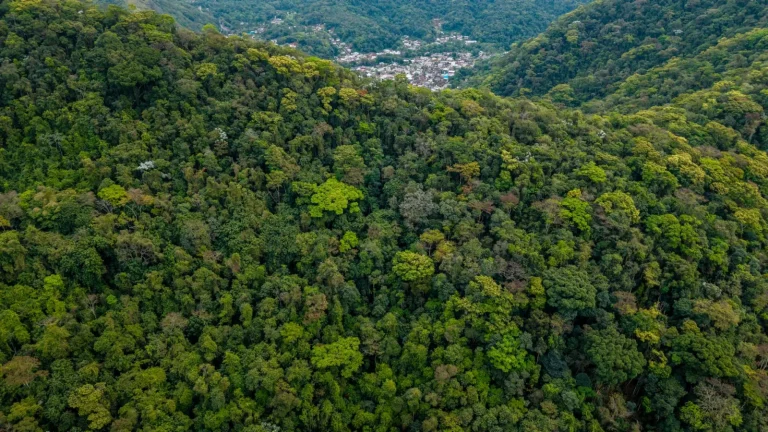
What makes this system self-reinforcing is that the water vapor doesn’t simply drift away. The dense canopy traps it. The layered structure of the forest – from the emergent layer down through the understory – creates a series of barriers that prevent rapid air exchange with the atmosphere above. Warm, moist air gets trapped in the lower layers, where it cools slightly and condenses into the perpetual mist and fog that characterizes rainforest interiors. You can feel this happening. The air becomes progressively heavier and more saturated as you move deeper into the forest, even on days when it hasn’t rained.
The Feedback Loop That Sustains Itself
This trapped moisture creates conditions that favor more transpiration. High humidity reduces the vapor pressure gradient between the leaf interior and the surrounding air, which sounds technical but means the trees don’t have to work as hard to release water. They can keep their stomata open longer without desiccating. More open stomata means more photosynthesis, more growth, and more leaf surface area available for transpiration in the next cycle. The system reinforces itself.
The forest floor amplifies this effect. The thick layer of decomposing organic matter acts as a sponge, holding moisture and releasing it slowly into the air. Fungi and microorganisms in the soil maintain this moisture retention. When you dig into the litter layer, it’s invariably damp, even during drier periods. This isn’t just about water availability for roots – it’s about maintaining the humidity gradient that keeps the entire microclimate functioning. A rainforest with a degraded understory or compacted soil begins losing this capacity almost immediately.
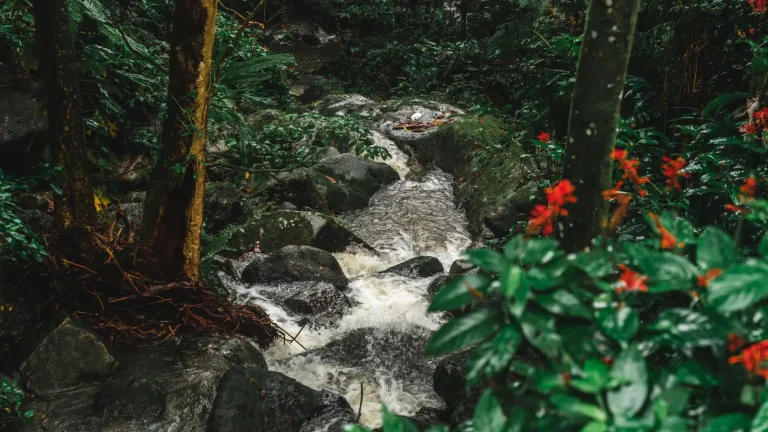
Condensation and fog are central to how the forest captures and redistributes water. In many rainforests, particularly at higher elevations, fog drips from the canopy contribute as much water to the system as rainfall does. Trees have evolved to intercept this moisture directly through their leaves and bark. Epiphytes – the orchids, bromeliads, and mosses that grow on branches – are essentially capturing water that would otherwise be lost. They’re not parasites; they’re part of the forest’s water capture infrastructure.
Temperature Regulation Through Density
The microclimate’s temperature stability is equally engineered. The dense canopy blocks direct solar radiation from reaching the forest floor. On a day when the air temperature above the canopy might reach 35°C, the temperature under the canopy often stays between 24 – 28°C. This isn’t accidental shading – it’s a consequence of the forest’s structure and the water cycling happening within it. The continuous transpiration creates an evaporative cooling effect that moderates temperature swings.
This temperature regulation matters more than it initially seems. Many rainforest organisms have narrow thermal tolerances. The constant, relatively cool, humid conditions aren’t just comfortable – they’re essential. Amphibians, insects, and even some plants would struggle to survive if exposed to the temperature and humidity fluctuations that occur above the canopy. The forest’s microclimate is the actual habitat. Remove the canopy, and you don’t just lose shade; you lose the entire environmental envelope that species depend on.
The leaf litter layer contributes to temperature stability as well. Decomposition generates heat, and the insulating properties of the accumulated organic matter moderate temperature fluctuations at ground level. This is why rainforest soil temperatures remain remarkably stable year-round, even in regions with distinct wet and dry seasons. The forest’s thermal inertia comes from this accumulated biomass and its constant metabolic activity.
What Happens When the System Breaks
The fragility of this self-regulating system becomes apparent when the forest is disrupted. Selective logging that removes large trees doesn’t just reduce shade – it breaks the transpiration cycle. With fewer large trees, less water is being released into the air. Humidity drops. The remaining forest experiences greater temperature fluctuations. Smaller trees that were adapted to the stable microclimate begin to stress. The system doesn’t gradually degrade; it can shift relatively quickly to a new, less favorable equilibrium.
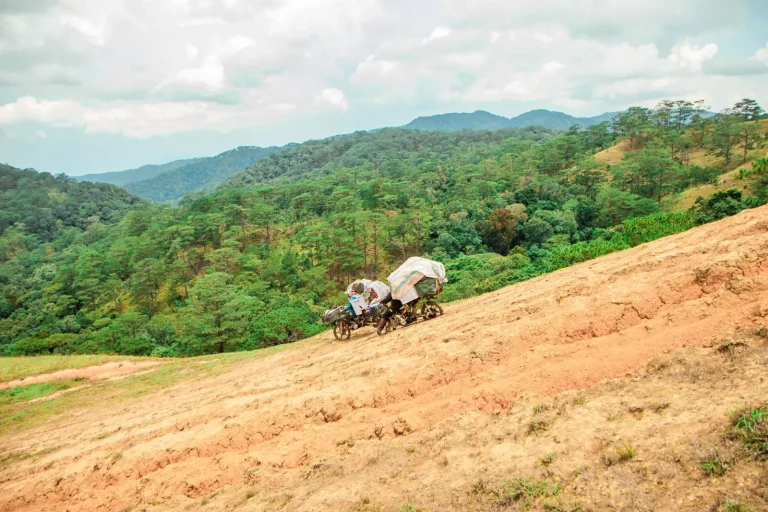
Edge effects demonstrate this clearly. Along the boundary of a cleared area, the microclimate changes noticeably within just a few meters. The air is drier, warmer, and more variable. Species composition shifts. Lianas and pioneer species that thrive in disturbed conditions move in. The forest’s ability to generate its own climate depends on a critical mass of vegetation and structural complexity. Below a certain threshold, the feedback loops that maintain the microclimate break down.
Fragmentation is particularly damaging because it increases the proportion of edge habitat. A rainforest broken into isolated patches loses the interior microclimate conditions that define true rainforest ecology. Each patch becomes progressively more exposed to external atmospheric conditions. The larger the fragments and the fewer the edges, the better the forest’s ability to maintain its microclimate. This has real consequences for species survival and forest regeneration.
Understanding that rainforests create their own climate rather than simply thriving in one reframes how we think about tropical forest conservation. It’s not just about protecting trees; it’s about maintaining the physical and biological structures that generate the environmental conditions the forest requires. A rainforest isn’t a collection of individual organisms existing in a stable climate. It’s a system that actively produces and maintains the climate it needs. That distinction matters when considering what it takes to keep a rainforest functioning.