
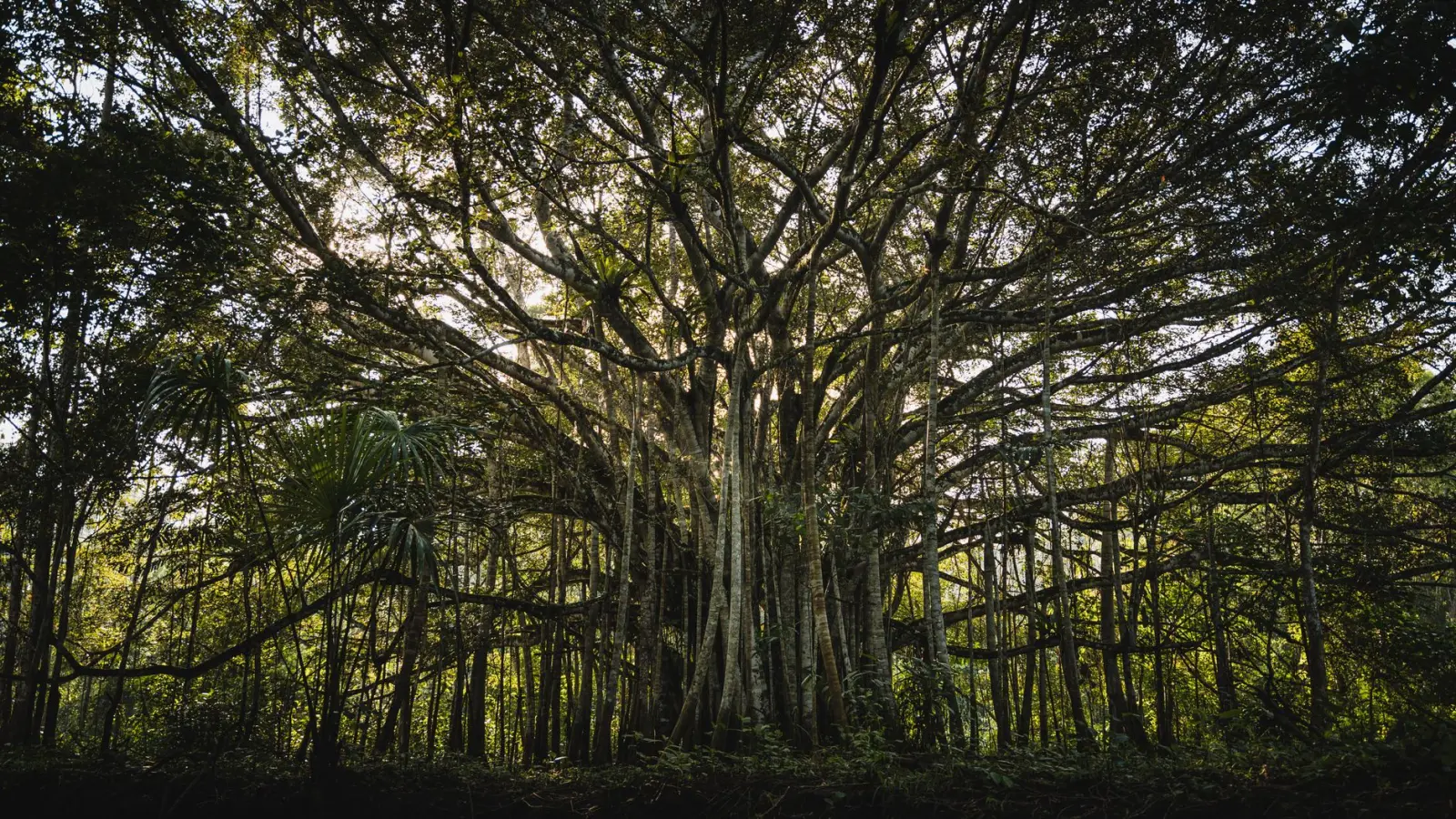
Spend enough time in a rainforest canopy, and you start to notice the figs. Not because they’re showy – they’re often the opposite. The fruit grows directly on the trunk and branches, hidden among leaves and vines, easy to miss unless you know what you’re looking for. But once you begin tracking where animals concentrate their feeding activity, the pattern becomes obvious. Figs aren’t just another food source. They’re a kind of ecological insurance policy that keeps the forest functioning when everything else is scarce.
The relationship between figs and rainforest wildlife runs deeper than simple nutrition. Over millions of years, fig trees and their animal visitors have evolved into something closer to a mutual dependency. The animals disperse fig seeds – often the only animals capable of doing so effectively – while the figs provide calories and nutrients at moments when the forest floor is otherwise bare. This isn’t a seasonal arrangement. It’s a year-round negotiation between plant and animal that shapes how entire ecosystems breathe.
Asynchronous Fruiting and the Hunger Gap
Most rainforest trees fruit in waves. Certain species synchronize their fruiting, flooding the forest with food for a few weeks or months, then nothing. This creates a predictable boom-and-bust cycle. Figs operate differently. Individual fig trees don’t all fruit at once. Instead, they stagger their production across the year, with some trees fruiting while others are dormant. This asynchronous pattern means there’s almost always a fig tree in fruit somewhere in the forest.
I’ve watched this play out in real time. During the lean months – when the major fruiting events have passed and the next wave hasn’t started – animals congregate around figs with an intensity that’s almost desperate. Primates, birds, bats, and insects that would normally be scattered across the canopy converge on these trees. They’re not there because figs are the most nutritious food available. They’re there because figs are the food available. The difference matters. Without that reliable supply, many animals would face genuine food stress, which cascades into reduced reproduction, lower survival rates, and population instability.
Nutritional Content and Digestive Efficiency
Fig flesh is mostly water and simple sugars. It’s not protein-rich or particularly dense in calories compared to seeds or nuts. But that’s precisely why it works as a gap-filler. The sugars are immediately accessible – no complex digestion required. For animals that need quick energy and can’t afford the metabolic cost of processing tough, fibrous foods, figs deliver fast fuel.
The seeds inside are another matter. Fig seeds are tiny, numerous, and pass through digestive systems largely intact. This is the entire point. The fig tree invests in producing flesh that attracts animals, and those animals become unwitting seed dispersal agents. The arrangement is so established that certain animal-fig pairs have evolved together for so long they’ve become almost obligate. Remove the animal, and that fig species struggles to reproduce. Remove the fig, and that animal population crashes.
Spatial Clustering and Behavioral Shifts
One of the more visible effects of fig fruiting is how it reorganizes animal movement and social behavior. When a large fig tree comes into fruit, it becomes a temporary hub. Solitary animals become gregarious. Territorial boundaries blur. Animals that normally avoid each other feed in close proximity because the resource is too valuable to ignore. This clustering has consequences – increased disease transmission, higher stress from crowding, more frequent conflicts – but these costs are apparently outweighed by the benefit of reliable food.
I’ve observed howler monkeys that typically stay in small, dispersed groups gathering in numbers of thirty or more around a single fruiting fig. The noise, the jostling, the hierarchical scrambling for position – it’s chaotic compared to their normal behavior. But it’s also temporary. Once that tree’s fruit is depleted, the animals scatter again. The fig has done its job. It’s drawn them through a difficult period, and now they move on to whatever other resources the forest offers.
Figs as Keystone Species
Ecologists use the term “keystone species” to describe organisms whose impact on an ecosystem is disproportionate to their abundance. Figs fit this description almost perfectly. They don’t dominate the forest by numbers. But their role in maintaining animal populations and, by extension, the health of the broader forest system, is outsized.
Remove figs from a rainforest ecosystem, and the consequences ripple outward. Frugivorous animals – those that depend on fruit – would face regular starvation. Insectivorous animals that rely on insects attracted to figs would lose a major feeding opportunity. Seed dispersal patterns would shift, altering forest composition over decades. Predators that feed on these animals would decline. The forest wouldn’t collapse overnight, but its structure and function would change fundamentally.
This isn’t theoretical. In forests where fig trees have been selectively logged or cleared, researchers have documented declines in primate populations, shifts in bird communities, and reduced overall animal biomass. The connection is direct and measurable.
Wasp Pollination and Hidden Complexity
Fig reproduction involves one of nature’s most specialized pollination systems. Each fig species is typically pollinated by a single species of tiny wasp. The wasp lays eggs inside the fig flower, and in the process, pollinates it. The fig develops, the wasp larvae mature, and the adults emerge to find another fig to repeat the cycle. It’s an arrangement so tightly coupled that neither partner can survive without the other.
This hidden dependency matters because it means fig production isn’t simply a matter of weather and tree health. It depends on wasp populations remaining viable. Pesticide use, habitat fragmentation, and climate shifts that affect wasp emergence timing can all disrupt fig fruiting, even if the fig trees themselves are healthy. I’ve seen situations where fig trees were abundant but produced little fruit because the pollinating wasps were scarce. The animals still came looking for food, found nothing, and moved on. The ecosystem’s safety net had a hole in it.
Understanding figs means understanding that what looks like a simple plant-animal interaction is actually a three-way or four-way relationship involving trees, animals, pollinators, and often parasites and competitors. Disrupting any one component can unravel the whole arrangement.
The role figs play in rainforest ecosystems is quiet and often invisible to casual observers. But for the animals living there, figs are non-negotiable. They’re the difference between a forest that can sustain stable animal populations and one that experiences regular population crashes. That reliability, that consistency across seasons and years, is what makes figs so ecologically valuable. It’s not glamorous work, but it’s essential.