
Spend enough time walking through a rainforest, and you stop seeing fallen logs as dead wood. They become something else entirely – active structures that sustain entire communities of organisms in the months and years after a tree comes down. What happens beneath that decaying timber tells you more about how a rainforest actually functions than almost anything else you can observe at ground level.
The moment a large tree falls, the conditions underneath shift dramatically. Temperature stabilizes. Humidity remains consistently high. Light becomes filtered and diffuse. The wood itself begins to soften as moisture penetrates the outer rings, and fungi start their work almost immediately. Within weeks, the log becomes a distinct microhabitat, separate from the soil below and the leaf litter surrounding it. This is not a slow process. In the humid tropics, decay moves at a pace that would astonish someone accustomed to temperate forests.
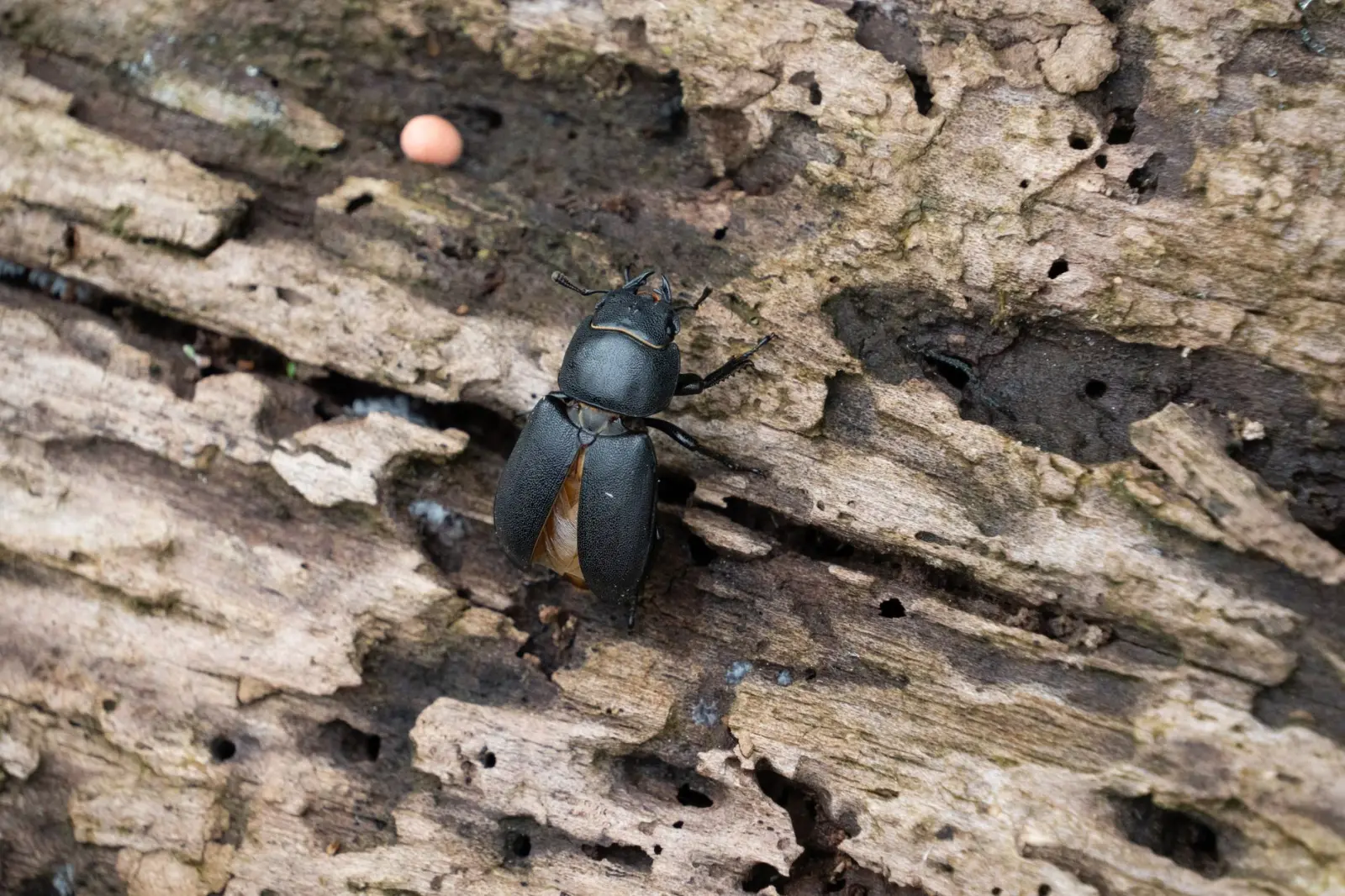
What strikes you first when you lift a section of rotting log is the sheer density of life. Insects dominate numerically. Beetle larvae tunnel through the wood in patterns that look almost deliberate, though they are simply following the grain and the softest tissue. Termites work in coordinated masses, their galleries creating a honeycomb structure within the log that can reduce solid wood to something resembling pumice. Ants establish colonies in the spaces between the wood fibers, using the log as a fortress and a hunting ground simultaneously. Millipedes and centipedes move through the gaps, preying on smaller arthropods and feeding on decaying organic matter.
The Fungal Network
Fungi are the true architects of log decomposition, though their work often goes unnoticed unless you know what to look for. The white thread-like structures you see running through rotting wood are mycelium, and they are actively breaking down cellulose and lignin – the structural compounds that make wood rigid. Different fungal species colonize the log at different stages. Pioneer fungi arrive first, often within days, and their enzymatic activity softens the wood enough for secondary colonizers to establish themselves. This succession of fungal communities is not random. Environmental conditions – moisture, oxygen availability, pH, temperature – select for specific species at specific times.
The fruiting bodies of these fungi occasionally appear on or near the log surface. Shelf fungi are common, their bracket-like structures extending from the log’s side. Other fungi produce smaller, more delicate fruiting bodies that emerge after heavy rain. These visible structures represent only a tiny fraction of the fungal biomass. The real work happens inside the wood, in the darkness, where millions of hyphal tips are simultaneously breaking down organic polymers and converting them into forms that other organisms can use.
Amphibians and Moisture
Fallen logs create refugia for amphibians that would struggle to survive in the open. Frogs and salamanders shelter in the cavities and crevices, where moisture levels remain stable even during drier periods. The log’s decomposition actually improves habitat quality for these animals over time. As the wood becomes softer and more fragmented, it creates more hiding spaces. The increased moisture and organic matter also support higher densities of arthropods, which means better feeding opportunities for the amphibians that use the log as shelter.
I have found small frogs that appear to spend their entire lives within a single log, moving between chambers and hunting the insects that are equally trapped in that confined space. These are not rare or specialized species in most cases. They are common frogs that have simply found an efficient microhabitat. The log becomes a self-contained ecosystem where predator and prey exist in close proximity, separated only by the thickness of rotting wood.
Nutrient Cycling in Action
The most important function of a fallen log is nutrient cycling, though it is not visually dramatic. As the wood decays, the nutrients locked in the timber – nitrogen, phosphorus, potassium, and trace minerals – become available to other organisms. Fungi absorb these nutrients and incorporate them into their own biomass. Insects consume fungi and wood. Amphibians and small mammals consume insects. Larger predators consume smaller animals. When these organisms die or produce waste, the nutrients return to the soil or are consumed by the next organism in the chain.
The log itself gradually sinks into the forest floor. Its edges become indistinct as soil organisms colonize the boundary between wood and earth. Roots from nearby plants penetrate the softening wood, accessing the concentrated nutrients. Over years, the log transforms from a discrete structure into a nutrient-rich mound that supports different vegetation than the surrounding forest. This is why you often see lines of trees or dense vegetation following the path of a fallen log. The log has become a linear oasis of fertility in the forest.
In temperate forests, a large log might persist for decades. In the tropics, the timeline is compressed. A log that would take 50 years to decompose in a northern forest might be substantially broken down within 10 to 15 years in the humid tropics. The organisms working on it are more numerous, more active, and operating under optimal conditions for decomposition. The result is a rapid cycling of nutrients back into the forest ecosystem.
What Changes as Decay Progresses
The community of organisms beneath a log shifts as the wood decays. Fresh logs, still relatively hard, support different species than logs in advanced stages of decay. Early colonizers – certain beetle species and fungi – give way to organisms that prefer softer, more fragmented wood. This succession matters. A log in its first year of decay hosts a different assemblage of insects than a log in its fifth year. Researchers studying rainforest biodiversity have learned to account for log age when sampling, because the species composition changes so dramatically.
The moisture content also shifts. A freshly fallen log, especially one cut by a falling tree, may initially be drier inside than you would expect. As fungi and insects open galleries and increase surface area, water penetration accelerates. The log becomes progressively wetter until it reaches a saturation point where it begins to fragment and lose structural integrity. At this stage, the distinction between “log” and “soil” becomes blurred. What remains is a rich, dark, crumbly substrate that is no longer recognizable as wood but is still chemically distinct from the surrounding earth.
When you work in rainforests long enough, you develop an intuition about log age based on how it feels and sounds. A young log is hard and makes a solid thud when struck. A middle-aged log is softer and may compress slightly under pressure. An old log crumbles between your fingers. These tactile differences correspond to real changes in the wood’s structure and the organisms inhabiting it. They also indicate how much longer the log will persist as a distinct feature in the landscape.
The hidden world beneath rainforest logs is not hidden from the forest itself. Every organism in the ecosystem depends on the processes happening there. Nutrient cycling, arthropod production, amphibian habitat, fungal diversity – all of these converge under a single piece of decaying wood. Understanding this microhabitat means understanding how the rainforest regenerates itself, how it maintains its productivity, and how it sustains the extraordinary biodiversity that defines tropical forests. The log is not a relic of the past. It is an active engine of the present.