
Most people who walk into a rainforest expecting to find streams follow the sound of running water downhill. What they don’t realize is that the actual beginning of those streams – the moment water transitions from diffuse seepage into something resembling a channel – happens in places that are often invisible or deeply counterintuitive. After spending years moving through tropical forests in Central America, Southeast Asia, and West Africa, I’ve learned that the origin point of a rainforest stream is rarely where visitors think it is.
The water that eventually becomes a recognizable stream doesn’t simply fall as rain and immediately start flowing downslope. In a rainforest, the process is far messier and slower. A significant portion of rainfall never reaches the ground at all. It gets intercepted by the canopy – leaves, branches, and aerial roots catch and hold water before it drips down to the next layer. Some of this water evaporates directly into the humid air. Some runs along branches and trunks toward the forest floor. What does reach the soil often doesn’t flow anywhere obvious. Instead, it soaks into the organic matter, gets absorbed by root systems, or moves laterally through the leaf litter in directions that have nothing to do with topography.
The Soil Becomes the First Collector
The actual beginning of stream formation happens in the soil, and it’s a process that takes time. Rainforest soil is not uniform. It’s layered with organic material – decomposing leaves, wood, fungal networks, and root systems that create a matrix more like a sponge than dirt. When rain falls, water moves through this matrix slowly, percolating downward and laterally. The richness of organic matter means the soil can hold enormous amounts of water. I’ve walked across what looked like solid ground only to feel it compress slightly under my weight, knowing there was water just inches below the surface.
As water moves through the soil, it follows paths of least resistance. These aren’t random. They follow the grain of the soil structure, the arrangement of root systems, and the presence of sand or clay layers that either allow or resist water movement. In many rainforests, there are distinct soil horizons – layers with different composition. Water can be held up by a clay layer, spreading laterally until it finds a weakness or a slope steep enough to overcome the resistance. This lateral movement of water through soil is where streams often truly begin, not at a single point but across a zone.
Springs and Seeps Mark the Transition
The first visible evidence of stream formation usually appears as springs or seeps. These are places where water, having moved through the soil and found a path of concentrated flow, emerges at the surface. In a rainforest, a spring might not look like the clear, defined opening you’d expect. It’s often just a slightly wetter area where moss grows thicker, where the ground stays boggy, where plants cluster more densely because water is more available. The water emerges so gradually that it’s difficult to say exactly where the stream “starts.” There’s no sharp boundary between seeping ground and flowing water.
I’ve spent time trying to trace streams backward to their source, and the exercise is usually humbling. You follow a clear channel uphill, and it gets smaller and smaller. Eventually, the channel disappears entirely. What remains is a depression in the forest floor, often filled with moss and saturated soil. Keep going uphill from there, and the depression becomes less distinct. At some point, you’re standing in forest that looks no different from anywhere else, yet water is moving through it. The stream hasn’t started yet – or rather, it started kilometers uphill in the form of diffuse seepage.
Topography Guides the Pattern
The shape of the land matters enormously. Rainforests often grow on terrain that is more varied than people assume. There are ridges, valleys, and slopes that aren’t always obvious when you’re at ground level surrounded by dense vegetation. Water moves toward low points, but in a rainforest with thick soil and vegetation, this movement is gradual. A hillside might have dozens of small seeps spread across it, each contributing water to slightly different areas. These seeps don’t immediately merge into a single stream. Instead, they feed into small channels that run parallel to each other, separated by just a few meters, before eventually converging.
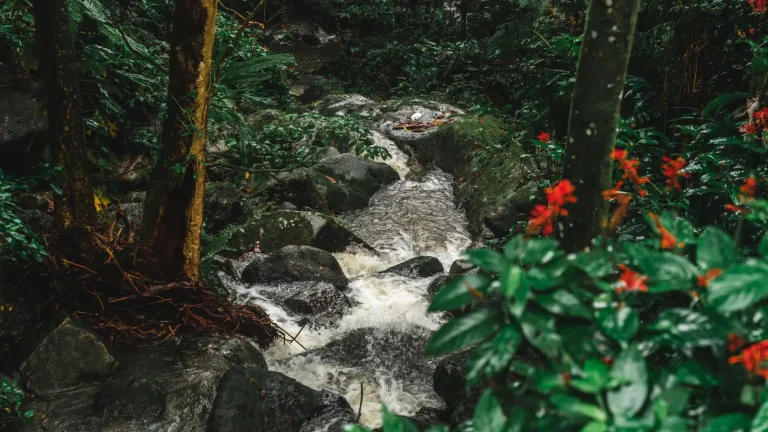
The convergence point is often where a stream becomes unmistakable. Multiple small flows of water come together, and suddenly there’s enough volume that the water cuts a visible channel. This channel is usually not deep – perhaps only a few centimeters in the first hundred meters – but it’s defined. The water has enough momentum and volume that it carves a path rather than simply soaking into the ground. The vegetation changes at this point too. Plants that prefer wet conditions cluster along the channel. The canopy might open slightly, allowing more light to reach the stream. Insects and small animals that depend on flowing water become more common.
Geology Beneath the Surface
What’s happening beneath the soil surface is just as important as what’s visible. Rainforests often grow over bedrock – limestone, granite, volcanic rock, or other stone layers. The depth of soil above this bedrock varies. In some places, soil is meters deep. In others, bedrock is close to the surface. Water moving through soil will eventually hit this bedrock and be forced to move laterally or upward. Where bedrock is close to the surface, water emerges as springs earlier in the landscape. Where soil is deep, water can travel much farther before becoming concentrated enough to form a visible stream.
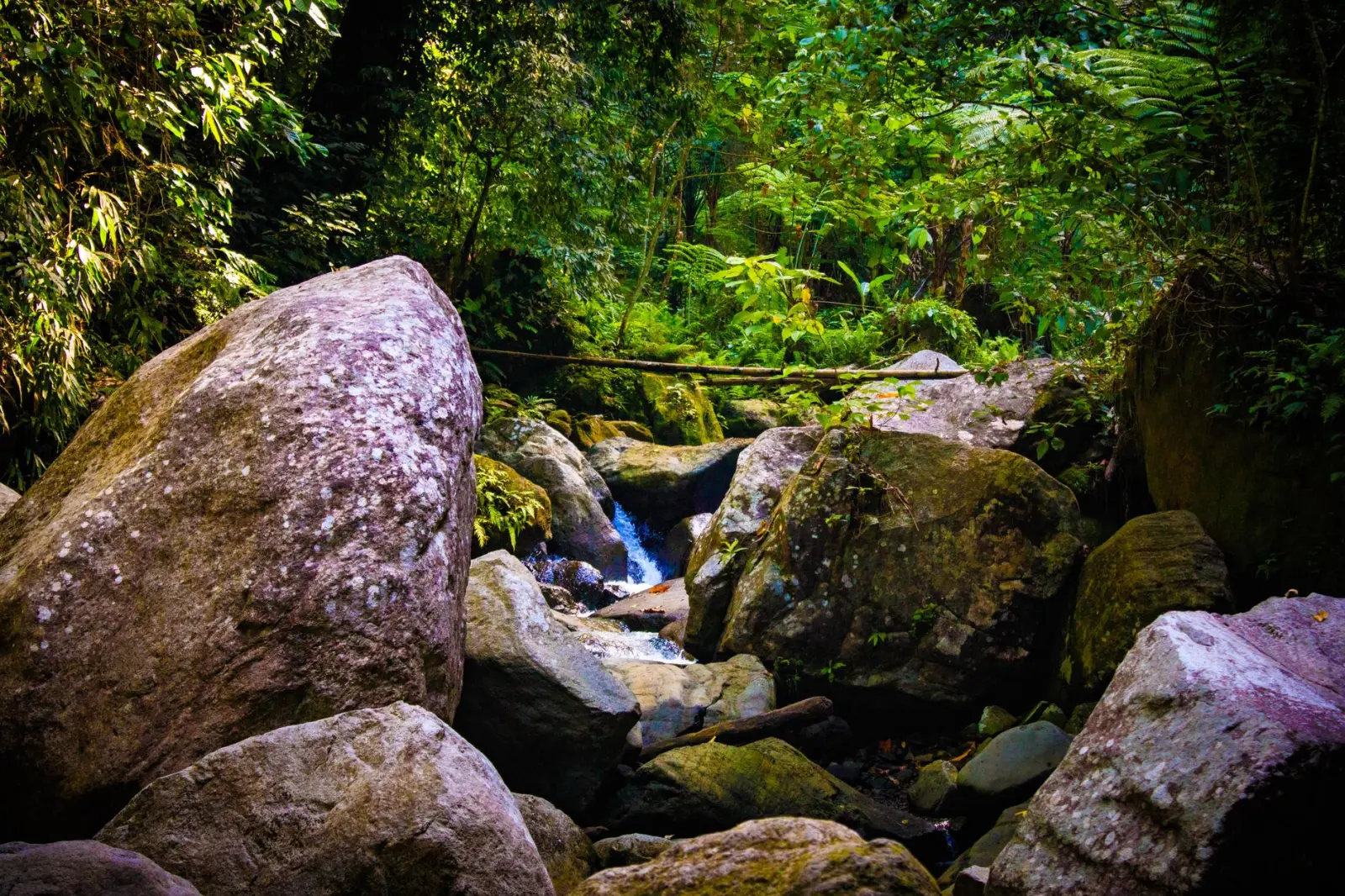
The composition of the bedrock also matters. Limestone is porous and can absorb water, meaning streams in limestone regions might disappear underground and reappear elsewhere. Granite is harder and less porous, so water tends to stay on the surface and form more conventional streams. Volcanic rock is variable – some types are porous, others are not. The geology determines not just where streams begin but how they behave, how clear they are, how warm or cold, and what minerals they carry.
After years of moving through rainforests, I’ve come to understand that asking “where does this stream begin” is often the wrong question. Streams don’t begin at a single point. They emerge from a landscape-wide process of water collection and concentration. The visible stream you see is just the end result of water that has been moving through soil, rock, and vegetation for a considerable distance. The real beginning is diffuse and gradual – happening in places you can’t easily see and over timescales that don’t match human intuition about how water moves. Understanding this changes how you read the forest and how you move through it.