Spend enough time in a rainforest during a storm, and you stop thinking about wind as a simple force. You start noticing how individual trees move differently, how some barely flex while others sway in arcs that seem impossible to survive. After years of working in tropical systems, I’ve learned that what looks like passive endurance is actually a set of precise structural and physiological strategies that evolved under relentless pressure.
The rainforest canopy isn’t a solid wall. It’s a layered, dynamic structure where wind behavior changes dramatically from the forest floor to the highest emergent trees. At ground level, wind is often barely perceptible – the canopy absorbs most of the energy. But in the upper reaches, especially during tropical storms or the sustained winds of hurricane season, the forces are genuinely violent. Trees that fail to adapt to this don’t persist. What you see standing is what works.
Flexibility as the Primary Defense
The most obvious adaptation is stem flexibility. Rainforest trees, particularly those in the mid-canopy and canopy layers, have wood that is often less dense than their temperate counterparts. This isn’t a weakness – it’s a design choice. Denser wood resists bending but snaps under extreme stress. Flexible wood bends, absorbs the energy of the wind, and returns to vertical once the gust passes. I’ve watched this repeatedly: a tree that appears to be failing at a 45-degree angle will straighten completely once the wind subsides.
The trunk taper matters enormously. Many rainforest trees don’t maintain a uniform diameter from base to crown. Instead, they taper gradually, which distributes stress more evenly along the length of the stem. A uniform cylinder concentrates bending stress at specific points; a tapered cone spreads it across the entire structure. This is basic mechanics, but the degree of taper varies by species and position in the canopy. Emergent trees often have more pronounced taper than understory species because they face more extreme wind loads.
Branch architecture also plays a role that’s easy to overlook. Many canopy trees don’t hold branches at rigid angles. Instead, branches attach at angles that allow them to move somewhat independently of the main trunk, and they’re often positioned to shed wind rather than catch it directly. A branch that can swing slightly absorbs wind energy without transmitting the full force to the trunk. This is why you see relatively few large branch failures in healthy rainforest trees compared to what you’d expect from the wind speeds involved.
Leaf Morphology and Canopy Structure
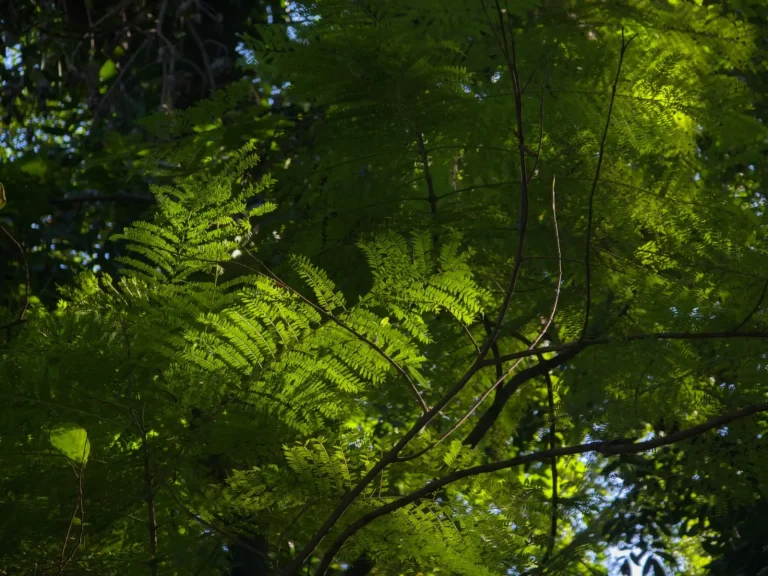
Leaf size and shape are not random. Many rainforest canopy trees have relatively small or deeply lobed leaves compared to understory plants. Small leaves present less surface area to the wind and experience lower drag forces. Lobed or dissected leaves allow wind to pass through rather than pressing against a solid surface. I’ve noticed that during high winds, the canopy seems to “breathe” – leaves flutter and twist, but the overall structure remains intact because individual leaves aren’t acting as sails.
The arrangement of leaves on branches also matters. Leaves that are arranged alternately along a twig, or that can rotate on their petioles, allow the canopy to present a constantly changing profile to the wind. A rigid, flat canopy surface would catch wind like a sail; a dynamic, three-dimensional canopy lets much of the wind pass through. This is why dense, uniform hedges are vulnerable to wind damage in ways that natural forest canopies are not.
Crown shape itself is an adaptation. Many tall rainforest trees develop narrow, streamlined crowns rather than broad, spreading canopies. This reduces the overall wind-catching surface area. The crown might be conical or columnar rather than hemispherical. From a distance, this looks like a natural consequence of competition for light, which it partly is, but the streamlined form also reduces wind resistance significantly.
Root Systems and Anchorage
Above ground flexibility means nothing without adequate anchorage. Rainforest soils vary enormously, but in many areas they’re shallow, waterlogged, or both. This presents a real constraint: you can’t dig a deep taproot in soil that’s saturated or only a meter deep before hitting laterite or bedrock. Instead, many rainforest trees develop extensive lateral root systems that spread widely near the surface, sometimes with buttresses or prop roots that provide additional stability.
Buttress roots are particularly common in large canopy trees. These are essentially reinforcing structures that extend from the base of the trunk and spread outward, increasing the effective width of the root system. They look dramatic, but they’re a practical solution to the problem of anchoring a tall, heavy tree in shallow soil. The buttresses don’t go deep; they go wide, distributing the tree’s weight and the forces from wind sway across a larger soil volume.
What’s often underestimated is the role of mycorrhizal associations. Many rainforest trees rely on fungal networks that extend well beyond the visible root system. These networks increase the effective surface area for nutrient uptake and water absorption, but they also seem to increase the tree’s ability to sense and respond to mechanical stress. A tree with a robust fungal network can adjust its physiology in response to chronic wind stress in ways that a tree with a degraded or absent fungal community cannot.
Physiological Responses to Chronic Wind
Trees don’t just have static structural adaptations. They respond actively to wind stress over time. Trees growing in consistently windy locations develop thicker wood, stronger branch attachments, and more compact crowns than genetically identical trees growing in sheltered locations. This is thigmomorphogenesis – growth shaped by mechanical stimulation. The constant flex and sway of wind-exposed trees triggers hormonal and developmental responses that strengthen the structure.
Interestingly, this response can be maladaptive if the tree is suddenly moved or if wind patterns change. A tree that has developed a compact, heavily reinforced structure for high-wind conditions will be overbuilt if the wind regime drops significantly. Conversely, a tree that evolved in a sheltered microclimate and is suddenly exposed to sustained wind will struggle to adapt quickly enough.
Sap flow and hydraulic conductivity also seem to play a role. Trees under chronic wind stress often maintain slightly higher water tension in their vascular system, which increases wood stiffness. This is a trade-off: stiffer wood resists bending but is more prone to cavitation and hydraulic failure under extreme drought. In the wet tropics, this trade-off generally favors increased stiffness during the windy season.
Failure Points and Real-World Limits
Despite all these adaptations, trees do fail. Wind damage in rainforests is not rare; it’s a regular disturbance that shapes forest structure and species composition. Failure typically occurs at predictable weak points: branch attachments, the junction between buttress roots and the main trunk, or the base of the root system itself. Trees that are diseased, infested with wood-boring insects, or growing in degraded soil fail more readily than healthy trees in good soil.
Storm damage patterns reveal something important: the trees that fail are often not the largest or the most exposed, but rather those in transitional positions – tall enough to catch significant wind but not tall enough to have the reinforced structure of true emergent trees. A tree that’s 30 meters tall in a forest where emergents reach 50 meters often experiences worse wind stress than either the smaller understory trees or the massive emergents.
Wind damage is also cumulative. A tree that survives one hurricane with branch loss or stem scarring is more vulnerable to the next one. The scar tissue is never as strong as original wood, and repeated damage can eventually exceed a tree’s capacity to compartmentalize and recover. This is why you see certain trees persisting with visible damage year after year – they’re surviving, but they’re not fully recovering.
What I’ve come to understand is that rainforest plants don’t have a single solution to wind. They have multiple, overlapping strategies: flexible wood, tapered stems, small leaves, streamlined crowns, wide root systems, and the ability to respond physiologically to stress. No single strategy would be sufficient. It’s the combination that allows these systems to persist in environments where wind is not an occasional disturbance but a constant pressure. The forest you see has already filtered out everything that didn’t work.