After spending years moving through rainforest regions – Central America, Southeast Asia, parts of Australia – you start to notice patterns in how water behaves in these environments. The swimming holes that draw travelers are rarely the same color twice, and the hues people photograph are almost never what they saw with their own eyes. The blue and green tones that make these pools famous aren’t tricks of the camera or atmospheric conditions alone. They’re the result of specific mineral compositions, water clarity, and the way light travels through depth.
The most striking pools tend to sit in limestone or dolomite regions, where the bedrock chemistry shapes everything downstream. When rainwater percolates through these rock layers over months and years, it dissolves minerals – primarily calcium and magnesium carbonates. This isn’t a slow process in the way you might think; tropical rainfall is intense and frequent, and the water moves quickly through fissures and cavities. By the time that water emerges as a spring or collects in a basin, it carries a suspended load of fine mineral particles, mostly calcium carbonate. These particles are so small – often measured in micrometers – that they remain suspended rather than settling to the bottom.
How Minerals Create Color
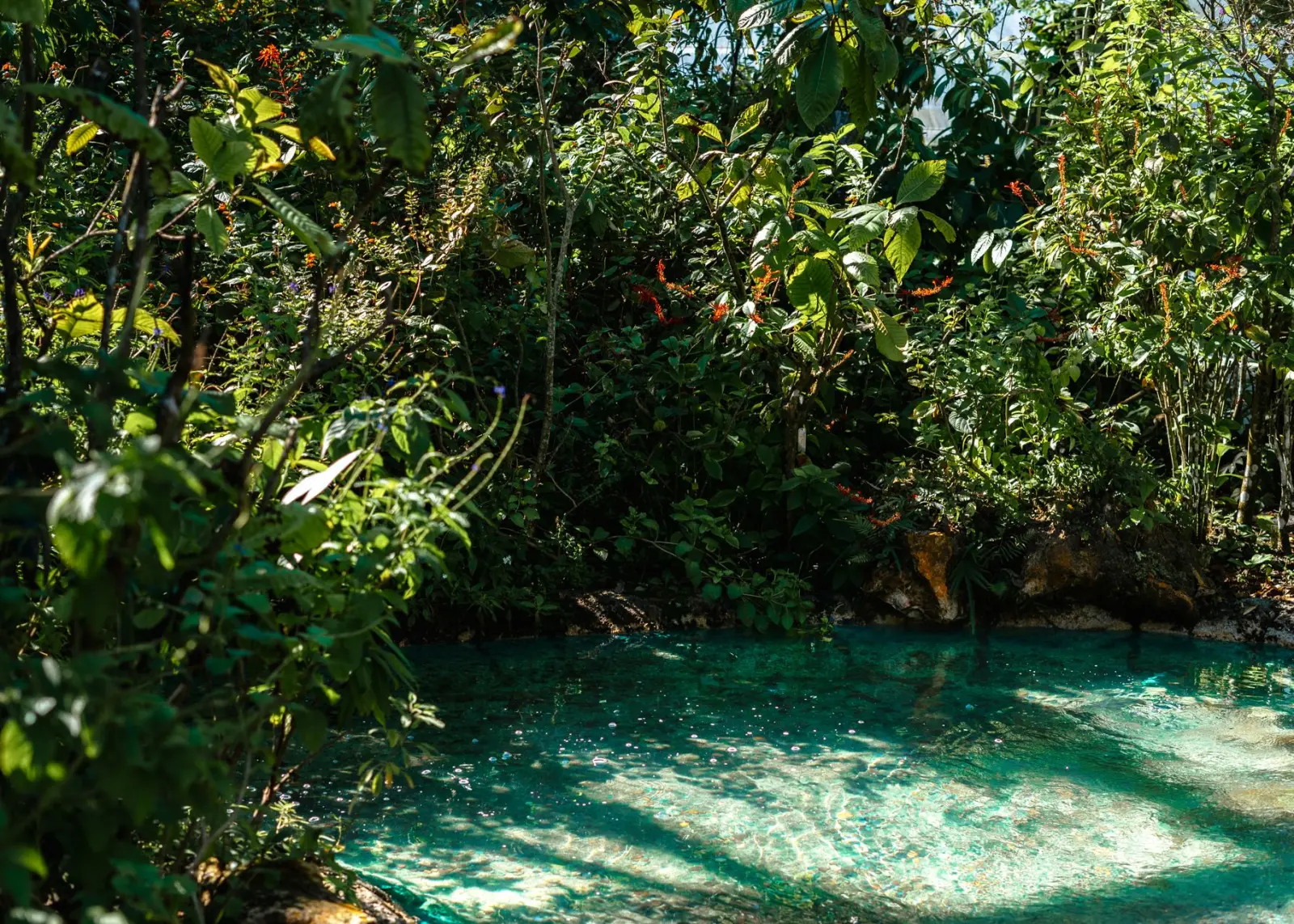
Suspended calcium carbonate particles scatter light in a specific way. They absorb the longer wavelengths – the reds and yellows – while reflecting shorter wavelengths back toward the surface. This is why the water appears blue or turquoise rather than clear. It’s the same optical principle that makes ocean water blue, though the ocean’s color comes from water molecules themselves absorbing red light. In rainforest pools, the minerals do most of the work. The finer the particle suspension, the more intense the blue tends to be. Coarser suspensions lean toward milky turquoise or pale green.
Green tones emerge when algae and tannins enter the equation. Rainforest pools that receive consistent sunlight and have slower water movement often develop algal growth. The chlorophyll in that algae shifts the reflected light toward green wavelengths. Tannins – organic compounds released from decomposing vegetation, especially leaves and wood – also absorb certain wavelengths and add a greenish cast. I’ve seen pools that were distinctly blue in the dry season turn noticeably greener within weeks once the wet season intensified and leaf litter accumulated upstream. The change isn’t dramatic in a single day, but it’s real and measurable if you’re watching the same pool over time.
Depth and Light Interaction
Water depth amplifies these color effects significantly. A shallow pool with the same mineral content as a deep one will appear lighter and less saturated. The light has less distance to travel through the water column, so fewer wavelengths get absorbed before bouncing back. Deep pools – those that are 15 feet or more – show richer, more vivid blues because the light path is longer. By the time light reflects off the bottom and travels back up, most of the warm wavelengths have been filtered out. This is why the deepest sections of a pool often look almost navy blue while the shallows appear pale turquoise.
The angle of sunlight matters too, though this is something most travelers overlook. A pool that looks brilliant blue at midday can appear dull and greenish-gray in late afternoon when the sun sits lower on the horizon. The light enters the water at a different angle, and the path it travels through the mineral suspension changes. I’ve watched photographers spend hours at a single location waiting for the sun to reach the right position. It’s not about the water changing; it’s about the geometry of light.
What Disrupts the Color
Heavy rainfall upstream muddies these pools faster than most people expect. When rain intensifies, it carries sediment – clay, silt, fine soil particles – into the water system. These particles are larger and denser than the dissolved minerals that create the blue color. They settle more slowly but scatter light differently, creating a brownish or gray cast. I’ve seen pools go from brilliant turquoise to murky brown within hours of heavy upriver rainfall. The color returns as the sediment settles and water clarity improves, but this can take days depending on the volume of water moving through the system.
Seasonal variation is substantial. Dry seasons produce clearer, more intensely colored pools because there’s less sediment input and the mineral-to-water ratio stays stable. Wet seasons bring more water volume, more sediment, and more organic matter. The colors shift toward green and the saturation decreases. If you’re planning a trip specifically to see blue rainforest pools, timing matters. The weeks just after the dry season ends – when rainfall has resumed but sediment hasn’t accumulated heavily yet – often produce the most vivid colors.
Algae blooms can occur in pools that receive too much direct sunlight combined with nutrient runoff. This turns the water green or even brownish-green, sometimes with a visible film on the surface. It’s not dangerous in most cases, but it’s aesthetically disappointing and signals that the pool’s ecosystem is responding to human activity or land-use changes upstream. I’ve seen this happen in popular tourist spots where foot traffic and development have increased nutrient inputs to the water system.
The Reality of What You’ll See
Most travelers arrive at famous rainforest pools with images in their minds from social media or travel guides. Those images are usually shot under optimal conditions – clear weather, midday sun, dry season timing, and often with color enhancement in post-processing. The actual experience is usually less saturated. The pool might be beautiful and genuinely blue or green, but it’s rarely as vivid as the photographs suggest. This isn’t a flaw in the location; it’s just how perception and documentation work. Your eyes see color differently than a camera sensor does, especially when you’re standing at water level rather than shooting from an angle.
The water temperature also affects how you perceive color. Cool, mineral-rich water from underground springs tends to be clearer and more vividly colored than warmer, stagnant pools. If a pool feels warm to the touch, it’s likely receiving more sunlight and surface evaporation, which concentrates minerals but also encourages algae growth. The coldest pools – those fed by active springs – usually have the most striking blues.
Understanding why these pools are colored the way they are doesn’t diminish the experience of being in one. If anything, it makes the observation more interesting. You’re not looking at a static natural wonder; you’re looking at a system responding to rainfall patterns, mineral geology, seasonal cycles, and light physics. The color you see on any given day is a snapshot of those conditions at that moment. A week later, the same pool might look entirely different, and there’s nothing wrong with either version – they’re just different expressions of the same underlying geology.