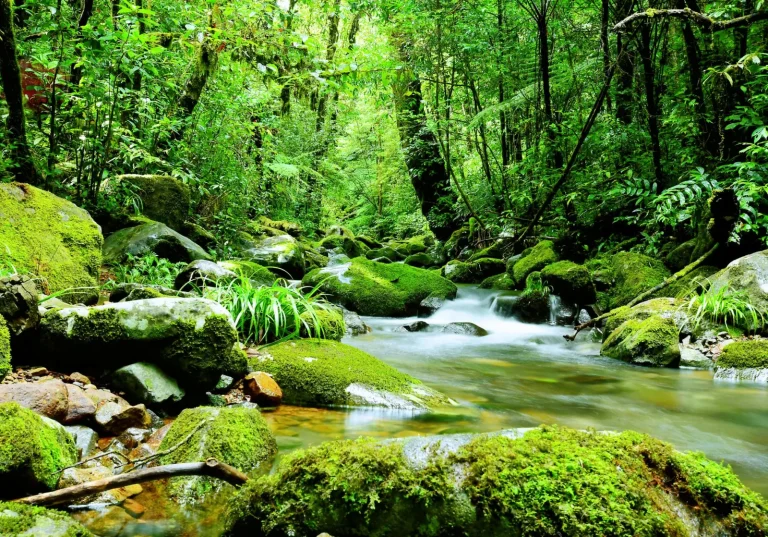

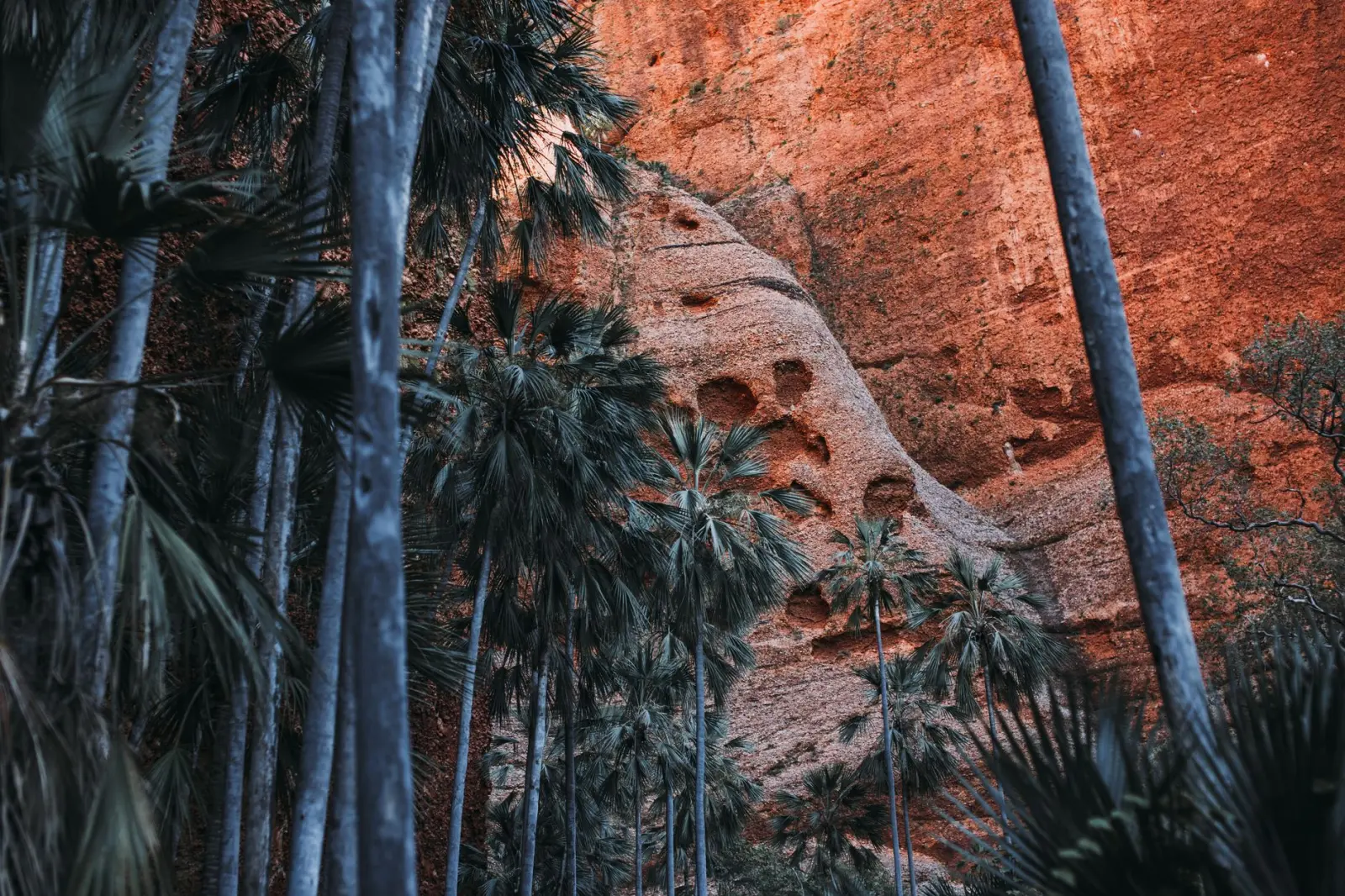
Traveling through sandstone country in tropical regions, you notice something that seems to contradict the surrounding terrain. Where the landscape is otherwise open, rocky, and sparse – often appearing almost desert-like in its exposure – you stumble into pockets of dense, humid rainforest. The transition can be abrupt enough to feel like stepping through a doorway. The air shifts. Moisture rises. The canopy closes overhead. This isn’t coincidence or random distribution. It’s a direct result of how sandstone geology shapes water movement, temperature regulation, and soil formation across the landscape.
Sandstone is a porous rock, which means it absorbs and holds water differently than granite, basalt, or limestone. When rain falls on a sandstone plateau or ridge, much of it doesn’t run off immediately into streams and rivers. Instead, it soaks downward through the stone itself. This water moves slowly through the porous matrix, filtering through layers of sand and silt that were compacted and cemented together millions of years ago. The result is a natural aquifer system that feeds groundwater to lower elevations and valley floors for weeks or months after rainfall events.
The Moisture Trap
In tropical regions with pronounced wet and dry seasons, this slow-release water system becomes critical. During the dry season, when surface water disappears and most vegetation enters stress mode, sandstone-fed valleys maintain groundwater flow. Streams continue running where they would otherwise dry to a trickle. Springs emerge at consistent points along valley walls. This reliable moisture allows rainforest vegetation to persist in areas where the climate would otherwise support only savanna, scrubland, or deciduous forest that sheds its leaves seasonally.
I’ve walked through these refuges in Australia’s Arnhem Land, in the sandstone ranges of Brazil’s interior, and across the escarpments of southern Africa. The pattern repeats. The rainforest exists not because the regional climate is wetter than surrounding areas, but because the sandstone geology creates a localized water surplus. The rock itself becomes the infrastructure that sustains the forest.
Temperature regulation adds another layer to this dynamic. Sandstone plateaus, especially when they rise significantly above surrounding valleys, influence air flow and cloud formation. Moist air moving across the landscape rises when it encounters elevated terrain, cooling as it ascends. This orographic effect can trigger cloud formation and occasional precipitation that wouldn’t occur over flat ground. More importantly, the plateau and its valleys create a thermal environment distinct from the open landscape beyond. During the hottest parts of the day, air trapped in deep valleys and shaded by dense canopy remains cooler than exposed areas. At night, the reverse happens – the thermal mass of the sandstone and the insulating effect of the forest canopy moderate temperature swings.
Soil Formation and Nutrient Cycling
The geology also influences soil chemistry and structure in ways that support forest growth. Sandstone weathers relatively slowly compared to other rock types, but the weathering products – sand and silt particles – create soils with specific drainage characteristics. These soils are often nutrient-poor by themselves, which seems counterintuitive for supporting rainforest. However, the consistent moisture and stable microclimate allow organic matter to accumulate and decompose at rates that build soil fertility over time. The forest floor becomes thick with leaf litter and humus, creating a nutrient cycling system that is largely self-contained. The forest feeds itself.
What I’ve observed repeatedly is that these rainforest refuges tend to have distinctive plant and animal communities. Species present in a sandstone-sheltered rainforest may differ from those in larger, continuous rainforests nearby. This isolation creates evolutionary pressure. Over generations, populations adapt to the specific conditions of their refuge. Some species become more specialized, more dependent on the particular microclimate. This is why these pockets often have high conservation value – they harbor endemic species found nowhere else, or populations of species that are rare across their broader range.
Practical Implications for Movement and Access
From a traveler’s perspective, understanding this geography changes how you navigate these landscapes. The rainforest pockets are rarely where you’d expect them based on a casual look at a map. They cluster in valleys, along certain ridgelines, and in areas where sandstone geology creates the right hydrological conditions. If you’re trekking through sandstone country and looking for water, reliable vegetation, or shelter, these refuges are worth seeking out. But they’re also fragile. The water systems that sustain them are sensitive to disruption. Dams, diversions, or changes in rainfall patterns can destabilize the balance quickly.
The vegetation in these refuges also affects movement. Rainforest is dense. Visibility is limited. Navigation requires care. Trails, where they exist, are often muddy and root-strewn. The humidity is intense, and the pace of travel slows considerably compared to open terrain. But this density is also what makes these places valuable for wildlife observation and for understanding tropical ecology in concentrated form. You see more species diversity per square meter in a sandstone-sheltered rainforest than you would across a much larger area of open savanna or woodland.
The relationship between sandstone geology and rainforest refuges is ultimately one of constraint and adaptation. The rock creates the conditions. The forest responds and evolves within those conditions. For anyone traveling through these landscapes, recognizing this connection transforms what might otherwise seem like random patches of forest into visible proof of how deeply geology shapes ecology and determines where life can flourish.