
After spending years moving through rainforests – both in fieldwork and travel – you notice something that initially seems counterintuitive. The forest floor and lower canopy layers are packed with thriving vegetation despite receiving only a fraction of the sunlight that reaches the top. This isn’t a puzzle that requires exotic explanation. It’s simply how these plants have adapted over time to an environment where direct sun is a luxury, not a necessity.
The rainforest canopy is dense enough that less than 5 percent of incoming light reaches the forest floor. Walk through an old-growth tropical forest and you’ll experience this directly – the air feels dim, almost twilight-like, even at midday. Yet the understory isn’t sparse or struggling. It’s crowded with ferns, shade-tolerant shrubs, and young trees waiting for a gap to open. These plants aren’t simply tolerating shade. They’ve evolved to exploit it efficiently.
Leaf Structure and Light Capture
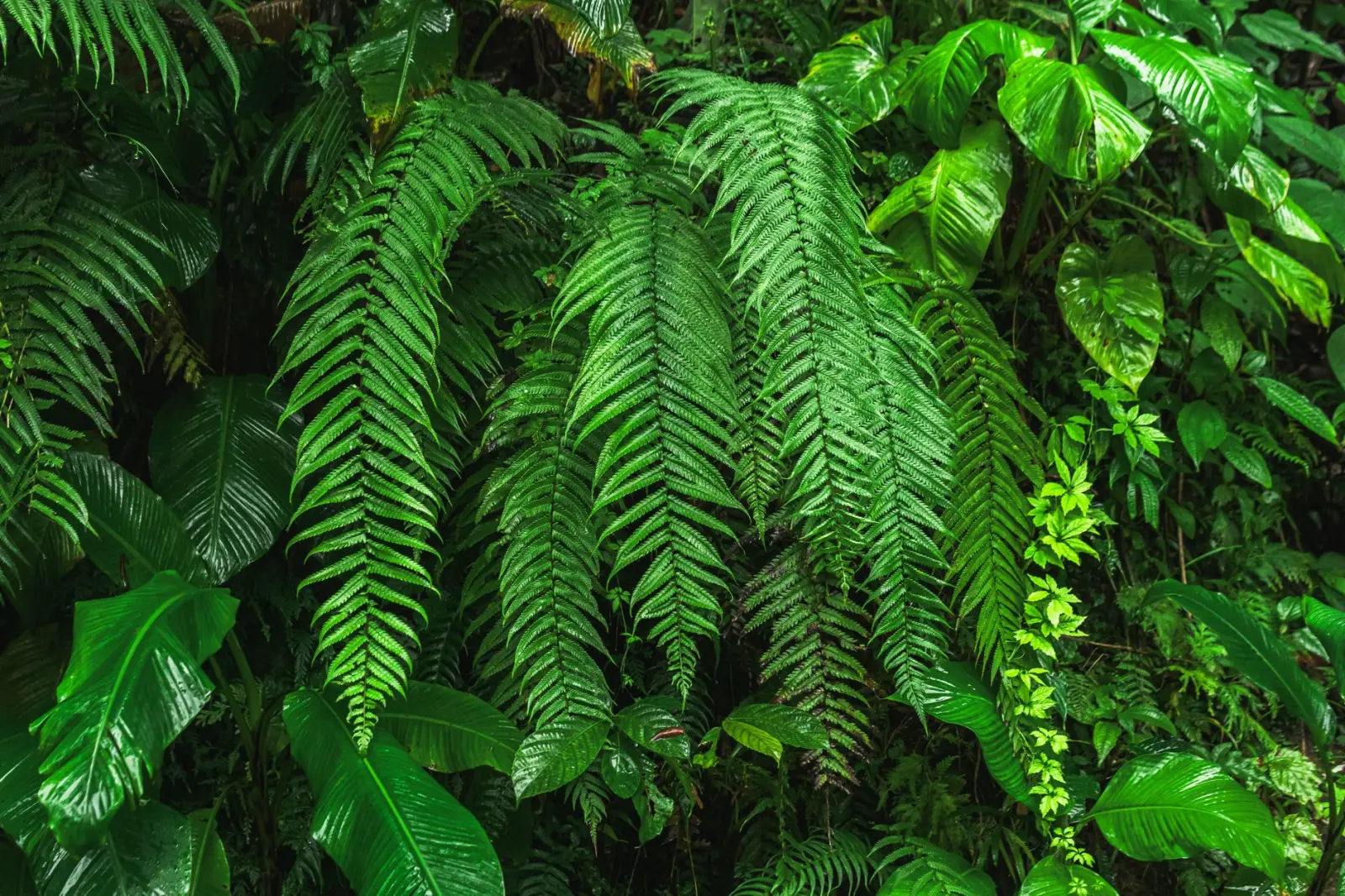
The most visible adaptation is in leaf design. Understory plants typically have larger, thinner leaves than their sun-exposed relatives. This isn’t random. Larger surface area captures more of the scattered, diffuse light that filters through the canopy. The thinness matters too – it allows light to penetrate deeper into the leaf tissue, maximizing photosynthetic efficiency in low-light conditions.
You’ll notice these leaves often have a distinctive glossy or waxy appearance. That sheen isn’t decorative. It reflects and concentrates light within the leaf structure, essentially making use of every photon that arrives. Some shade plants have evolved leaves with special cellular arrangements that act almost like light-gathering channels, directing light toward the chloroplasts where it’s needed.
Many understory plants also position their leaves in ways that minimize self-shading. Rather than overlapping haphazardly, leaves arrange themselves on stems to avoid casting shadows on other leaves of the same plant. In the dim environment, even the shade cast by your own foliage is a waste of precious light.
Photosynthetic Efficiency at Low Light
The chemistry of photosynthesis in shade plants differs from sun plants in measurable ways. Shade-adapted plants have higher concentrations of chlorophyll – the pigment that captures light energy. This allows them to squeeze more energy from the weak light available. They also tend to have more of the light-harvesting complexes that work in low-light conditions, while reducing the structures that are only useful under intense sun.
What’s often overlooked is the trade-off. These plants are more efficient in shade but less efficient in full sun. If a shade plant suddenly receives direct sunlight, it can actually suffer photoinhibition – the light damages its photosynthetic machinery because it’s not equipped to handle the intensity. This is why transplanting rainforest understory plants into a sunny garden often fails, even with proper watering and soil.
The photosynthetic rate itself is slower in shade plants. They’re not producing energy as quickly as canopy plants, but they don’t need to. Their growth is slower, their metabolism more conservative. This is a fundamental difference in strategy – not weakness, but adaptation to a resource-limited environment.
Nutrient Cycling and Root Systems
Shade plants don’t just survive on light efficiency alone. The rainforest floor is a nutrient-rich environment because of constant decomposition. Dead leaves, fallen branches, and animal matter break down rapidly in the warm, humid conditions. Understory plants have evolved shallow, spreading root systems that tap into this nutrient layer rather than reaching deep into soil.
Many shade plants form relationships with fungi – mycorrhizal associations – that dramatically improve their ability to extract nutrients from decomposing organic matter. The fungal networks extend the plant’s reach and break down complex organic compounds into forms the plant can absorb. In the dim understory, this partnership is almost essential. You’re not just growing a plant; you’re growing a plant-fungal system.
Epiphytes – plants that grow on other plants – represent an extreme adaptation to shade and nutrient scarcity. Orchids, bromeliads, and ferns perch on tree branches where they catch more light than the forest floor offers, while their roots absorb moisture and nutrients from rain and decaying matter that collects around them. They’re not parasites; they’re simply occupying a niche where resources are more accessible.
Pigment Diversity Beyond Chlorophyll
If you examine shade-adapted leaves closely, you’ll notice they’re often not pure green. Many have reddish, purple, or bronze undertones. These come from anthocyanins and carotenoids – pigments that also capture light but in different wavelengths than chlorophyll. In the filtered light of the understory, where blue and red wavelengths are more available than in full sun, these additional pigments become valuable light-harvesting tools.
Some plants have evolved leaves with iridescent or metallic properties that further enhance light capture. The Monstera deliciosa, common in tropical understories, has leaves with unusual cell structures that increase light absorption. These aren’t aesthetic features – they’re functional adaptations that have been refined over millions of years.
Growth Rate and Longevity
The trade-off for surviving in shade is growth speed. Understory plants grow slowly. A shade-adapted shrub might take decades to reach full size, while a canopy tree grows rapidly once it receives full sun. This slow growth actually confers an advantage – the plant invests less energy in rapid expansion and more in durability. Shade leaves tend to be tougher, longer-lived, and more resistant to damage than sun leaves.
When a canopy gap opens – from a fallen tree or storm damage – shade plants respond. Young trees that have been waiting in the understory for years suddenly receive increased light and can accelerate growth. This is the mechanism by which rainforests regenerate. The understory isn’t a static layer of permanent residents; it’s a dynamic waiting room where plants are positioned to exploit opportunities when they arise.
What strikes you after years in these environments is how efficient the system is. Nothing is wasted. Every adaptation serves a purpose. Shade plants aren’t struggling organisms barely surviving in darkness. They’re specialized species that have optimized every aspect of their physiology to thrive in conditions where direct sunlight is rare. The rainforest works not because everything competes for sun, but because different plants have evolved to use different resources in different ways.