
Spend enough time walking through rainforest, and you stop seeing vines as a uniform tangle. They’re solving a specific problem: how to reach light without spending the energy to build a rigid trunk. The canopy sits 100 feet or more above the forest floor, and the understory is dim. A vine that stays low gets shaded out. But growing straight up into open air requires structural support that vines simply don’t have. What you see instead is a collection of different solutions, each one tuned to particular conditions and host availability.
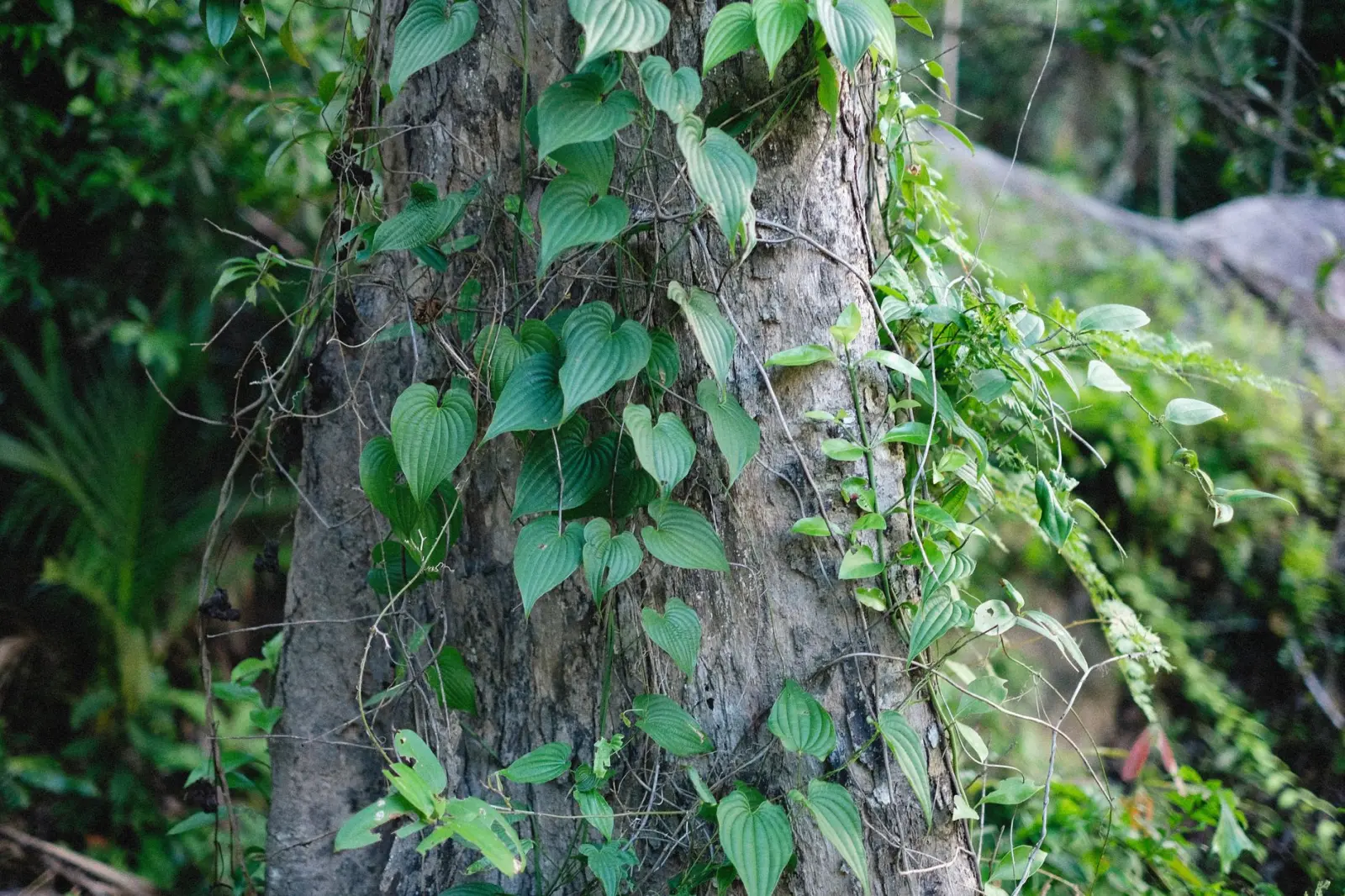
The most obvious strategy is twining. A vine spirals around a tree trunk or branch as it grows upward, using the host plant as a scaffold. The vine doesn’t grip or adhere – it just wraps around whatever is there. This works well in dense forest where vertical supports are plentiful. The vine grows relatively fast once it finds something to coil around, and it doesn’t require specialized attachment structures. But twining vines are dependent. If the host tree is thin or has smooth bark, the vine can slip. If the host dies and falls, the vine often falls with it. I’ve seen twining vines collapse in sections when a supporting branch broke during a storm, leaving the vine hanging loose until it either found another anchor or died back.
Clinging and Adhesion
Other vines have evolved small rootlets or adhesive pads that allow them to cling directly to bark or even smooth surfaces. These aerial rootlets don’t absorb water or nutrients – they’re purely mechanical. The vine essentially glues itself to the host tree and climbs by producing new rootlets as it grows upward. This approach is slower than twining, but it’s more secure. A clinging vine won’t slip off a smooth trunk, and it doesn’t need to find a branch at just the right angle. The trade-off is energy. Growing adhesive rootlets takes resources, and the vine has to produce them continuously as it climbs.
The most efficient climbers I’ve observed combine strategies. A vine might start by twining around lower branches where supports are small and numerous, then switch to clinging rootlets higher up where the host trunk is thicker and smoother. Some vines produce hooks or thorns that catch on bark irregularities, reducing the work of adhesion. These hybrid approaches suggest that vines aren’t locked into a single growth pattern – they adjust based on what they encounter.
Reaching for the Canopy
Once a vine reaches the lower canopy, the environment changes. Light increases, but so does wind stress. A vine that’s coiled around a thin branch 80 feet up experiences forces that would snap a younger vine. At this height, many vines stop growing upward and instead spread laterally, creating a network of branches that can photosynthesize in direct sunlight. This lateral spread is where the vine finally becomes productive. The climb was just the means to an end.
Not all vines make it to the canopy. Many fail partway up, either because they can’t find suitable hosts, because they run out of energy, or because they get shaded out by faster-growing competitors. A vine that twines around a host tree that itself is being shaded will slow down and eventually die. I’ve found dead vines still wrapped around trees in the understory, their growth halted years ago when the light conditions became untenable. These failures are normal – they’re part of the competition for space and light that defines the rainforest.
Host Tree Relationships
The choice of host tree matters more than is often acknowledged. A vine growing on a tree with rough, deeply furrowed bark has an easier time finding purchase than one on smooth bark. A host tree that sheds its bark regularly can actually dislodge clinging vines. Some host trees are toxic or produce compounds that inhibit vine growth, while others seem to tolerate vines readily. Over time, certain vine species become associated with certain host trees, not because of preference but because those are the combinations that survive.
The relationship isn’t entirely one-sided. A heavy vine load can slow a host tree’s growth or, in extreme cases, damage branches through sheer weight. I’ve seen large vines actually strangle the branches they climb, cutting off nutrient flow and causing the branch to die back. But the host tree rarely dies from this. It’s more of a cost-benefit situation. The tree provides a climbing structure; the vine takes some resources. Most host trees seem to accept this trade-off as part of living in a competitive forest.
Seasonal timing also influences vine growth. In many rainforests, there’s a wet season when water is abundant and a drier period when it’s scarce. Vines often push their growth upward during the wet season, when water stress is low and energy can go into climbing rather than survival. During the dry season, growth slows or stops. This pattern means that a vine’s progress up the canopy isn’t constant – it’s episodic, with bursts of growth followed by plateaus. A vine that takes five years to reach the canopy might have spent only two of those years actually growing upward.
What’s often overlooked is the role of light quality, not just quantity. Vines don’t respond equally to all wavelengths of light. Red and far-red light signals whether a plant is in shade or in direct sun. A vine in deep understory shade receives a different light signal than one in dappled light, and this affects how it grows. Some vines will grow more aggressively upward in response to the light signal of being shaded, as if they’re trying to escape. Others respond by growing more slowly, conserving energy. This physiological flexibility is what allows vines to persist in variable conditions.
The mechanical engineering of vine growth is worth understanding too. A twining vine must generate enough tension in its coils to support its own weight as it climbs. If the vine is too heavy or the coil too loose, it will slip. Clinging vines face a different problem – they must produce enough adhesive force to hold themselves and any water weight they accumulate. A heavy rain can add significant mass to a vine, and if the adhesion fails, the vine falls. This is why you sometimes see vines that have fallen partway down a tree, still attached at the top but hanging loose below.
The canopy itself is a different world from the understory. Once a vine reaches it, the growth pattern changes again. The vine encounters other vines, branches from neighboring trees, and direct sunlight. Vines in the canopy often grow horizontally or even downward, creating the tangled mat that makes the canopy so visually dense. This growth pattern is less about reaching light and more about maximizing light capture and spreading to find new supports. A successful vine in the canopy can live for decades, continuously growing and shedding old growth, becoming an integral part of the canopy structure itself.