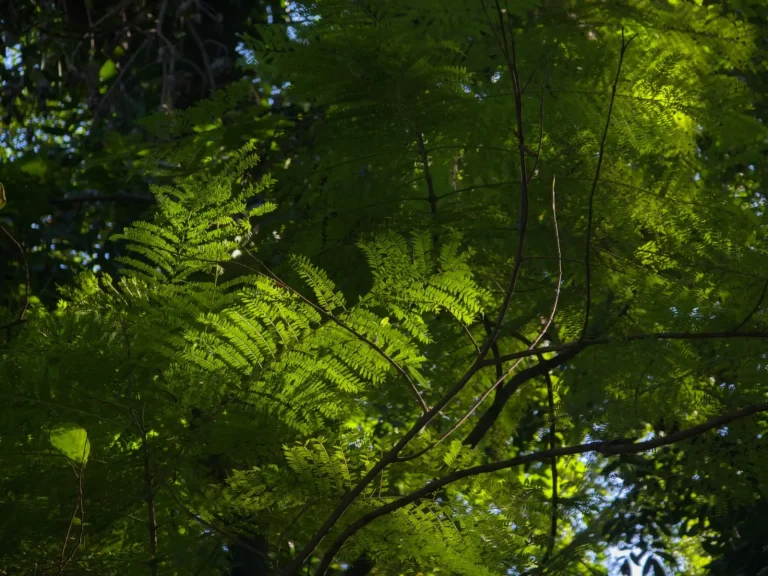
Spend enough time in a rainforest, and you start noticing ferns everywhere – clinging to tree trunks, carpeting the forest floor, dangling from branches in impossible tangles. The first thing most people ask is how they got there without seeds or flowers. The answer lies in a reproductive strategy so different from what we’re used to seeing that it almost seems like two separate plants are involved. In a way, that’s exactly what’s happening.
Ferns don’t reproduce the way flowering plants do. There’s no pollen, no fruit, no seed coat protecting an embryo. Instead, they produce spores – microscopic, single-celled structures that are released by the millions. A single fern frond can shed hundreds of thousands of spores in a single season. If you’ve ever rubbed the underside of a mature fern leaf and noticed a fine dust on your fingers, you’ve held spores. That dust is the entire reproductive apparatus, and it’s far more efficient in a rainforest environment than you might initially think.
The Spore Stage and Sporophyte
The fern plant you actually see – the one with the familiar fronds and visible structure – is called the sporophyte. Its job is to produce and release spores. On the underside of mature fronds, you’ll find clusters of small, rounded structures called sporangia. These look like tiny brown or rust-colored bumps, often arranged in neat rows or patterns. Inside each sporangium are hundreds of spores waiting to be released.
The timing of spore release matters considerably. In a rainforest, where humidity is consistently high and the air rarely dries out completely, spores can be released almost year-round. But there are still patterns. Many fern species have peak spore production during wetter months, when conditions are most favorable for germination. The spores themselves are incredibly light – so light that they can drift on air currents for weeks or even months. Some species produce spores that travel hundreds of kilometers before landing. In the rainforest, with its dense canopy and still air, most spores fall relatively close to the parent plant, but enough drift upward and outward to colonize new surfaces.
What’s often overlooked is that spore production is metabolically expensive. A fern that’s putting energy into making millions of spores isn’t putting that energy into growing larger fronds or storing reserves. This is why you see variation in fern populations – some individuals are robust spore producers while others focus more on vegetative growth. Environmental stress, like drought or heavy shade, can shift this balance. A fern struggling in poor light might produce fewer spores but maintain its structure better.
The Gametophyte: The Hidden Stage
Here’s where rainforest fern reproduction gets genuinely strange. When a spore lands on a suitable surface – wet soil, a rotting log, the bark of a tree – it doesn’t immediately grow into a new fern. Instead, it germinates into something completely different: a gametophyte. This is a tiny, usually heart-shaped structure, rarely more than a few millimeters across. Most people have never seen one because they’re so small and short-lived.
The gametophyte is where sexual reproduction actually happens. It produces both male organs (antheridia) and female organs (archegonia). For fertilization to occur, sperm from the antheridium must swim through a film of water to reach the egg in the archegonium. This is the critical constraint. Without standing water or at least persistent moisture, fertilization simply doesn’t happen. This is why ferns are so dependent on humid conditions. A rainforest provides exactly what ferns need: constant moisture, minimal drying cycles, and surfaces that stay wet for days or weeks at a time.
The gametophyte stage typically lasts only a few weeks. If fertilization doesn’t occur during that window, the gametophyte dies. If it does occur, a new sporophyte begins to develop directly from the fertilized egg, still attached to the gametophyte. The young fern eventually grows large enough to become independent, at which point the gametophyte withers away. In the rainforest, where conditions are reliably moist, this process succeeds far more often than it would in drier climates.
Vegetative Reproduction and Survival
Sexual reproduction through spores is reliable, but ferns have another strategy that’s often equally important: vegetative reproduction. Many rainforest ferns produce runners or rhizomes that spread horizontally through soil or across tree bark, generating new fronds at intervals. Some species produce tiny plantlets directly on their fronds – miniature ferns that eventually drop off and establish themselves nearby. A few species don’t produce viable spores at all and rely entirely on vegetative spread.
Vegetative reproduction is faster and more certain than waiting for spores to germinate and gametophytes to develop. A fern spreading via rhizome can establish a clone of itself in weeks. This matters in a rainforest where competition for space is intense. A fern that can quickly claim territory through vegetative growth has a real advantage, especially in the understory where light is limited and conditions are relatively stable. The trade-off is that vegetative reproduction produces genetic clones, so there’s no genetic variation. Species that rely too heavily on vegetative spread can become vulnerable to disease or environmental change.
What I’ve observed repeatedly is that successful rainforest ferns use both strategies. They maintain the capacity for sexual reproduction through spores, keeping genetic diversity alive, while also spreading vegetatively to secure local territory. This dual approach is why ferns have persisted in rainforests for hundreds of millions of years. They’re not flashy reproducers like flowering plants, but they’re remarkably persistent.
Environmental Dependence and Constraints
The entire fern lifecycle is tethered to moisture. This isn’t a minor detail – it’s the fundamental reason ferns dominate rainforests and struggle in drier climates. Spores can survive desiccation, but gametophytes cannot. If a spore germinates and the gametophyte dries out before fertilization occurs, the entire reproductive cycle fails. In a rainforest, this rarely happens. In a seasonal tropical forest or a temperate woodland, it happens constantly.
Light availability also shapes fern reproduction in ways that aren’t immediately obvious. Many rainforest ferns are shade-tolerant and can germinate and develop in very low light. But some species actually require brief periods of brighter light to trigger spore production. This means a fern growing in deep shade might produce spores only when a tree falls nearby and light suddenly increases. The forest’s disturbance regime – how often gaps open and close – directly influences which fern species can reproduce successfully in a given location.
Rainforest ferns are also dependent on the forest structure itself. Epiphytic ferns – those growing on trees – need stable perches and regular moisture from mist and rain. Ground ferns need soil that stays consistently damp but not waterlogged. Tree ferns, which can grow quite large, need the structural support and microclimate that only an intact forest provides. Damage the forest structure, reduce humidity, or alter the disturbance regime, and fern reproduction falters. This is why fern diversity crashes in degraded or fragmented rainforests, even when the plants themselves survive.
After years of observing fern populations across different rainforest regions, what stands out is how finely tuned their reproduction is to specific conditions. They’re not generalists. A fern that thrives on a moss-covered log in a humid lowland forest might never successfully reproduce on the same log in a montane forest where nights are cooler and humidity drops periodically. The difference in reproductive success can be dramatic, even though the adult plants might look identical. This sensitivity to microclimate is both the ferns’ greatest strength in a stable rainforest and their greatest vulnerability in a changing one.