
Spend enough time in a tropical rainforest and you begin to notice that plants here operate under entirely different constraints than those in temperate zones. The constant moisture – often 80 to 90 percent humidity, sometimes higher – creates conditions that would rot most plants we’re familiar with. Yet the forest floor teems with life, and the canopy towers above in apparent defiance of what should be a fungal death trap. The adaptation isn’t a single mechanism but rather a suite of overlapping strategies that plants have refined over millions of years.
The most immediate problem high humidity presents is water management. You might assume that in a wet environment, plants would simply absorb as much water as they want. The reality is more nuanced. Constant moisture in the air and soil means plants cannot rely on water scarcity to regulate their physiology the way desert or temperate plants do. Instead, they face the opposite challenge: preventing waterlogging and the fungal infections that follow.
Leaf Structure and Water Shedding
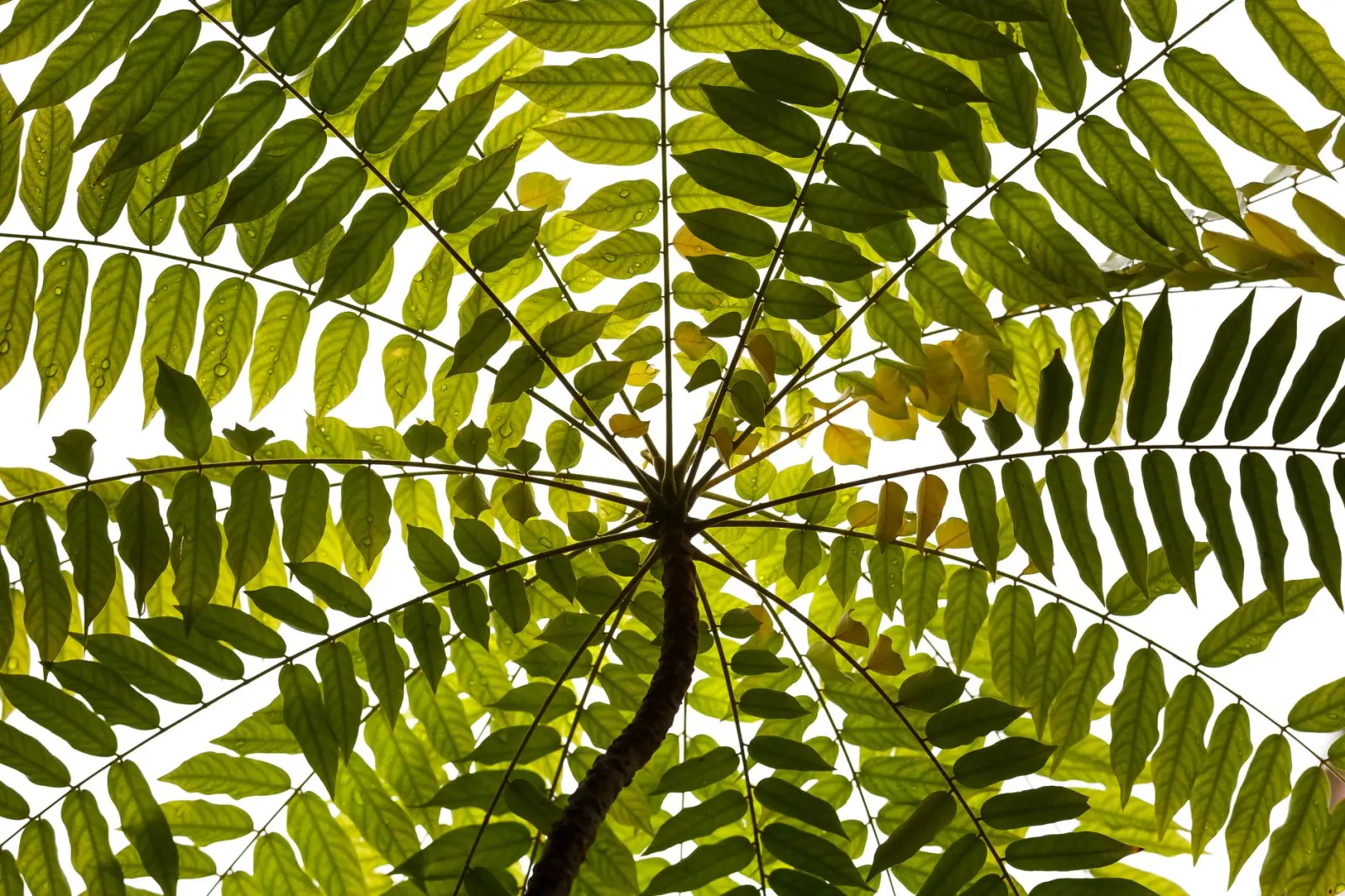
The leaves you see in a rainforest are not random. Many have a distinctive shape and texture that serves a specific function. Drip tips – those pointed extensions at the leaf apex – are perhaps the most visible adaptation. I’ve watched water run off these tips during heavy rain, and the effect is deliberate. The pointed shape accelerates water movement off the leaf surface, reducing the time moisture sits on the tissue. This matters because fungi and bacteria thrive on wet leaf surfaces. By shedding water quickly, the plant reduces infection risk.
Beyond the drip tip, many rainforest leaves have a waxy or glossy upper surface. This cuticle is thicker and more hydrophobic than leaves from drier climates. The waxy layer repels water and slows water absorption through the leaf surface. Some plants develop a silvery or reddish tint on new growth, which comes from a reflective coating that also aids water shedding. The underside of the leaf often has a different texture – sometimes hairy or with a powdery coating – which serves a different purpose: it allows the stomata (the pores through which the plant breathes and loses water) to function even when surrounded by moisture.
Root Systems and Fungal Relationships
Underground, the adaptation becomes even more intricate. Rainforest soils are often waterlogged or near saturation. Roots that sit in constant moisture face oxygen depletion and root rot. Many rainforest trees have developed shallow, spreading root systems rather than deep taproots. Buttress roots – those large, wing-like structures you see at the base of large trees – serve multiple functions: they provide structural support on shallow soil, but they also increase the surface area exposed to air. The plant essentially spreads its roots horizontally to access oxygen in the upper soil layers and leaf litter.
Perhaps more important than the root structure itself is the relationship between roots and fungi. Most rainforest plants form mycorrhizal associations with fungi that colonize their roots. The fungus extends into the soil and brings water and nutrients to the plant, while the plant provides sugars to the fungus. In high-humidity environments, this partnership becomes critical. The fungus acts as an intermediary that helps the plant absorb nutrients from the nutrient-poor, waterlogged soil while also providing some protection against root pathogens. I’ve observed that plants without these fungal partners struggle in rainforest conditions, even when all other factors seem favorable.
Transpiration and Humidity Gradients
One overlooked aspect of rainforest plant physiology is how they manage transpiration – the loss of water through leaves. In a dry climate, plants minimize transpiration to conserve water. In a rainforest, the problem is reversed. The air is already saturated with moisture, so the vapor pressure gradient between the leaf and the air is minimal. This means water doesn’t evaporate readily from the leaf surface, which would normally cool the plant and allow nutrient transport through the xylem.
To cope with this, rainforest plants have evolved leaves with a higher density of stomata, often positioned to catch any slight air movement. Some species have leaves that are thinner and more delicate than you’d expect, which allows for more efficient gas exchange even in still, humid air. The plant essentially trades the structural robustness you see in sun-exposed plants for the physiological flexibility needed to function in constant moisture. Interestingly, many rainforest plants also develop leaves that are smaller and more numerous than their temperate relatives, which may relate to managing the balance between photosynthesis and the risk of fungal infection on large leaf surfaces.
Epiphytes and Aerial Strategies
Not all rainforest plants root in soil. Epiphytes – plants that grow on other plants – represent a different adaptation strategy entirely. Orchids, bromeliads, ferns, and mosses drape the branches of large trees, sometimes so densely that the host tree’s own leaves are obscured. These plants have adapted to life in the canopy where air movement is greater and humidity, while still high, allows for better water regulation. Their roots are often reduced or specialized for gripping rather than absorbing water. Instead, many epiphytes have evolved waxy leaves or specialized structures that collect and store water, allowing them to survive the brief dry periods that occur even in rainforests.
Bromeliads, in particular, have developed a tank-like structure at their base where water collects. This water serves dual purposes: it provides moisture during drier spells, and it creates a microhabitat for insects and other organisms. The plant absorbs nutrients from the decomposing matter in this water tank rather than relying solely on soil nutrients. This adaptation speaks to a broader pattern in rainforest plants: they often supplement nutrient uptake through alternative pathways because rainforest soils, despite being wet, are often nutrient-poor due to rapid decomposition and leaching.
What becomes clear after years of observing these plants is that high humidity doesn’t simply mean “wet conditions.” It means constant pressure from fungi and bacteria, reduced water gradients for transpiration, nutrient-poor soils, and limited oxygen availability. The plants that thrive here have not evolved to love moisture but rather to manage its challenges with precision. Their leaves shed water deliberately. Their roots spread shallow and partner with fungi. Their stomata remain functional despite the lack of evaporative pressure. These aren’t dramatic adaptations – there are no carnivorous mechanisms or extreme structural innovations. Instead, they represent thousands of small refinements that, collectively, allow a plant to persist in an environment that seems designed to rot it.