
After spending years working in tropical rainforests, you notice something that surprises most first-time visitors: the ground isn’t a waterlogged swamp everywhere. Yes, it’s wet. Yes, it’s humid. But the forest floor often feels surprisingly firm, and the massive trees overhead seem entirely unconcerned about the rainfall that would flatten a temperate forest. There’s a reason for that. Rainforest trees don’t just tolerate extreme rainfall – they’ve engineered themselves to thrive in it, and understanding how reveals something fundamental about how plants adapt to their environment.
The sheer volume of water falling in a tropical rainforest is difficult to grasp without being there. Some regions receive 400 inches annually. That’s not just rain; it’s a relentless hydrological assault. A single storm can drop several inches in hours. Yet the canopy remains intact, the trees stand firm, and the forest continues functioning. This isn’t luck or accident. It’s the result of millions of years of refinement in how wood grows, how roots anchor, and how water moves through the system.
Leaf Architecture and Water Shedding
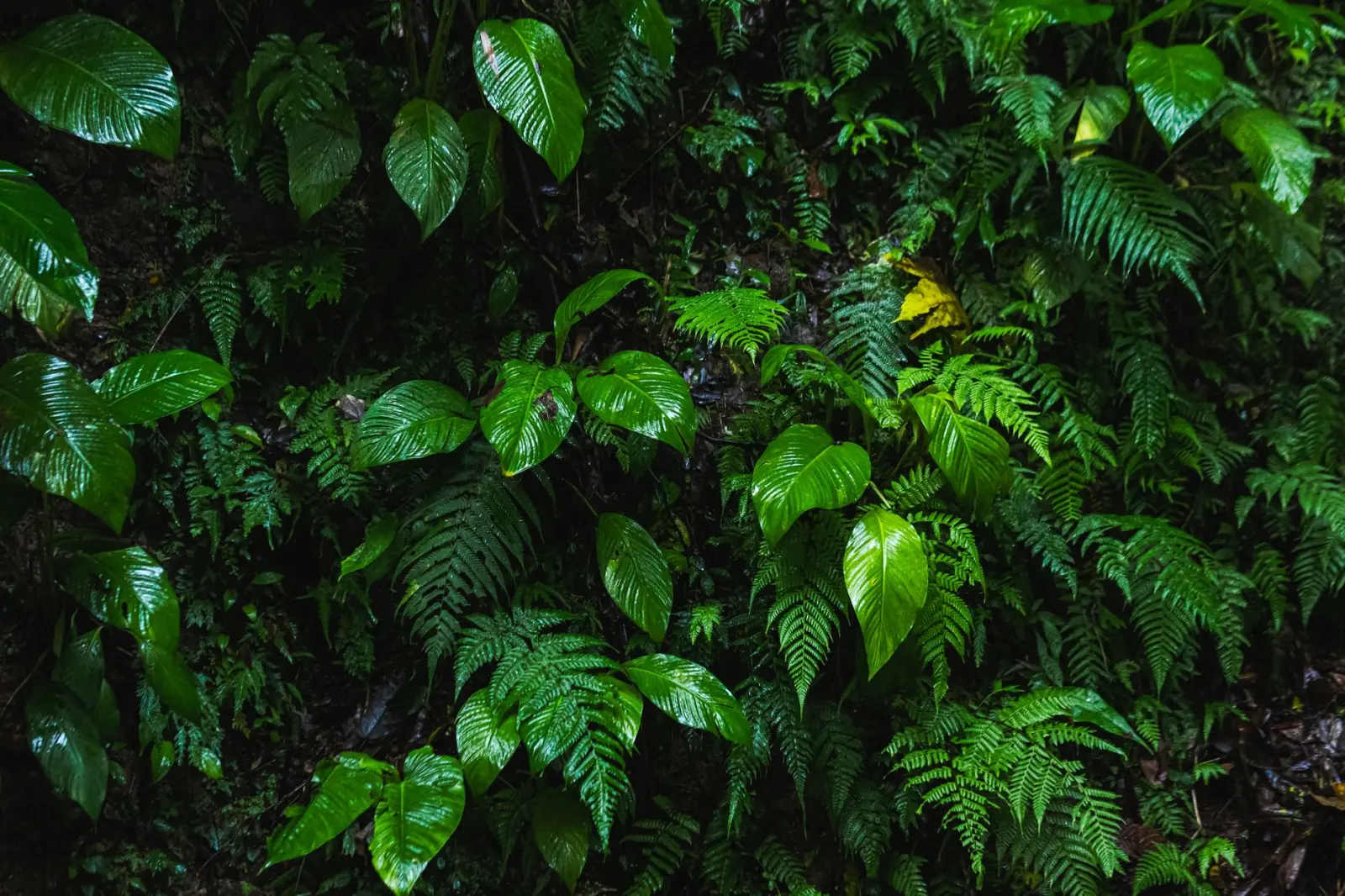
The first line of defense happens at the leaf level. Rainforest leaves are notably different from what you see in temperate forests. They’re typically larger, with a waxy, glossy surface and a pronounced pointed tip called a drip tip. That pointed extension isn’t decorative. It channels water off the leaf surface quickly, preventing water from pooling and damaging the leaf tissue underneath. The waxy coating, called a cuticle, reduces water absorption and encourages runoff rather than saturation.
What’s less obvious is the angle at which leaves hang. In rainforests, you’ll notice leaves are often oriented at angles that shed water efficiently rather than presenting flat surfaces to catch it. This isn’t random positioning. The petiole – the stem connecting the leaf to the branch – has a specific flexibility that allows leaves to adjust their angle with wind and water pressure, naturally shedding excess moisture. Leaves in heavy rain essentially redirect water downward and outward rather than absorbing it, which would damage the leaf and create weight stress on the branch.
Wood Structure and Density
The wood itself is fundamentally different from temperate forest timber. Rainforest hardwoods are typically denser and heavier than their northern counterparts. This density serves multiple purposes. First, it provides structural rigidity. When a tree is constantly saturated with water and exposed to wind, the additional weight of moisture means the wood needs to be stronger to avoid snapping. A lighter wood would fail under the combined stress of its own water content plus wind loading.
The cellular structure of rainforest wood also tends to have tighter grain patterns and less variation between seasons. Temperate trees have distinct growth rings because they experience dormancy in winter. Rainforest trees grow year-round, which creates more uniform wood structure. This uniformity actually improves resistance to splitting and cracking – problems that plague less dense woods when they’re repeatedly soaked and then partially dried.
I’ve observed that rainforest trees rarely show the radial cracks you see in freshly cut temperate hardwoods. That’s not because the wood is impervious to moisture stress, but because the cellular structure accommodates moisture movement more evenly. The wood swells and shrinks, but it does so in a way that doesn’t create the stress concentrations that lead to failure.
Root Systems and Soil Anchoring
Below ground, the strategy shifts. Rainforest soils are often surprisingly shallow when you dig into them. The bedrock or clay layer can be only a few feet down. This means rainforest trees can’t rely on deep taproots like many temperate trees do. Instead, they’ve evolved massive, spreading lateral root systems that anchor into the shallow soil layer and spread far from the trunk. Many large rainforest trees develop buttress roots – those distinctive flared bases you see in photographs – which distribute the tree’s weight across a wider area and provide additional lateral stability.
The buttress root system is particularly important during heavy rainfall and wind events. When soil is saturated, it loses cohesion. The friction that normally holds soil in place decreases dramatically when water fills the pores. Buttress roots act as guy-wires, anchoring the tree across a much larger footprint than a narrow trunk could manage. I’ve seen trees over 150 feet tall standing in soil that’s essentially mud, held upright by root systems that extend 40 or 50 feet from the trunk in multiple directions.
Root density in rainforest soil is also higher than most people expect. The soil is full of fine roots from multiple trees, creating a kind of network that stabilizes the entire soil matrix. When one tree’s roots intertwine with its neighbors, the whole community becomes more resistant to failure. A single tree might not stand in saturated soil, but a forest of trees with interlocking root systems creates mutual support.
Water Movement and Drainage
The forest floor itself is engineered for drainage. Rainforest soils are rich in organic matter – fallen leaves, branches, and decomposing wood – which creates a porous, spongy layer. This layer acts as a buffer, absorbing water quickly and holding it temporarily, then releasing it gradually. This prevents the kind of surface runoff and erosion you’d see in bare soil. The water soaks in, moves through the organic layer, and drains into the mineral soil below.
What’s critical is that this drainage happens despite the heavy rainfall. The soil structure, maintained by constant organic input and root activity, stays permeable even when saturated. Temperate forest soils can become compacted and waterlogged, but rainforest soils remain relatively open because they’re constantly being worked by decomposition and root growth. The forest essentially maintains its own drainage infrastructure.
Trees also manage water actively. Rainforest trees transpire enormous amounts of water – they pull moisture up from the soil and release it through their leaves. On a humid day in the rainforest, you’re often breathing air that’s been humidified by tree transpiration. This water loss from the tree actually helps prevent waterlogging of the root zone. The tree is pulling water out of the soil as fast as it’s falling from the sky, creating a kind of equilibrium.
Branch Structure and Load Distribution
The branching pattern of rainforest trees is also adapted to extreme rainfall. Branches tend to be thick and relatively short compared to temperate forest trees, with multiple branches splitting off at wide angles rather than narrow angles. This geometry distributes stress more evenly. A narrow-angle branch fork is a stress concentration point – exactly where you’d expect failure when loaded with water and wind. Wide-angle forks distribute the load across a larger area of wood.
I’ve noticed that rainforest trees rarely have the long, slender branches you see in temperate forests. The branching is more compact, more robust. This isn’t just about aesthetics or light competition. It’s about mechanical engineering. A tree that’s going to live in an environment where branches regularly carry several hundred pounds of water needs architecture that won’t fail under that load.
The canopy structure itself reflects this adaptation. Rainforest canopies are often more open and layered than they appear from the ground. There’s space between branches, allowing wind to pass through rather than creating a solid wall of resistance. This reduces the overall wind loading on the tree. A dense, solid canopy would catch more wind force; a more open structure lets wind flow through with less resistance.
After years of observing these systems, what stands out is how integrated the adaptations are. It’s not one feature that allows rainforest trees to handle extreme rainfall – it’s dozens of features working together. The leaf architecture sheds water efficiently. The dense wood provides strength. The shallow, spreading root system anchors the tree. The soil structure drains properly. The branching geometry distributes loads. The transpiration rate pulls water from the soil. Remove any one of these, and the system becomes vulnerable. Together, they create a forest that doesn’t just survive in one of Earth’s wettest environments – it thrives in it.