
Spend enough time working in or studying tropical mountain regions, and you begin to notice a pattern that seems almost mechanical in its consistency. Around a certain elevation – often between 1,000 and 3,000 meters depending on latitude and proximity to ocean – the landscape shifts. The air thickens with moisture. Visibility drops. Trees become gnarled and moss-laden. This is not random weather. It is the result of a predictable collision between geography and atmospheric physics that happens the same way, year after year, in the same locations.
The foundation of cloud forest formation rests on a simple geographic fact: warm air holds more moisture than cold air. When that warm, moisture-laden air encounters a mountain slope and is forced upward, it cools as it rises. This cooling happens at a reliable rate – roughly 6.5 degrees Celsius per kilometer of elevation gain in dry air, slightly slower in humid air. As the air cools, it eventually reaches its dew point, the temperature at which it can no longer hold all its water vapor. At that moment, water condenses into visible cloud droplets. The mountain itself does not create the moisture; it simply forces the air upward into conditions where condensation becomes inevitable.
The Role of Prevailing Winds and Exposure
Which slopes actually develop cloud forests depends heavily on wind direction and mountain orientation. In most tropical regions, trade winds or monsoon patterns push moisture-laden air toward specific mountain faces. The windward side of a mountain – the side facing the prevailing wind – intercepts this moist air directly. Air is forced up the slope, cools, and condenses into clouds that may persist for hours or even most of the day. The leeward side, by contrast, receives air that has already lost much of its moisture on the windward ascent. This creates a rain shadow effect, and cloud forests rarely establish there.
I have observed this asymmetry countless times in Central America and the Andes. On the Caribbean-facing slopes of Costa Rican mountains, cloud forests are dense and lush at mid-elevations. Cross the ridge to the Pacific side, and the vegetation becomes drier and more sparse at the same elevation. The difference is not soil quality or sunlight; it is the direction from which the wind arrives. A mountain range oriented north-south will have very different cloud forest distribution than one oriented east-west, simply because the prevailing wind direction determines which slopes receive the steady influx of moist air.
Elevation, Temperature, and the Condensation Zone
Cloud forests do not form at all elevations. They require a specific window where conditions align. Near sea level, even on mountains, the air is typically too warm for condensation to occur as readily, and any clouds that form tend to dissipate quickly. At very high elevations – above 3,500 or 4,000 meters in many tropical regions – the air becomes so cold and dry that moisture is scarce, and clouds may be present but sparse vegetation suggests harsh conditions. The cloud forest sweet spot falls in between, where the air is cool enough to condense moisture regularly but warm enough to support dense plant growth.
The specific elevation where this occurs varies with latitude. Near the equator, cloud forests typically form higher up the mountain than they do in subtropical regions. A mountain in Ecuador might have cloud forest starting around 2,000 meters, while a similar mountain in southern Mexico might show the same ecosystem at 1,200 meters. This is because equatorial regions have warmer air even at high elevations, requiring greater altitude to cool the air sufficiently for condensation. Proximity to ocean also matters. Mountains near coasts have more readily available moisture in the air, so cloud forests can form at lower elevations than mountains in continental interiors.
Persistent Cloud Cover and Its Ecological Consequence
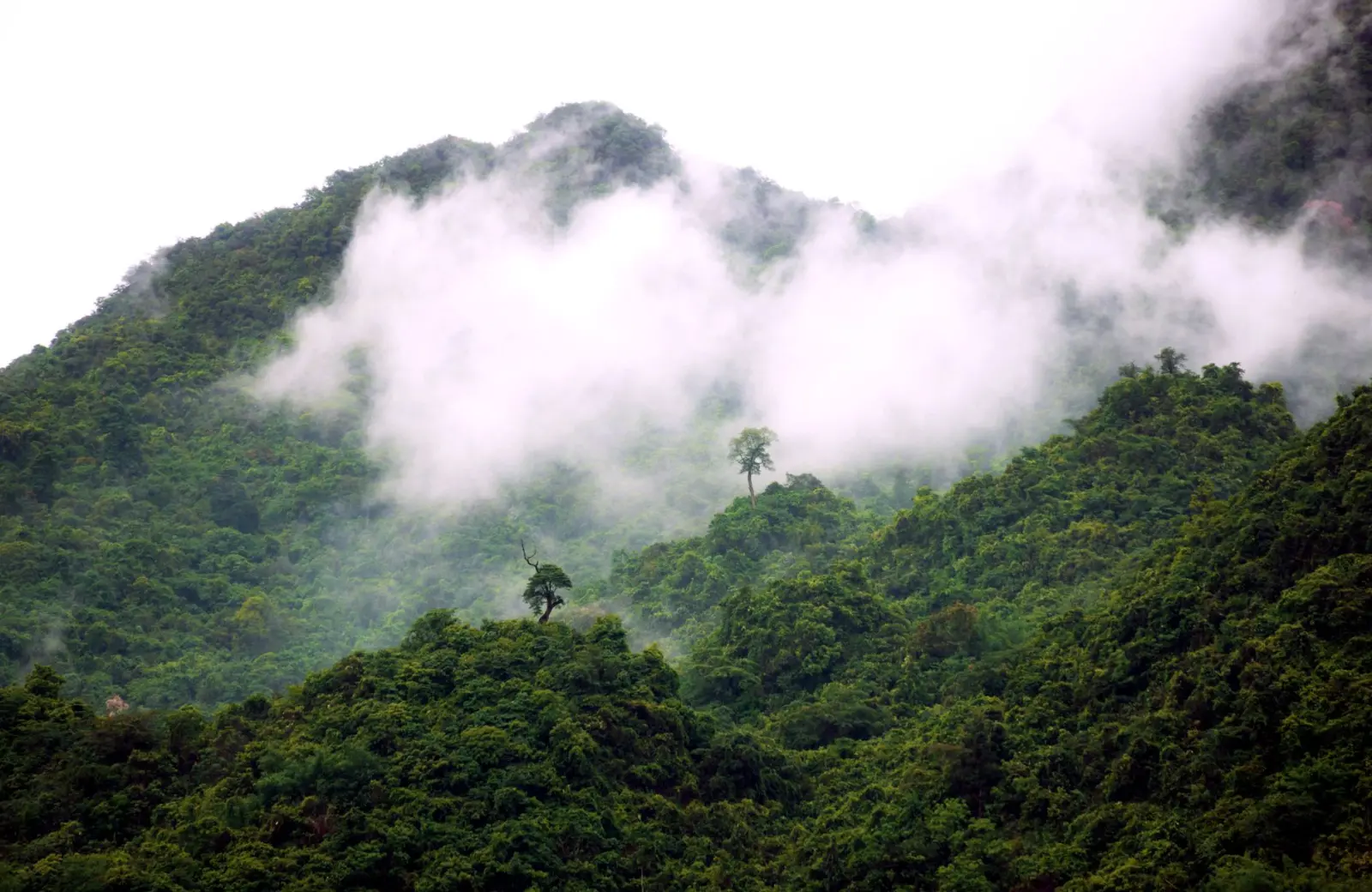
What distinguishes a true cloud forest from other mountain forests is not occasional cloud cover but persistent cloud immersion. In a cloud forest, the vegetation spends a substantial portion of the day – often 6 to 12 hours or more – literally within the cloud layer itself. This is not metaphorical. The trees are wet. Visibility is reduced to tens of meters. The air feels saturated. This persistence happens because the mountain continues to force air upward throughout the day, and as long as that air is moist enough and the temperature is right, condensation continues.
This constant cloud immersion reshapes the entire ecosystem. Plants in cloud forests do not rely solely on rainfall reaching the soil; they absorb moisture directly from the cloud droplets that settle on their leaves and branches. Epiphytes – plants that grow on other plants without parasitizing them – thrive in these conditions because they have constant access to atmospheric moisture. Mosses, lichens, and orchids cover tree trunks and branches in thick mats. The canopy itself becomes a sponge, intercepting water from clouds and dripping it to the forest floor. In some cloud forests, this cloud-water interception contributes as much moisture to the ecosystem as actual rainfall.
The temperature regime in a cloud forest also differs from the surrounding lowlands. Cloud cover acts as a blanket, reducing daytime heating and nighttime cooling. Temperatures remain relatively stable and moderate. This stability, combined with high moisture, creates conditions where decomposition slows and organic matter accumulates. Soils in cloud forests tend to be rich and acidic, often with thick layers of leaf litter and humus. The reduced light penetration – clouds block significant solar radiation – means plants have adapted to thrive in shade, with larger leaves and slower growth rates than their lowland relatives.
When Conditions Shift or Fail
Cloud forests are not static. They respond to changes in wind patterns, ocean temperature, and atmospheric moisture. During dry seasons or drought years, the air flowing toward mountains may be less humid, and cloud formation becomes sporadic. The cloud forest does not disappear, but it experiences stress. Epiphytes dry out. Decomposition accelerates. The ecosystem shifts toward conditions more typical of drier forests. Conversely, during particularly wet seasons or when ocean temperatures are elevated, cloud immersion may intensify, and the cloud forest becomes even more lush.
Elevation changes in cloud forest boundaries have been documented in response to climate patterns. In some regions, the lower boundary of cloud forests has shifted upward over recent decades, a sign that either the air is becoming drier or the mountain slopes are warming enough that condensation occurs at higher elevations. This is not a trivial shift; it compresses the habitat available for cloud forest species, many of which have narrow elevation ranges and cannot easily migrate to new locations.
Understanding cloud forest formation requires recognizing that these ecosystems are not permanent fixtures but rather the temporary outcome of specific atmospheric conditions meeting specific geography. The mountain does not create the moisture or the clouds; it intercepts and concentrates them. The forest that grows there is a response to that concentration, a living system adapted to a climate of perpetual dampness and moderate temperatures. When the wind patterns shift, when ocean temperatures change, or when the atmosphere warms, the conditions that sustain cloud forests can shift as well. This is why these ecosystems, for all their apparent permanence and density, remain fundamentally dependent on the precise alignment of forces that created them.