
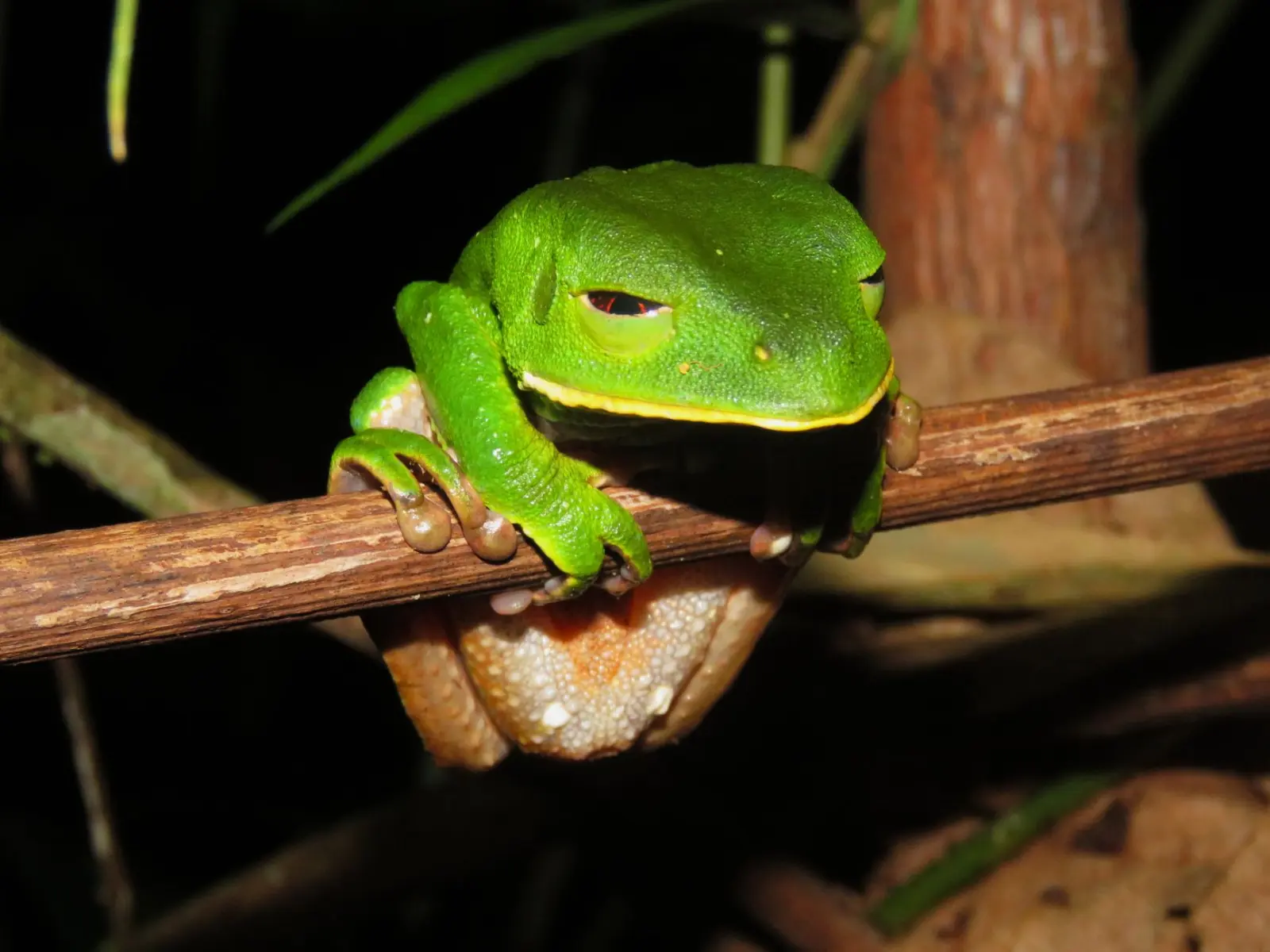
After spending years observing amphibians in rainforest environments across Central America and Southeast Asia, I’ve noticed something that becomes obvious once you start paying attention: frogs are among the first creatures to vanish when something goes wrong. Not because they’re weak, but because their entire physiology is calibrated to a very narrow set of conditions. When those conditions shift, even modestly, their bodies simply cannot keep pace.
The sensitivity isn’t random. It’s built into their biology at a fundamental level. Frogs lack the physiological buffers that many other animals possess. They have no fur for insulation, no blubber layer, no ability to regulate water loss through their skin the way reptiles can. Their skin is permeable – it’s how they breathe, how they absorb water, and how they interact with their chemical environment. That same permeability that allows them to thrive in a stable rainforest becomes a liability the moment conditions destabilize.
Temperature is perhaps the most obvious pressure point. Rainforest frogs evolved in environments where daily temperature variation is minimal. The canopy buffers extremes. In many tropical regions, the difference between the warmest and coolest part of a day might be only 5 to 8 degrees Celsius. A frog’s metabolism is tuned to this consistency. When you introduce even a 2 or 3 degree shift in average temperature, it disrupts their breeding cycles, their feeding behavior, and their immune function. I’ve watched populations decline noticeably during unusually warm dry seasons, not because frogs died directly from heat, but because the timing of their breeding no longer aligned with the emergence of the insects they depend on for food.
Moisture and the Skin Problem
Water availability and humidity levels are equally critical. Rainforest frogs don’t drink water in the way mammals do. They absorb it through their skin. If humidity drops below a certain threshold – and this varies by species but often hovers around 70 to 80 percent – frogs begin to desiccate. The process is gradual and insidious. A frog won’t necessarily collapse immediately, but its body becomes stressed. Its ability to fight off fungal infections weakens. Its reproductive capacity declines. I’ve observed frogs in areas experiencing longer dry seasons developing skin lesions and infections that wouldn’t occur in more stable conditions.
This vulnerability to moisture changes has a cascading effect. Rainforest canopy structure determines humidity levels on the forest floor. When trees are removed or when the forest canopy thins due to drought or disease, humidity drops. The frogs don’t migrate to better conditions – they’re territorial and site-faithful. They stay in their territories and gradually weaken. The decline often happens slowly enough that it’s invisible to casual observation, but if you return to a site year after year, the absence becomes undeniable.
Chemical Sensitivity and Pollution
Frogs are also extraordinarily sensitive to chemical changes in their environment. Their permeable skin means they absorb whatever is in the water and air around them. Agricultural runoff, pesticides, heavy metals – these don’t just contaminate the water where frogs live. They enter the frogs’ bodies directly through their skin. I’ve documented population crashes in areas adjacent to agricultural development where pesticide use intensified. The frogs didn’t necessarily die from acute poisoning. Instead, their immune systems were compromised, making them vulnerable to the chytrid fungus, a pathogen that has devastated amphibian populations worldwide.
The fungus itself is a useful example of how environmental stress multiplies problems. Chytrid thrives in certain temperature and moisture conditions. A healthy frog with a robust immune system can often resist infection. But a frog already stressed by suboptimal conditions – slightly warmer temperatures, lower humidity, chemical exposure – becomes susceptible. The pathogen then spreads rapidly through a weakened population.
Breeding Cycles and Phenological Mismatch
Rainforest frogs have evolved breeding patterns synchronized with seasonal rainfall and the availability of food resources. Many species breed during specific months when humidity is high and insects are abundant. If rainfall patterns shift – arriving later, ending earlier, or becoming more erratic – the frogs’ breeding cycles become misaligned with the availability of food for tadpoles. I’ve observed breeding events where tadpoles hatched into ponds that dried up weeks earlier than in previous years, or where the emergence of small insects that tadpoles feed on was delayed relative to hatching. The result is mass tadpole mortality, and an entire breeding cohort is lost.
This phenological mismatch is subtle but devastating over time. A single failed breeding season might not eliminate a population, but repeated failures across several years do. The population ages without sufficient recruitment of young frogs to replace mortality. Within a decade, what was once a thriving population becomes a handful of elderly individuals.
What makes frogs particularly valuable as environmental indicators is that they experience these pressures before most other animals. Birds can move. Mammals can adjust their behavior or migrate. Frogs, by virtue of their biology and their site fidelity, are trapped. Their decline is an early warning signal that conditions have shifted beyond the tolerance range of the ecosystem. By the time you notice frogs disappearing, you’re already looking at an environment that has fundamentally changed from its historical baseline.
The practical reality I’ve encountered repeatedly is that rainforest frog populations are not resilient to rapid environmental change. They’re exquisitely adapted to stability. In a world where that stability is increasingly rare, their sensitivity becomes a liability rather than an asset. Understanding why they fail – not as a moral question, but as a biological one – is essential to understanding what’s happening to the rainforests themselves.