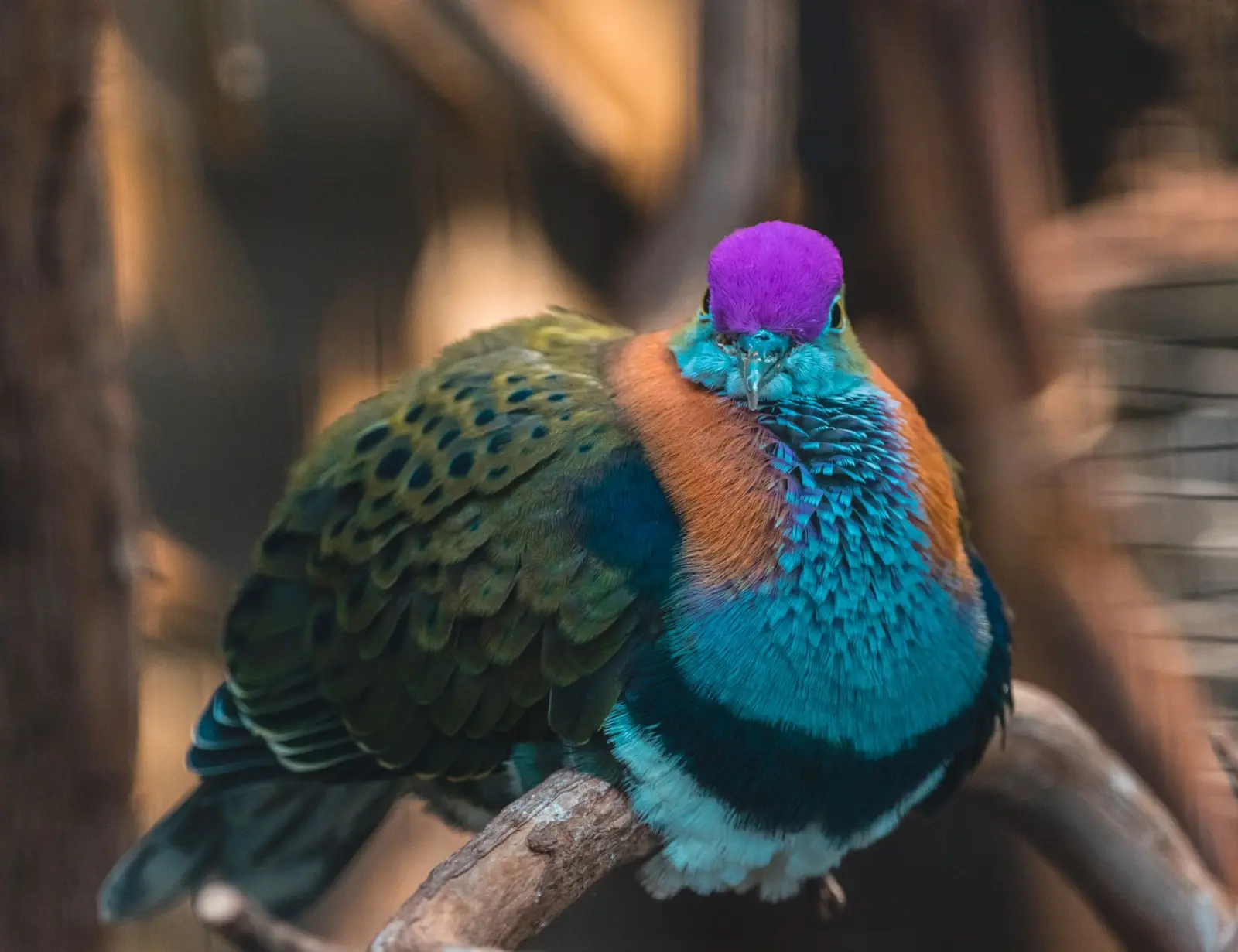
Wompoo fruit-doves are one of those birds that most people never see, even when they’re present. I’ve spent considerable time in Australian rainforests – particularly in north Queensland and parts of New South Wales – and the wompoo is a bird that rewards patience but punishes carelessness. They’re large for a dove, with a deep purple body and that distinctive pale yellow-green chest that catches light in a particular way. Once you’ve seen one, the silhouette stays with you, but getting to that first sighting often takes longer than visitors expect.
The fundamental challenge with wompoo fruit-doves is that they’re canopy feeders. They spend most of their time in the upper levels of rainforest, moving between fruiting trees – figs, native peppers, and various rainforest fruits that most people wouldn’t recognize. This means they’re often above eye level, obscured by dense foliage, and visible only when they move between trees or when light catches them at the right angle. Unlike many Australian birds that forage on the ground or in mid-story vegetation, wompoos require you to look up, to wait, and to understand the rhythm of fruiting cycles in the forest.
Timing and Seasonal Patterns
Wompoos are most active and visible during fruiting season, which varies depending on the specific rainforest type and location. In my experience, late spring through early autumn tends to be more productive, though this isn’t absolute. The birds move according to fruit availability, not according to a calendar. I’ve had seasons where wompoos were abundant in June and seasons where July was nearly silent. This inconsistency frustrates people who expect wildlife to follow predictable schedules.
Early morning is genuinely the best time to observe them, though not in the way people typically imagine. It’s not that wompoos are exclusively active at dawn – they feed throughout the day. Rather, the forest is quieter, your own fatigue is lower, and you’re more likely to notice movement and sound. The birds make a distinctive deep, resonant call – a series of low, almost owl-like notes – and hearing this call often precedes seeing the bird by several minutes. By mid-morning, the forest fills with other bird calls and insect noise, making wompoos harder to locate by ear.
Behaviour and Feeding Ecology
What strikes me most about wompoo behaviour is their deliberate, almost methodical approach to feeding. They’re not frantic like smaller frugivores. A wompoo will land on a fruiting tree, settle for a moment, feed quietly, then move on. They often perch for longer than you’d expect, which gives you time to locate them if you’re patient. The problem is that this patience needs to be active – you can’t simply stand in one spot and wait. You need to move slowly through the forest, stop frequently, listen, and scan the canopy systematically.
They’re also surprisingly wary. A wompoo will detect your presence before you see it, and they’ll move away quietly rather than make a dramatic escape. I’ve watched birds slip through the canopy with barely a sound, visible for only a second or two before they’re gone. This isn’t aggression or panic – it’s simply how they navigate their environment. If you crash through the undergrowth or make sudden movements, you’ll push them out of the area entirely.
Habitat Requirements and Distribution
Wompoos need intact rainforest with mature fruiting trees. This is non-negotiable. They’re found in rainforest from the Atherton Tablelands in Queensland south through to northern New South Wales, but their presence depends entirely on forest quality and fruit availability. Fragmented or degraded rainforest supports fewer birds. I’ve returned to rainforest patches I knew well five or ten years earlier and found wompoos absent – not because the birds had moved far, but because the fruiting trees had been damaged or the forest structure had changed.
The birds are sedentary to semi-nomadic depending on conditions. During good fruiting years, they establish territories and stay relatively put. During lean years, they move more extensively, and you might find them in areas where they weren’t present the previous season. This creates real difficulty for anyone trying to predict where to find them. Local knowledge – talking to rangers, other birdwatchers, or people who work in the forest regularly – is genuinely more valuable than any guidebook.
Practical Considerations for Observation
Rainforest walking is physically demanding in ways that aren’t always obvious beforehand. The ground is uneven, often wet, and visibility is restricted. You need proper footwear with good grip, and you need to move slowly enough to avoid injury and to actually notice birds. Many people rush through rainforest, thinking that covering more ground will increase their chances of seeing wildlife. The opposite is true. Slow movement, frequent stops, and genuine attention to the environment yield better results.
Binoculars are essential, but they need to be relatively lightweight and fast-focusing. Rainforest canopy watching involves a lot of scanning and adjusting, and heavy optics become a liability. I’ve also found that listening matters more than looking when it comes to wompoos. Learning their call – that deep, resonant series of notes – transforms your ability to locate them. Once you hear a bird, you have a starting point for visual searching.
Weather affects visibility significantly. Overcast days are often better than bright sunny days because the light is more even and the birds are less likely to be silhouetted. Heavy rain tends to suppress activity, though wompoos will still feed in light rain. The worst conditions are bright, clear mornings when the canopy is backlit and birds become nearly invisible against the sky.
Wompoo fruit-doves are ultimately a bird that requires investment – time, patience, and genuine attention to the forest environment. They’re not rare, but they’re not easy, and that combination makes them rewarding when you finally get a clear sighting. Understanding that this is a canopy bird, that they move according to fruit availability, and that observation requires slow, attentive movement through difficult terrain sets realistic expectations. Once those expectations are in place, the rainforest becomes a more coherent place to navigate, and the birds become less mysterious and more simply present.