There’s a particular quality to rainforests before 7 a.m. that most visitors never experience. The air sits heavy and cool. Bird calls haven’t yet merged into the afternoon cacophony. Insects are still moving slowly. If you’ve done this a handful of times across different regions, you start to notice patterns – which walks actually reward an early start, which ones don’t, and what separates a genuinely useful dawn excursion from a miserable pre-dawn slog that leaves you exhausted by mid-morning.
The fundamental reason people wake up early in rainforests is straightforward: wildlife is more active and visible when temperatures are lower. Mammals move more freely. Birds call and forage rather than shelter. Insects are easier to spot before the heat drives them into leaf litter and canopy depths. But this advantage only materializes if you’re on the right walk, with realistic expectations about what “early morning” actually means in practice, and with your body adjusted to the local rhythm rather than fighting jet lag and fatigue.
Timing and the Reality of “Early”
When guides or tourism websites mention early morning rainforest walks, they typically mean starting between 5:30 and 6:30 a.m. This isn’t arbitrary. Sunrise in tropical regions happens quickly – there’s no long twilight period like at higher latitudes. The window between first light and the forest becoming fully active is narrow, maybe 90 minutes at most. Starting later than 6:30 a.m. often means you’ve already missed the peak activity period for many species.
The catch is that actually being ready to walk at 5:30 a.m. requires preparation the evening before. You need to have eaten something light, hydrated without overdoing it, and adjusted your sleep schedule at least two days in advance. Showing up at the trailhead groggy and running on coffee alone is a common mistake. You’ll move slowly, miss details, and likely feel worse by 8 a.m. than if you’d simply started at 7:30 a.m. after a proper breakfast and rest. The guides notice this immediately – tourists who are genuinely ready tend to see more, not because the forest is different, but because they’re alert enough to process what’s happening around them.
Which Walks Justify the Early Start
Not all rainforest trails benefit equally from dawn timing. Walks that pass through open water – oxbow lakes, river edges, or wetland areas – tend to be most rewarding at dawn. Animals come to water to drink before the heat intensifies. The Tambopata Reserve in Peru, particularly the clay lick trails near Puerto Maldonado, genuinely delivers at 5:30 a.m. Macaws, parrots, and other birds descend in visible numbers. The same walk at 8 a.m. is noticeably quieter.
Canopy walkways and elevated trails show different patterns. The Danum Valley in Borneo has several canopy platforms where early morning visits catch primates moving through the mid-story levels. Gibbons call at dawn. Orangutans are occasionally visible in the upper canopy before they settle into feeding. But here, the advantage is less about density of sightings and more about the quality of light and the absence of other visitors. You’re not fighting crowds for space on narrow platforms.
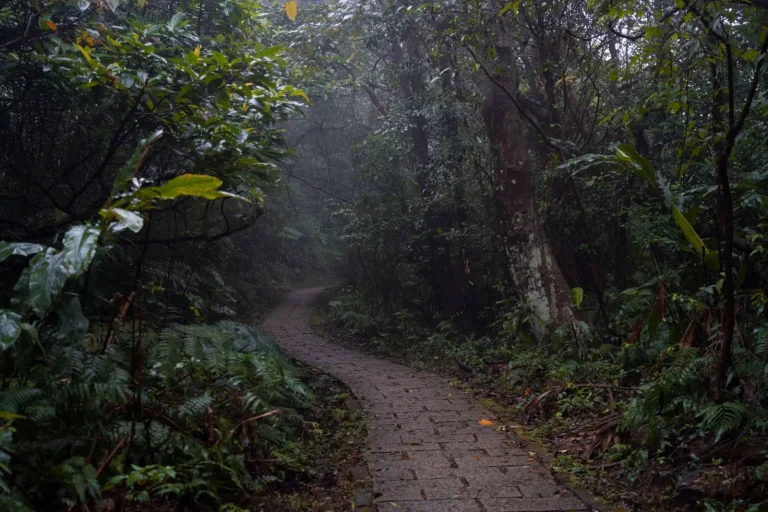
Ground-level forest walks – the majority of rainforest trails – are more variable. A trail through dense primary forest might show you insects, frogs, and occasionally larger mammals at dawn, but the same trail at 10 a.m. will also show you these things, just fewer of them. The experience is different in tone rather than dramatically different in content. If the walk’s primary appeal is the forest environment itself rather than specific wildlife, the early start matters less. If you’re walking to see jaguars or tapirs, dawn is essential. If you’re walking to experience old-growth forest and canopy structure, timing is less critical.
Preparation and Physical Reality
Early morning rainforest walks are physically demanding in ways that aren’t always obvious beforehand. The humidity is often higher before sunrise, not lower. The forest floor is wet from overnight condensation. Your muscles are stiff from sleep. You’re asking your body to move through uneven terrain in low light while simultaneously being alert and quiet enough not to disturb wildlife. This is not a casual stroll.
Proper footwear matters more than most people assume. Slip-resistant boots or trail shoes with good grip are essential, not optional. Wet roots and muddy sections are common. A twisted ankle in a rainforest at 6 a.m., miles from help, is a serious situation. Gaiters or long pants protect your legs from insects and vegetation. A headlamp or flashlight is necessary for the first 30 to 45 minutes, though you’ll use it sparingly to avoid disturbing animals. Bring more water than you think you need – the combination of early exertion and tropical heat means dehydration creeps up quickly.
Insect repellent is worth considering, though its effectiveness is limited. Mosquitoes are generally less active at dawn than at dusk, but they’re present. Some people find that avoiding bright colors and perfumed products helps more than repellent. Biting insects are part of rainforest experience; accepting this rather than fighting it usually leads to a better walk.
Working With Guides and Managing Expectations
The quality of an early morning walk depends heavily on your guide. A good guide knows the specific trail’s patterns – where animals tend to be at different times, which areas are more productive, how to move quietly without being theatrical about it. They also know when to stop and wait versus when to keep moving. Poor guides rush through, talk constantly, or have you backtracking repeatedly because they’re uncertain about the route.
If you’re hiring a guide locally rather than through a tour operator, ask directly about their experience with dawn walks on that specific trail. How many times have they done it? What have they actually seen? Guides who are honest about “we might see birds and insects, but large animals are rare here” are more reliable than those who promise jaguars or sloths. The best guides manage expectations clearly and then deliver experiences that exceed those modest expectations.
Group size matters. A solo walker or pair with a guide will see more and have a different experience than a group of eight. Larger groups move slower, make more noise, and require more management. If you have the option, smaller groups are worth prioritizing. Some of the best rainforest experiences happen when you’re moving with just one other person and a guide who knows the forest well enough to move naturally rather than following a set script.
Regional Variation and Realistic Outcomes
Rainforests vary dramatically by region, and what works in one location doesn’t necessarily transfer to another. The Amazon basin near Iquitos in Peru offers different wildlife and different timing patterns than the Atlantic Forest in Brazil or the rainforests of Central America. Humidity levels, vegetation density, and animal behavior all shift. A guide who’s excellent in one region might be less effective in another.
Southeast Asian rainforests tend to be denser and more challenging to move through than Amazonian forests. Early morning walks here often focus on listening rather than seeing – bird calls, insect sounds, the acoustic landscape. You might walk for two hours and see relatively few animals but hear dozens of species. This is genuinely interesting if you’re prepared for it, frustrating if you’re expecting visual wildlife encounters.
African rainforests are often smaller and more fragmented than South American ones. Early morning walks here sometimes involve longer approach hikes to reach productive areas. You’re not walking through continuous forest but rather moving between patches. This affects both the experience and the realistic timing of the walk.
After years of early morning rainforest walks across multiple continents, the consistent factor isn’t the location or the specific trail – it’s the combination of realistic expectations, adequate physical preparation, and a guide who knows both the forest and how to work with the particular group of people they’re leading. The forest will be there regardless of what time you arrive. Whether you actually connect with it depends on everything else you bring to the walk.