
The dry season in rainforests is often presented as the ideal window for visiting, and there’s truth to that, but the reality is more nuanced than most travel writing suggests. I’ve spent enough time in tropical forests during both wet and dry periods to know that “dry” doesn’t mean what most people think it means. Rain still falls. Trails still flood in places. The difference is one of degree and predictability, not a complete absence of moisture.
The practical advantage of dry season travel is straightforward: accessibility improves. Trails that become impassable mud channels during heavy rains become walkable again. River crossings that require guides and careful planning become routine. Lodges that close seasonally reopen. This matters more than it sounds when you’re actually trying to move through dense forest terrain with limited daylight hours and the constant weight of humidity.
What changes most noticeably is visibility. Canopy cover in rainforests is thick year-round, but during dry months, water levels drop enough that you can see further into the understory. Wildlife becomes slightly easier to spot because animals congregate around remaining water sources rather than dispersing across flooded areas. The forest floor dries out enough that animal tracks become visible, which changes how guides can track and locate wildlife.
The Amazon Basin During Low Water
The Amazon during its dry season, roughly June through November depending on the specific region, presents a different landscape than the flooded forest most people imagine. The rivers recede, and what becomes accessible are the terra firme forests – the upland areas that remain above water year-round. This is where most lodges operate during dry months, and it’s where you’ll actually spend your time hiking and observing.
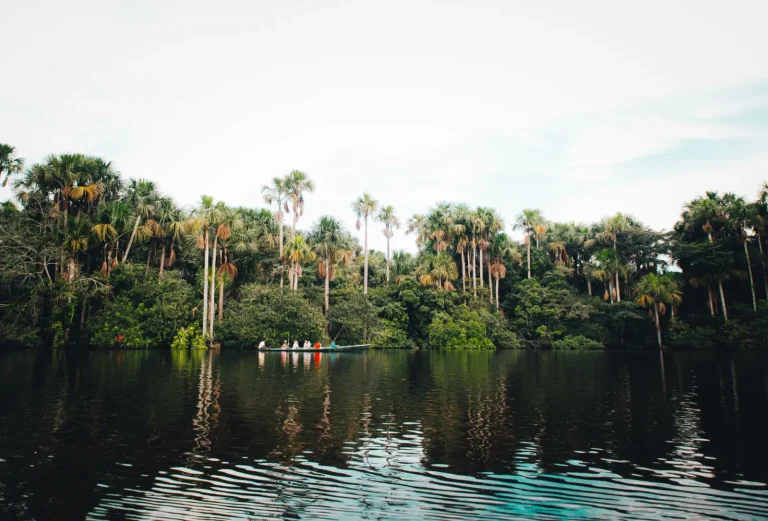
The lower Tambopata region in Peru is representative of what works during this period. The river drops enough that clay licks become accessible – mineral-rich riverbanks where macaws and parrots congregate in the early morning. This isn’t possible during high water. The trails inland from the river become reliably walkable, and the combination of reduced water and concentrated wildlife around remaining water sources makes for more consistent wildlife encounters than you’d get during wetter months.
The limitation here is that you see a different forest. The flooded forest ecosystem – the várzea – is largely inaccessible during dry season. If your interest is specifically in that environment, dry season travel misses it. But for most visitors who want to hike, observe wildlife, and move without constant logistical complications, dry season in the Amazon works better. The trade-off is that you’re seeing perhaps 40 percent of the forest ecosystem rather than the full range.
Southeast Asian Rainforests and the Monsoon Window
Borneo and the Malaysian Peninsula have different dry seasons depending on which coast you’re on. The southwest monsoon (roughly May to September) brings dry conditions to Sabah and Sarawak, while the northeast monsoon (November to March) is better for the peninsula’s east coast. This matters because monsoon patterns here are more pronounced than in the Amazon, and getting the timing wrong means dealing with genuine obstacles.
Kinabalu National Park in Sabah is most reliably accessible during the May-to-September window. The trails don’t become impassable during other months, but the frequency of afternoon storms increases, visibility drops, and the climbing window on the summit narrows significantly. During dry season, you have a realistic 12-hour window for the final ascent without encountering active weather. During wet season, that window shrinks or disappears entirely on many days.
The Danum Valley in Sabah operates year-round, but dry season changes the experience measurably. The forest remains wet – it’s a rainforest – but the constant heavy rain becomes intermittent. This matters for wildlife observation. During heavy monsoon periods, animals shelter more, move less, and are harder to locate. During dry season, they’re more active and visible. The difference in sightings between seasons can be 30 to 50 percent, depending on what you’re looking for.
Central African Rainforests and Accessibility
The Congo Basin has a more complex seasonal pattern than either the Amazon or Southeast Asia. There are two dry seasons of varying intensity depending on location. The main dry season in the northern Congo (June to August) affects places like the Central African Republic and northern DRC, while the southern Congo has a different pattern. This complexity means that “dry season” isn’t a unified concept across the region.
Odzala-Kokoua National Park in the Republic of Congo is most accessible during the June-to-August window. The forest floor dries enough that the network of bai – forest clearings – becomes more accessible. These are critical for observing forest elephants, buffalo, and other large mammals that gather there. During wet season, the bai remain waterlogged and less useful as observation points. The difference in wildlife viewing success is substantial.
What’s often overlooked about Central African rainforests is that accessibility isn’t just about trails and water levels. It’s about road conditions getting to the forest. During wet season, the roads leading to parks can become impassable for weeks at a time. Dry season means you can actually reach the starting point of your visit. This logistical reality affects more trips than the forest conditions themselves.
What Dry Season Actually Changes
The core shifts during dry season are predictable once you’ve seen them a few times. Trails become more reliably walkable. Water-dependent wildlife concentrates in accessible areas. Visibility improves, both for seeing into the forest and for guides to navigate. Lodges operate at higher capacity, which means more guides available and more consistent service. These are real advantages that compound when you’re spending a week or more in the forest.
What doesn’t change is the fundamental nature of rainforests. They remain humid, warm, and wet. Rain still falls during dry season – sometimes heavily. The forest floor remains damp. Insects, fungi, and moisture-dependent organisms continue their normal activity. You’re not stepping into a dry environment. You’re stepping into a rainforest where water levels are lower and rain is less frequent, which is a different thing entirely.
The other reality is that dry season brings crowds. Popular locations like Tambopata in Peru, Kinabalu in Sabah, and major lodges throughout the Amazon operate at full capacity during dry months. This affects the experience. You’re more likely to encounter other visitors on trails. Wildlife may be more habituated to human presence, which can be good for observation but changes the sense of isolation. Some people prefer the quieter, wetter season precisely because fewer people are there, despite the logistical complications.
Timing within the dry season matters as much as choosing the dry season itself. Early dry season, when the transition is recent, often offers the best combination of accessibility and lower crowds. Mid-dry season brings peak accessibility but also peak tourism. Late dry season can see trails drying out so much that dust becomes an issue, and some water sources dry up entirely, which concentrates wildlife but also concentrates visitors.
The practical reality is that dry season works well for most visitors because it reduces logistical friction. You spend less time dealing with obstacles and more time actually observing the forest. Whether that trade-off is worth it depends on what you’re trying to see and how much you value solitude over convenience. But the accessibility improvement is real, measurable, and consistent across rainforest regions.