

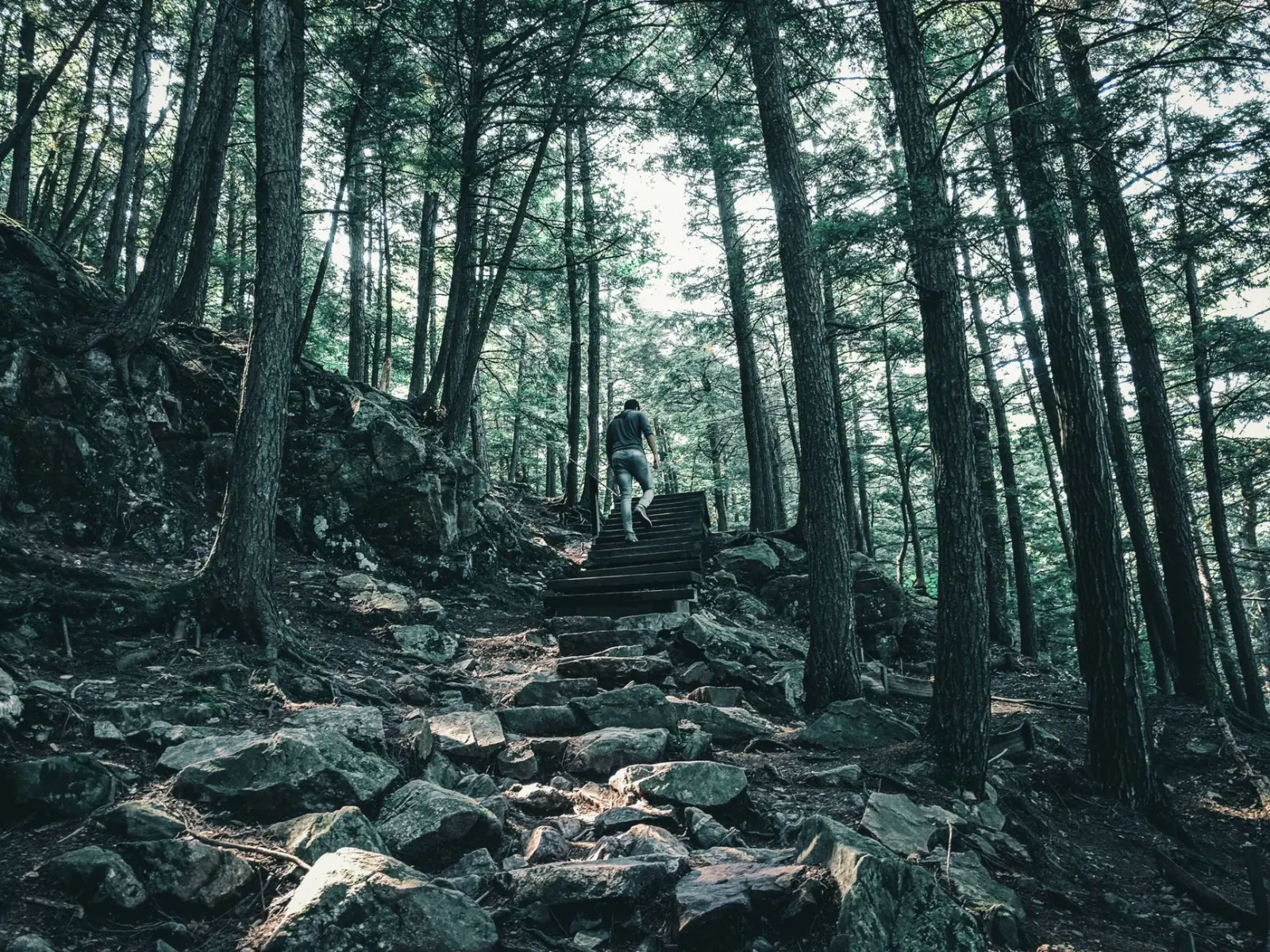
The forest around Moran Falls operates on its own logic. After spending considerable time moving through these woods – both during peak season and in the quieter months – I’ve come to recognize patterns that don’t always appear in standard trail descriptions. The landscape here isn’t hostile, but it demands respect and a realistic understanding of what you’re actually walking into.
The immediate area surrounding the falls sits in a temperate rainforest environment. This means the ground underfoot is almost always damp, even when it hasn’t rained recently. The forest floor is thick with moss, decomposing vegetation, and organic matter that creates a spongy, unstable surface. Your footing is never quite as secure as it feels on a maintained trail. Roots cross the path constantly, and they’re often hidden beneath a thin layer of moss or leaf litter. People regularly underestimate this. They walk with the same stride they’d use on a paved surface and find themselves catching a toe or losing balance unexpectedly.
Water management is the dominant feature of this forest. Streams and seepage are everywhere. Even on dry days, water runs through the landscape in ways that aren’t immediately obvious. Gullies that look shallow can become swift channels after rain. The forest canopy is dense enough that rain reaches the ground in a diffuse way, but water still accumulates rapidly in low areas. I’ve seen people surprised by how quickly a small creek rises or how muddy a seemingly dry patch becomes after an hour of steady rainfall.
Seasonal Shifts and Visibility
Winter and early spring transform the forest significantly. The canopy is thinner, which initially seems like it would improve visibility. Instead, the reduced overhead cover means more light reaches the forest floor, and the undergrowth becomes denser and more tangled. Ferns, young trees, and brambles fill spaces that appear more open from a distance. In late autumn and winter, fallen branches accumulate on the ground, creating a cluttered surface that makes forward movement slower and more deliberate.
Summer brings a different problem. The canopy fills in completely, and the forest becomes genuinely dark in the midday hours. Shadows are deep, and depth perception becomes unreliable. Moss-covered rocks and logs blend into the surrounding vegetation. The undergrowth is lush but also conceals uneven ground. People moving through in summer often move faster because the visibility seems clearer, but the ground is actually more treacherous.
Late spring and early summer are when the forest is most navigable. The canopy is full but not yet creating deep shadow, and the ground has dried enough to be reasonably stable. This is also when most people attempt longer explorations, which means the informal trails become more defined simply from foot traffic.
Trail Conditions and Informal Routes
There’s no single, officially maintained trail network around Moran Falls. Instead, you encounter a web of informal routes created by repeated foot traffic. Some of these paths are well-established and relatively easy to follow. Others fade and reappear unpredictably. The problem is that these informal trails don’t always go where you think they’re going. They often follow the path of least resistance rather than the most direct route, which means they can loop back on themselves or lead into dead ends.
The forest floor near the falls themselves is particularly unreliable. The constant moisture and spray from the water create conditions where vegetation grows aggressively and the ground is perpetually unstable. Moss covers rocks so completely that you can’t judge their size or shape. Rocks that look solid can shift under weight. I’ve watched experienced hikers slip and catch themselves on what appeared to be a straightforward approach to the water’s edge.
Moving away from the falls, the forest opens slightly. The terrain becomes less dramatic, but navigation becomes more ambiguous. Without clear landmarks, it’s easy to drift off course. The forest looks similar in most directions, and the dense vegetation means you lose sight of reference points quickly. People often rely on their phone compass or GPS, which works, but a compass can give you direction without telling you whether the ground ahead is passable.
Physical Demands and Pacing
The forest around Moran Falls doesn’t have steep elevation changes in most areas, but the terrain is exhausting in ways that elevation gain alone doesn’t capture. The constant need to watch your footing, step over obstacles, and navigate around water features means you move slower than you would on a conventional trail. A distance that might take 30 minutes on a maintained path can take twice that in the forest. Fatigue sets in differently here – it’s not primarily in your legs but in your attention and balance.
The dampness affects your body’s thermoregulation. Even on cool days, the moisture in the air and the constant presence of water means you don’t cool down as efficiently as you would in drier conditions. People often overdress for the temperature, then find themselves overheating once they’re moving. Conversely, if you get wet, the air temperature can feel much colder than it actually is.
Wildlife and Seasonal Presence
The forest supports a range of wildlife, most of which you won’t see. Deer move through regularly, particularly in early morning and late afternoon. Birds are constant but often only audible. Insects are present year-round but are most noticeable in summer and early autumn. The forest is not dangerous in the conventional sense, but it’s not empty either. You’re moving through an active ecosystem, and respecting that changes how you move and what you pay attention to.
After spending time in this forest, the main lesson is straightforward: it rewards patience and attention. The landscape isn’t difficult in terms of technical skill, but it demands respect for its conditions. Moving slowly, watching your footing, and understanding that distances take longer than they appear to are not optional precautions – they’re realistic adjustments to how the forest actually works. The falls themselves are worth the effort, but the journey through the forest is where the real experience happens.



