The green catbird announces itself long before you see it. After years of moving through Australian rainforests, I’ve learned that the sound – a loud, harsh mewing that genuinely resembles a distressed cat – is far more reliable than any visual sighting. The bird itself remains frustratingly difficult to locate, despite occupying the same patch of forest day after day. This disconnect between presence and visibility defines much of what makes these birds interesting to encounter in the field.
Green catbirds inhabit the rainforests of northeastern Australia, primarily in Queensland and extending into parts of New South Wales. Their range follows the wet tropics and subtropical rainforest patches, nowhere abundant but reliably present in suitable habitat. What counts as suitable is worth understanding. These birds favor dense, closed-canopy forest with a thick understory – the kind of rainforest that feels claustrophobic to walk through. They rarely venture into open areas or even into the lighter margins where rainforest meets eucalyptus woodland. This habitat preference alone explains much of their elusiveness.
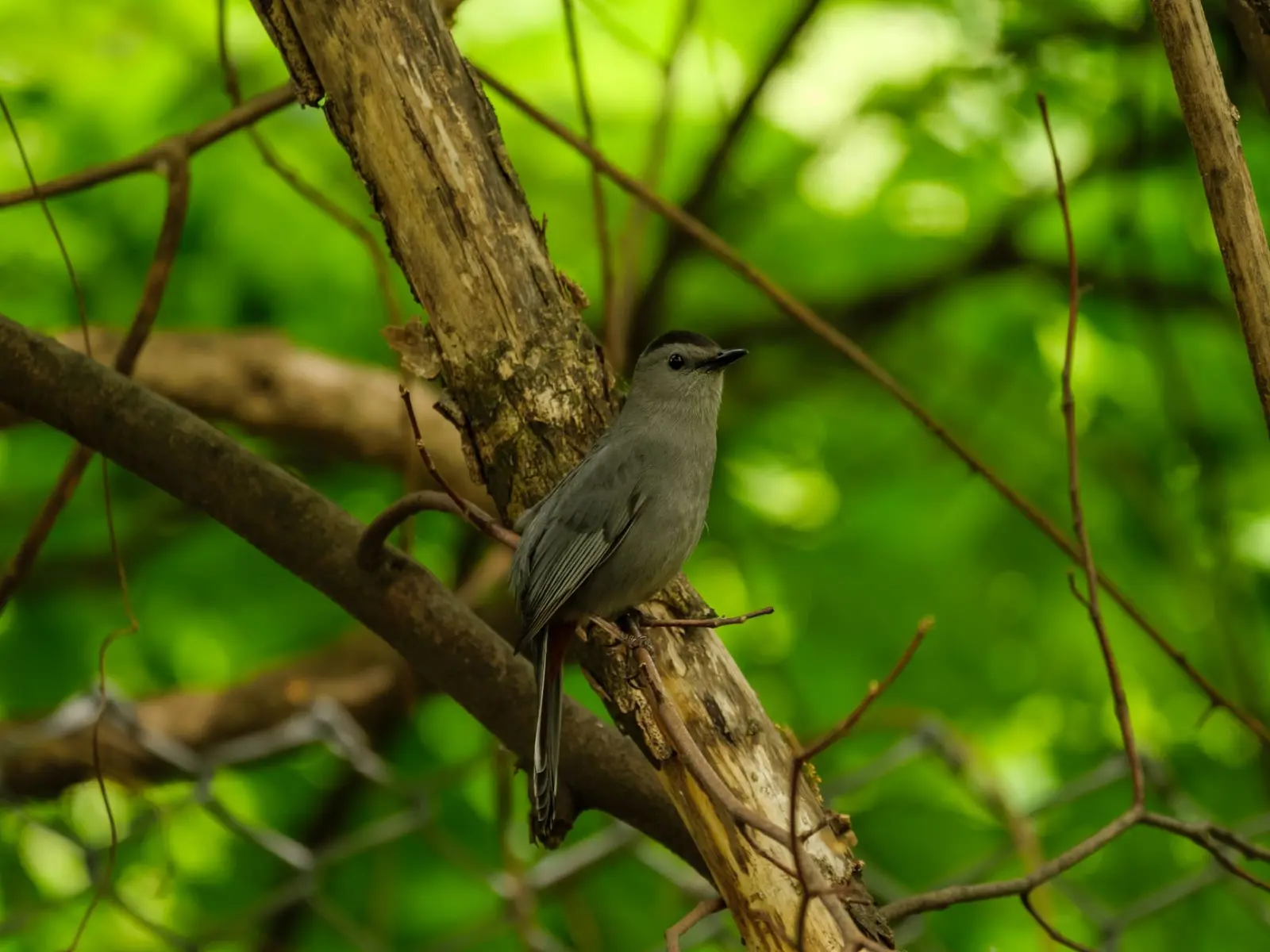
The bird itself is modest in appearance, which compounds the visibility problem. A green catbird is roughly the size of a kookaburra but built more compactly, with predominantly green plumage that blends seamlessly into foliage. The head carries a distinctive black cap and face mask, and there’s a patch of bare blue skin around the eye, but these features only become apparent when the bird is close enough to see clearly. Most of the time, you’re looking at a dark green shape moving through vegetation, and by the time your eyes focus on it, the bird has already shifted position.
Behavior and Movement Patterns
Green catbirds are not particularly social. They move singly or in pairs through the forest, foraging in the mid-story and upper understory for fruit and insects. Their movements are deliberate rather than frantic – they don’t flit rapidly between branches like many rainforest birds. Instead, they tend to perch and feed methodically, moving to a new location only when the current area has been worked through. This deliberate pace might seem like it would make them easier to observe, but it works against you because they remain stationary for just long enough that you think you have time to get closer, then move again before you’ve covered the distance.
The mewing call serves territorial and contact functions. Pairs maintain loose territories, and the male calls regularly throughout the day, particularly in early morning and late afternoon. The intensity of calling varies seasonally and even by weather conditions. On humid, overcast days, they tend to call more frequently. On hot, clear days, calling drops off noticeably. This pattern has practical implications if you’re trying to locate birds – the conditions that make rainforest walking most pleasant are often the conditions when the birds are least vocal.
Breeding occurs in spring and early summer. During this period, birds become somewhat more predictable in their movements as they focus on nest sites and provisioning. The nest itself is a loose, open cup placed in a fork or on a branch, often at moderate heights. Nests are not well concealed, which seems counterintuitive given how difficult the birds are to see otherwise. I’ve found that nests are easier to locate by watching the birds’ movement patterns than by scanning branches directly.
Feeding Ecology and Seasonal Shifts
Diet composition changes noticeably across seasons. In the wet season, when fruit is abundant, green catbirds feed heavily on berries from rainforest trees – native figs, Elaeocarpus species, and various other fruiting plants. They also take insects, particularly when feeding young. In drier months, they become more insectivorous, gleaning from foliage and bark. This dietary flexibility allows them to persist in rainforests year-round, but it also means their activity patterns and visibility shift with food availability.
The relationship between green catbirds and rainforest fruit production is worth noting. They’re not specialist frugivores like some rainforest birds, but neither are they incidental fruit-eaters. They occupy a middle ground, taking advantage of abundant fruit when available but maintaining a mixed diet. This flexibility has probably contributed to their persistence in fragmented rainforest habitats, where specialized frugivores have struggled more obviously.
Rainforest Fragmentation and Real-World Presence
Over the past two decades, I’ve noticed shifts in where green catbirds occur and how frequently they’re encountered. Larger, more intact rainforest patches support more stable populations. In smaller, isolated forest fragments, sightings become less predictable. The birds don’t disappear entirely from small patches, but their presence becomes sporadic rather than reliable. This reflects broader patterns in how rainforest birds respond to habitat loss and fragmentation.
The acoustic environment of the rainforest matters more than you might initially think. In areas where human activity is constant – roads nearby, regular foot traffic, clearing operations – green catbirds call less frequently and are encountered less often. This isn’t necessarily because the birds have left; it’s more that their behavior changes in response to disturbance. They become quieter and more cryptic, which makes them effectively invisible even when present.
Encountering a green catbird in the field typically happens one of two ways. Either you hear the call and manage to locate the bird visually before it moves, or you stumble upon one by accident while moving through the forest. The deliberate approach – sitting quietly and waiting for a calling bird to move closer – sometimes works, but patience is required. The bird may call from a location for several minutes, then fall silent for an hour. Moving toward the sound while it’s calling rarely results in a close view; the bird almost always moves away before you’ve closed the distance significantly.
The green catbird remains a bird of the rainforest interior, neither common enough to be taken for granted nor rare enough to justify extended searching. Its presence is felt more through sound than sight, and its behavior reflects an adaptation to dense, complex forest habitat where visibility is limited for predators and observers alike. Understanding this bird means accepting that some rainforest species are meant to be heard more often than seen, and that this isn’t a failure of observation but rather a reflection of how these birds have evolved to live in their environment.