
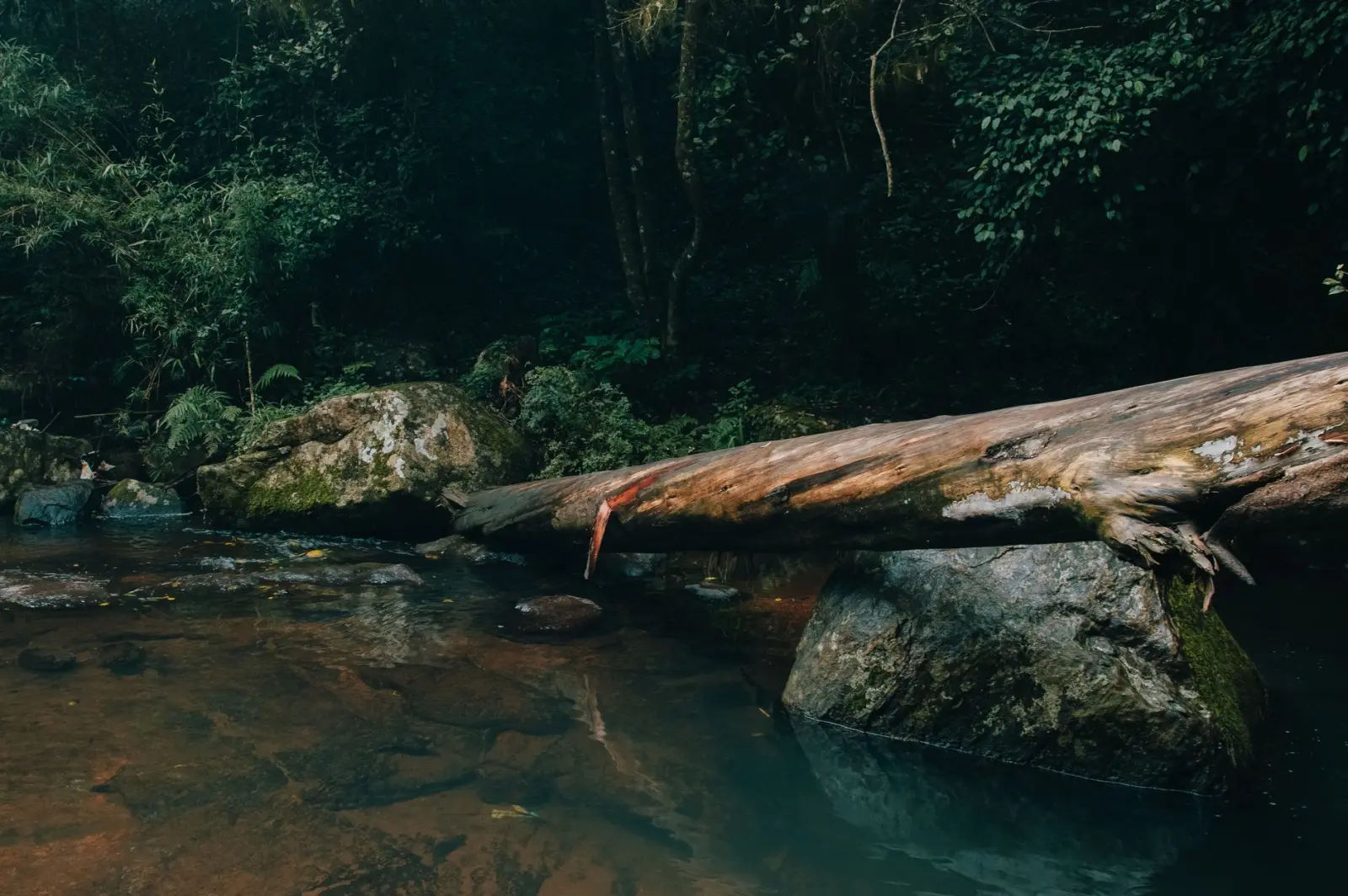
Spending time in Australian rainforest streams, you notice the eels before you understand them. They move through dark water with purpose, often at night, sometimes in numbers that seem improbable for a creature that appears solitary. After years of observing these migrations and working with river systems across Queensland and northern New South Wales, the patterns become clearer, though they remain genuinely complex. The eels you encounter in upland streams are not residents. They are part of a cycle that began in the ocean and may take years to complete.
The Australian freshwater eels – primarily the shortfin eel (Anguilla australis) and the longfin eel (Anguilla reinhardtii) – are catadromous fish. This means they live in freshwater but must return to the ocean to breed. What makes this arrangement significant for anyone working in or studying rainforest systems is that the reverse journey, from ocean to stream, is where most of the drama unfolds. Young eels, called glass eels or elvers, enter river systems in spring and early summer, typically between September and March in the Southern Hemisphere. They are transparent, finger-length creatures that look almost alien under close inspection. The timing is not random. It coincides with rainfall patterns and tidal conditions that make upstream passage possible.
The Upstream Push
The journey from river mouth to headwater streams is not a sprint. An eel entering a Queensland rainforest system might spend weeks or months moving upstream, traveling at night and resting during daylight hours in deeper pools or under debris. They navigate by following current, sensing chemical gradients in the water, and responding to light levels. In systems with minimal barriers, an eel can cover several kilometers in a season. In fragmented rivers with weirs, dams, or waterfalls, progress slows dramatically or stops entirely.
What I have observed repeatedly is that eels are surprisingly capable climbers. They can move through wet vegetation, across damp rocks, and even up the slime-covered faces of small waterfalls. This ability has allowed them to colonize streams that seem impossibly isolated. However, this capacity has limits. A vertical drop of more than a meter or two, especially if the surface is smooth concrete or metal, becomes an effective barrier. Modern river infrastructure – irrigation weirs, hydroelectric dams, road culverts – has fragmented eel populations in ways that historical obstacles like natural waterfalls never did. Natural falls tend to have spray zones, moss coverage, and irregular surfaces that eels can exploit. Human structures are often engineered for efficiency, not for eel passage.
The density of migrating eels varies enormously between systems and between years. Some seasons, you will find hundreds of glass eels in a single pool at the base of a waterfall. Other years, the same pool yields only dozens. This variation reflects ocean conditions, rainfall timing, and the reproductive success of the previous generation. It also reflects cumulative impacts on river systems – pollution, water extraction, habitat loss – that reduce recruitment. When you are working in a stream and elver numbers are low, it is often a sign that something upstream has changed, or that ocean conditions have shifted in ways that affect spawning success.
Life in the Rainforest
Once an eel settles into a rainforest stream, it becomes a resident for years, sometimes decades. The shortfin eel tends to occupy faster-flowing sections and more open water, while the longfin eel prefers dense vegetation, leaf litter, and the darkest pools. Both are ambush predators, feeding on small fish, crustaceans, insect larvae, and anything else that fits in their mouth. In productive rainforest streams with high invertebrate biomass, eels grow steadily. In degraded systems with poor water quality or limited food, growth is slow.
The duration of the freshwater phase varies. Some eels may mature and return to the ocean within five to seven years. Others remain in streams for fifteen years or more. Size is the primary trigger for seaward migration, not age. An eel needs to reach a certain body mass – typically around 400 grams for shortfins, larger for longfins – before the physiological shift toward reproduction begins. This means that in cold, unproductive streams, eels may never reach spawning size. They remain as residents indefinitely, or until they die.
What changes the eel’s behavior most noticeably is the approach of the spawning phase. As an eel prepares to migrate seaward, its body undergoes transformation. The eyes enlarge. The lateral line becomes more pronounced. The coloration shifts from the mottled brown of a stream resident to the silvery tone of a migratory eel. This phase is called the “silver eel” stage, and it is when eels stop feeding and begin moving downstream, typically in autumn and winter. The trigger appears to be a combination of water temperature, day length, and internal reproductive cues. Once this shift begins, an eel is committed. It will not feed again until it reaches the ocean, sometimes traveling hundreds of kilometers downstream to do so.
Barriers and Bottlenecks
The downstream journey should be easier than the upstream one. Gravity is on the eel’s side. Yet modern rivers present obstacles that historical systems did not. Hydroelectric dams with turbines kill eels that pass through them. Weirs with steep drops force eels to navigate spillways or find alternative routes that may not exist. In some systems, eels accumulate at barriers, unable to proceed, waiting for conditions that allow passage or simply dying in place.
I have seen pools below dams where dozens of silver eels congregate, their bodies showing signs of stress and injury from repeated attempts to pass. Some systems have installed eel passes – structures designed to allow downstream passage – but these are far from universal. Even where they exist, their effectiveness depends on design, maintenance, and whether eels actually locate them. An eel moving downstream in darkness, following current and chemical cues, may not find a purpose-built passage if it is not aligned with the main flow.
The loss of eels at migration barriers is not merely an inconvenience for the species. It represents a disruption of nutrient cycling. Adult eels that successfully reach the ocean spawn in the Coral Sea, and their larvae drift back to Australian coasts months later. The eels that never complete this cycle never contribute to reproduction. Over decades, this creates a demographic bottleneck. Populations in fragmented river systems decline not because of habitat loss alone, but because reproductive success is compromised.
What the Eels Tell Us
Working with rainforest streams, you learn to read eel populations as an indicator of river health. A system with robust numbers of glass eels, healthy resident eels of various sizes, and regular silver eel migrations is a system that is functioning. The presence of eels indicates that barriers are passable, water quality is adequate, and food webs are intact. Conversely, a stream with few eels, or eels confined to a narrow section below an impassable barrier, is a system under stress.
Changes in eel migration timing have become noticeable over the past two decades. Glass eel recruitment appears to be shifting earlier in some systems, possibly in response to changing ocean temperatures and current patterns. Silver eel migration windows seem to be compressing, with migrations occurring over shorter periods. These shifts are subtle but consistent enough that researchers tracking these populations have documented them. For someone working in the field, the practical implication is that assumptions about when eels will be moving – and therefore when management actions like barrier removal or fish passage installation should occur – may need updating.
The relationship between rainforest eels and river systems is ancient and deeply integrated. The eels have shaped stream ecosystems for millennia, and the streams have shaped the eels. Understanding this relationship requires patience and repeated observation, not just data collection. It requires noticing when eels are present and when they are absent, when they are moving and when they are settled, and what conditions precede changes in behavior. This is how you begin to see the eels not as individual animals, but as part of a larger system that is itself changing.