Crimson rosellas are among the most visually arresting birds you’ll encounter in Australian rainforests, yet they’re often misidentified or overlooked entirely by visitors who aren’t familiar with their specific habitat preferences. Over years of moving through subtropical and tropical rainforest systems across Queensland and northern New South Wales, I’ve noticed that people tend to expect these birds to be everywhere in the canopy. In reality, they occupy a narrower ecological niche than many assume, and understanding where and when you’re likely to see them changes how you move through the forest.
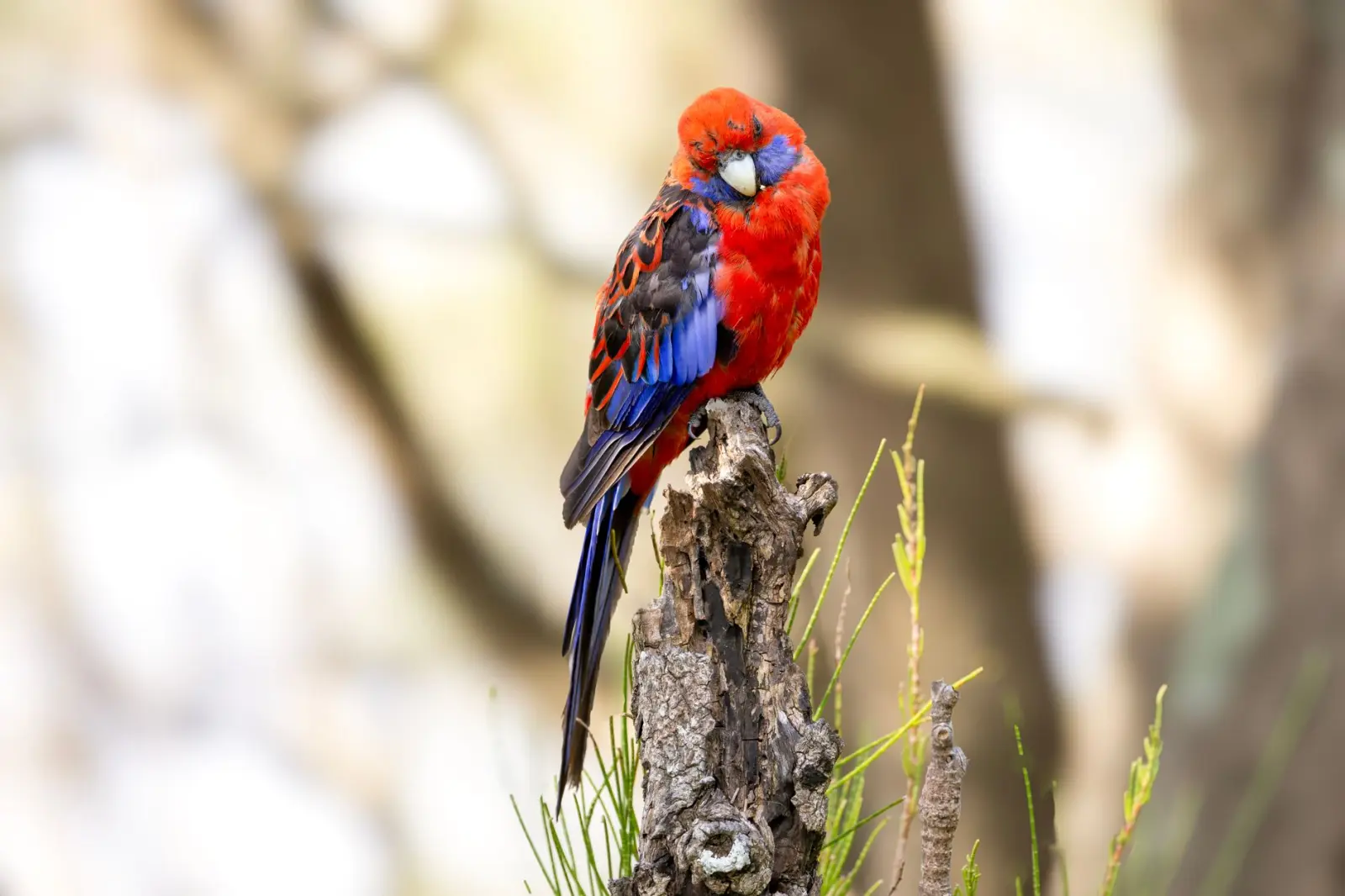
The bird itself is unmistakable once you’ve seen it clearly. The plumage is a deep crimson red across the body, wings, and tail, with bright blue panels on the wings and a distinctive blue cheek patch. The contrast is so vivid that in strong light it can almost seem artificial. What catches people off guard is how that color reads differently depending on forest light conditions. In the dense shade of the rainforest interior, crimson can appear muted or even blackish until the bird moves into a gap or shaft of light. I’ve watched visitors scan the canopy for ten minutes without spotting a rosella perched only a few meters away, simply because the lighting rendered it nearly invisible.
Where They Actually Occur
Crimson rosellas are not rainforest specialists in the way that many other Australian parrots are. They prefer the ecotone – the transitional zone between rainforest and open forest or cleared land. This means you’re more likely to encounter them at the forest edge, along roadsides that cut through rainforest, or in areas where the canopy has been disturbed or opened up by natural gaps or fallen trees. They’ll venture into the rainforest proper, but they do so selectively and often in response to specific food availability rather than as permanent residents.
In my experience, the most reliable places to see crimson rosellas are around the margins of rainforest patches, particularly where eucalypts or other flowering trees grow near the rainforest boundary. They’re also common in disturbed areas – old logging sites that have regenerated, areas with scattered trees, and even suburban gardens adjacent to rainforest. This preference for edges and semi-open habitat explains why they’re so common in places like the hinterland regions of the Gold Coast or Sunshine Coast, where rainforest remnants are fragmented by human settlement.
Behavior and Movement Patterns
Crimson rosellas are vocal and often gregarious, moving in small flocks that can range from three or four birds to a dozen or more. Their calls are distinctive – a series of loud, sharp screeches and whistles that carry well through the forest. This vocalizing is actually useful for locating them, though it can also make them seem more abundant than they actually are. A single flock moving through the canopy can sound like dozens of birds to an untrained ear.
The birds tend to be most active in early morning and late afternoon, which aligns with broader feeding patterns in parrots. During the heat of midday, they’re often less conspicuous, resting in dense foliage or moving less frequently. I’ve found that timing matters significantly when trying to observe them. A walk through rainforest margins at dawn will yield far more sightings than the same walk at noon. They also respond to flowering events – when certain trees come into bloom, rosellas will concentrate in those areas for weeks at a time, then disappear as the flowers fade.
Diet and Seasonal Movements
Crimson rosellas feed on seeds, fruits, and flowers. In rainforest contexts, they’ll take native fruits and seeds, but they’re equally attracted to cultivated trees in nearby gardens and orchards. This dietary flexibility means their presence in any given area can fluctuate seasonally based on what’s fruiting or flowering. During winter months in subtropical rainforests, they often move to higher elevations where certain trees fruit at different times than lowland species.
This seasonal movement is something I’ve observed repeatedly but that many field guides understate. A rainforest patch that hosts rosellas regularly in spring might see them disappear entirely by mid-summer, only to return in autumn. Understanding this pattern prevents the frustration of visiting a location where you’ve previously seen them and finding none. It also explains why local knowledge is so valuable – residents who’ve lived in an area for years develop an intuitive sense of when rosellas will appear.
Distinguishing Them from Other Parrots
In rainforest settings, you might encounter several other parrot species, and confusion is common. Rainbow lorikeets are superficially similar in size and habitat preference but have a completely different color pattern – predominantly green with red underparts and blue and yellow markings. Scaly-headed parrots, which do occur in some rainforest areas, are smaller and lack the distinctive blue cheek patch. Australian king parrots are larger, more heavily built, and have a different silhouette in flight.
The key distinguishing feature of crimson rosellas is that combination of deep red body color with bright blue wing panels and the blue cheek patch. In flight, they’re quite distinctive – the blue on the wings flashes conspicuously against the red body. Once you’ve seen this pattern clearly, confusion with other species becomes unlikely.
What I’ve noticed over time is that people often conflate rainforest presence with abundance. Crimson rosellas are common in Australian rainforest regions, but “common” doesn’t mean they’re everywhere or easy to observe. They’re patchily distributed, dependent on specific habitat features, and responsive to seasonal and year-to-year variations in food availability. Seeing them reliably requires understanding these patterns and visiting the right locations at the right times. The reward for that effort is watching a genuinely striking bird move through the forest canopy – a visual experience that doesn’t diminish even after repeated encounters.