
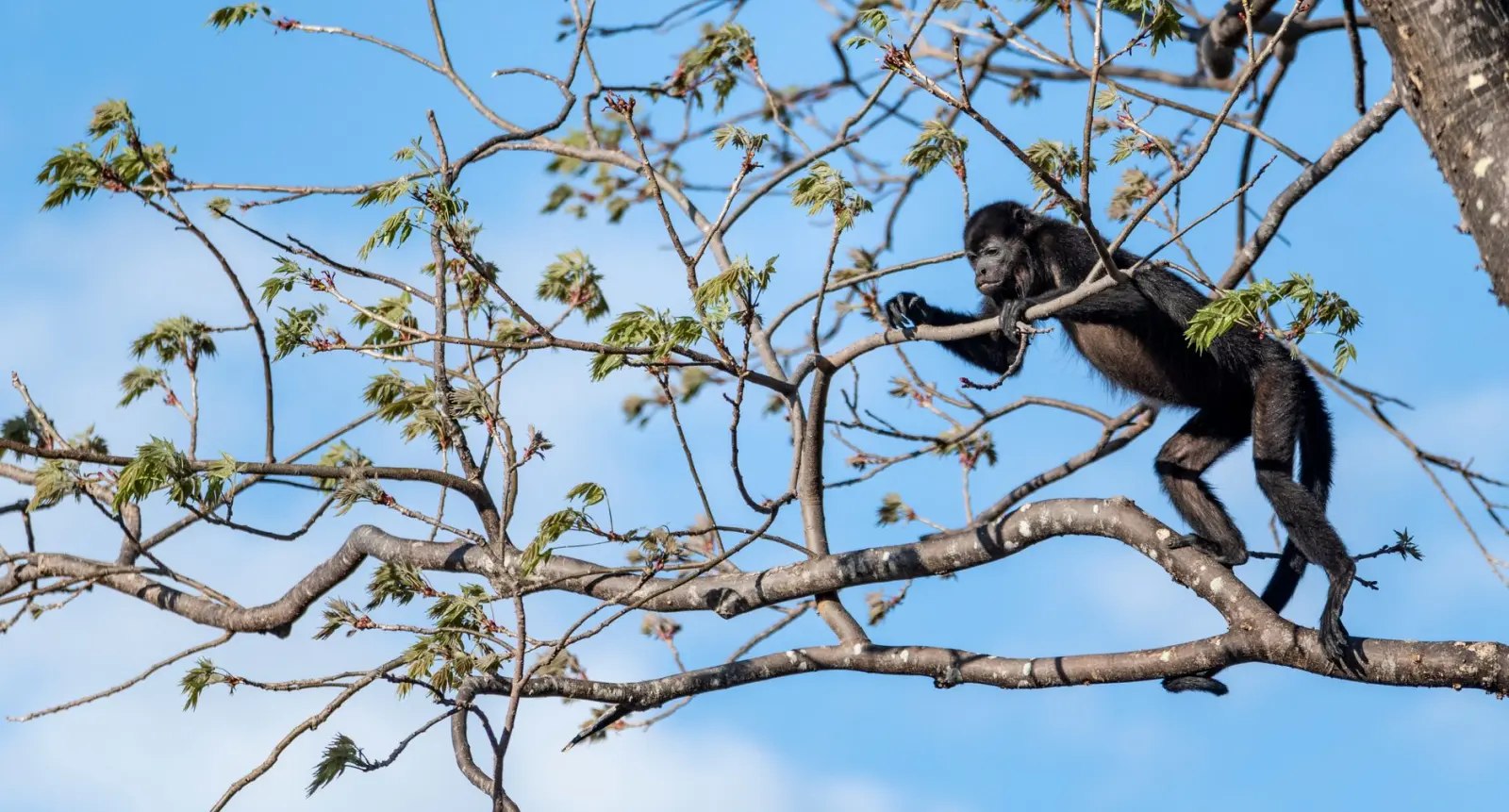
Spending time in rainforests teaches you quickly that the canopy isn’t a single layer – it’s a complex, stratified world where animals have evolved remarkably specific ways to move and hunt. The canopy isn’t just overhead; it’s where most of the forest’s life actually happens. I’ve watched howler monkeys navigate gaps that would seem impassable, seen harpy eagles hunt with precision from branches that barely bend under their weight, and observed sloths move with a slowness so deliberate it seems almost mathematical. The animals that live up there aren’t randomly scattered. They’ve adapted to exploit particular heights, branch thicknesses, and food sources with an efficiency that becomes obvious once you start paying attention.
The vertical structure of a rainforest canopy creates distinct zones, and animals partition themselves across these zones with surprising consistency. The emergent layer – the tallest trees that poke above the main canopy – hosts different species than the dense middle canopy below it. Eagles and harpy eagles hunt in the emergent zone where visibility extends far enough to spot prey moving in the canopy. The main canopy, where most of the leaf mass and fruit production occurs, teems with monkeys, birds, and insects. Below that, the understory is quieter, more humid, and hosts animals that rarely venture higher. This vertical separation isn’t random or temporary. Over evolutionary time, animals have developed the specific anatomy and behavior patterns needed to thrive at their preferred height.
Movement Strategies Across Different Branch Types
How an animal moves through the canopy depends almost entirely on its body size and the structural support available. Small animals – insects, tree frogs, tiny birds – can move across thin twigs and even leaf stems because their weight distributes across a much larger surface area relative to their mass. I’ve watched poison dart frogs navigate leaf surfaces no thicker than a pencil, their adhesive toe pads gripping with enough force that they can hang upside down. Larger animals face different constraints. A howler monkey weighing up to 10 kilograms needs branches that can support that weight. They’ve developed long arms and a prehensile tail that acts as a fifth limb, allowing them to distribute their weight across multiple branches simultaneously and move with a kind of controlled swinging that looks risky but is mechanically sound.
Harpy eagles, the largest raptors in the Americas, face a particular challenge. They weigh up to 9 kilograms and hunt in a space filled with small branches. They don’t swing through the canopy like monkeys. Instead, they perch on the thickest branches and wait, or they move through the forest with a deliberate, powerful flight that allows them to maneuver around obstacles. Their talons – some larger than a grizzly bear’s claws – are designed to pierce through fur and bone, not to grip tiny branches. Their hunting strategy depends on explosive acceleration from a perch, not sustained movement through dense vegetation. I’ve observed them hunt sloths by waiting near a sloth’s regular travel routes, then striking with sudden force. The canopy architecture actually works in their favor because it funnels prey into predictable pathways.
Feeding Patterns and Vertical Foraging
Different animals feed at different heights because the food itself is stratified. Fruiting trees produce fruit at various points in their canopy structure. Some fruit appears at the very top of the crown, exposed to sun and accessible mainly to birds and small monkeys. Other fruit develops deeper in the canopy, where it’s more protected but harder to reach. Howler monkeys tend to feed on leaves and unripe fruit that other animals ignore, which is why they can maintain stable populations in areas where fruit-eating monkeys would struggle. They’re not competing for the same food source; they’re exploiting a different tier of the resource base.
Sloths, which move so slowly that they seem almost immobile, have actually optimized their feeding strategy around the canopy structure. They eat leaves from cecropia trees and a few other species, and they move slowly enough that they can digest their food while moving. A sloth might spend an entire day in a small section of canopy, eating leaves within arm’s reach, then move to an adjacent tree the following day. This isn’t laziness or poor adaptation. It’s an energy conservation strategy that works because their metabolism is extremely low and their digestive system is specialized for breaking down tough leaves. The canopy structure supports this strategy because the leaves they need are consistently available, and they don’t need to travel far to find food.
Territorial Behavior and Canopy Communication
Animals in the canopy use sound, scent, and visual signals to communicate across distances, and the structure of the canopy affects how these signals travel. Howler monkeys produce calls that can carry for kilometers through the forest. The dense vegetation actually helps these calls travel because the sound bounces off leaves and branches, amplifying it in certain directions. I’ve heard howler monkeys calling at dawn from what seemed like multiple directions simultaneously – the canopy was creating echoes that made it impossible to pinpoint their exact location. This is useful for territorial defense because it makes the group sound larger and more spread out than it actually is.
Other animals use the canopy structure itself as a territorial marker. Some birds defend specific fruiting trees, arriving at dawn and remaining in that tree for hours or days. They’re not just eating; they’re establishing ownership. The canopy creates natural boundaries because the trees themselves are discrete units. An animal defending a fruiting tree is defending a specific, defensible resource. The vertical structure makes this feasible in a way it wouldn’t be on the ground, where territories would need to be much larger to encompass the same amount of food.
Scent marking in the canopy is less common than on the ground, but it does occur. Some primates have scent glands and mark branches along their regular travel routes. These marks persist for hours or days, depending on humidity and rainfall. The canopy’s moisture means scent marks fade faster than they would in drier environments, but they’re still effective for communicating with other individuals of the same species. The marks indicate recent presence and help animals avoid unnecessary encounters or, conversely, help them find mates during breeding season.
Predator-Prey Dynamics in Three Dimensions
Predation in the canopy operates differently than on the ground because escape routes are vertical as well as horizontal. A bird being chased by a snake can dive downward, or it can climb higher toward thinner branches that won’t support the snake’s weight. A monkey being pursued by an eagle has similar options – it can move into denser vegetation where the eagle’s wings are a liability rather than an advantage. This three-dimensional complexity means that predator and prey are constantly adapting to each other’s strategies.
Snakes in the canopy are typically ambush predators. They drape themselves across branches and wait for birds or small mammals to pass within striking distance. Their camouflage is often excellent because they’ve evolved to match the color and texture of branches. I’ve nearly stepped on canopy snakes while walking through the understory because they were so well-concealed. Their hunting success depends on remaining undetected, not on speed or agility. Once they strike, the encounter is usually over in seconds. Either they connect and secure their prey, or the prey escapes and they must wait for the next opportunity.
The canopy’s structure also creates refuges for prey animals. Dense tangles of vines and small branches can shelter birds and small mammals from larger predators. A jaguar or puma can’t climb into these spaces effectively, so prey species have evolved to use them as safe zones. Young animals often learn these refuges by following their mothers, and this knowledge becomes part of their survival strategy. The canopy isn’t just a feeding ground; it’s a complex landscape of danger and safety, and animals navigate it with an awareness of both.
After years of observing canopy animals, the most striking pattern isn’t any single adaptation or behavior. It’s how thoroughly these animals have integrated themselves into the vertical structure of the forest. They don’t simply live in the canopy; they’ve evolved to exploit it with a specificity that makes them nearly inseparable from it. Remove the canopy structure, and these animals lose not just their home but the fundamental basis of their survival strategy. The canopy isn’t scenery for rainforest animals – it’s the actual architecture of their world.