
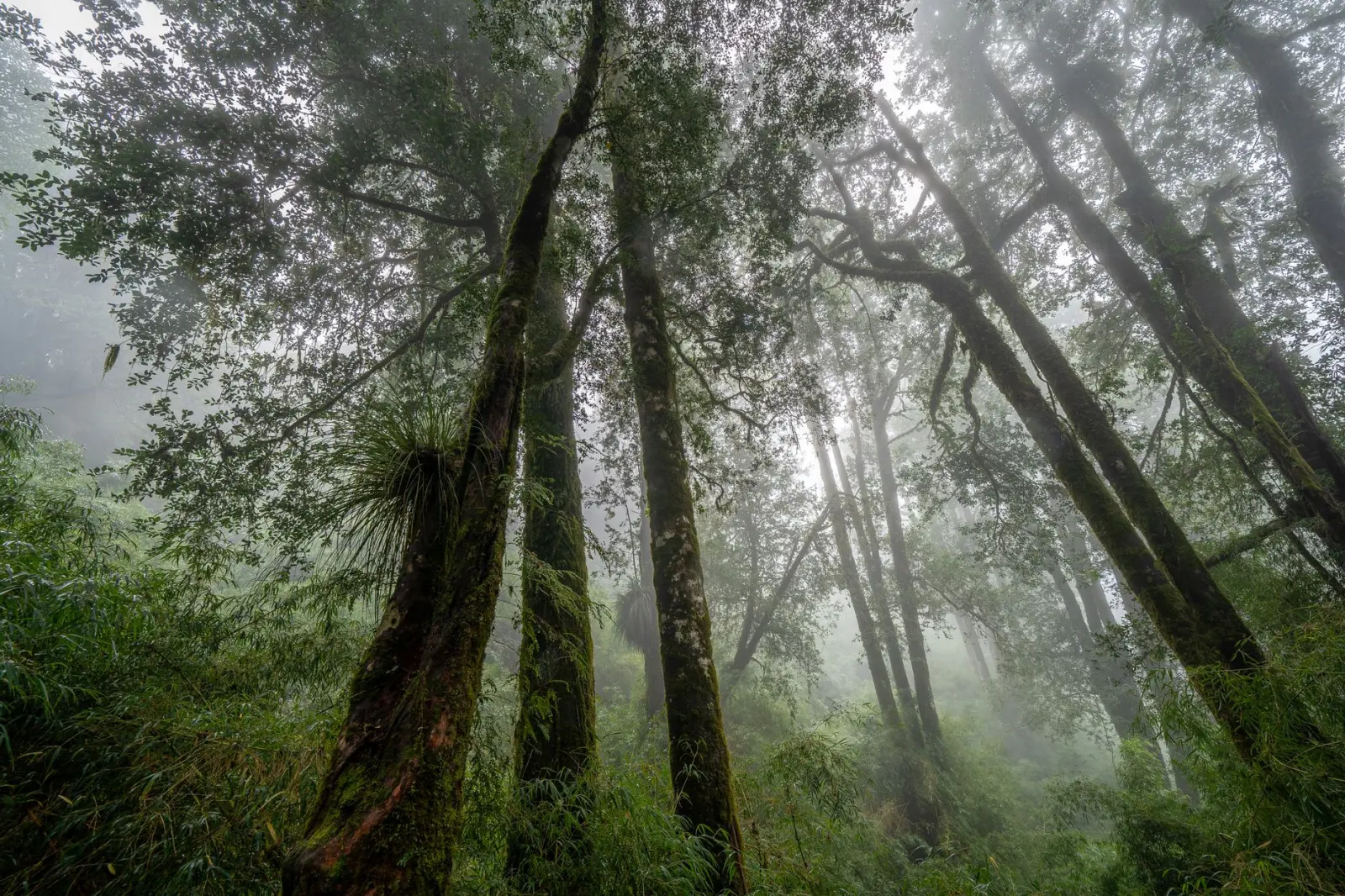
Spending time in old-growth rainforest, you notice the height immediately. The canopy towers overhead at 150 feet or more in places, with individual emergent trees breaking through at 200 feet. It’s not random. The extreme vertical architecture of tropical rainforests reflects a specific set of environmental conditions and competitive pressures that don’t exist in the same way elsewhere on Earth.
The most obvious driver is light. In a rainforest, the forest floor exists in near-permanent shade. A seedling at ground level receives perhaps 1 to 2 percent of the sunlight that reaches the canopy. That’s not enough to sustain growth or reproduction for most species. The only way to access adequate light is to grow upward, and to grow faster than your neighbors. This creates relentless vertical competition. Trees that grow taller than their neighbors gain a decisive advantage. They intercept more light, photosynthesize more efficiently, and can allocate more energy to reproduction and defense. Trees that remain shorter are gradually shaded out and eventually die. Over generations, this selects for height.
What makes this competition so intense in rainforests is the year-round growing season. In temperate forests, winter cold halts growth for months. In rainforests, temperatures remain warm and relatively stable throughout the year. Rainfall is abundant and distributed across all seasons, so water stress is rarely a limiting factor. A tree can grow continuously. This removes the seasonal brake that exists elsewhere. A rainforest tree can invest energy in height gain every single month of the year, while a temperate forest tree gets only a few months of active growth. Over decades, this compounds dramatically.
Structural Support and the Cost of Height
Growing tall carries a penalty: you need stronger wood to support your own weight. A tree that is 200 feet tall and 6 feet in diameter must have wood dense and stiff enough not to snap under its own mass, wind load, and the weight of water and epiphytes in its crown. Rainforest soils, however, are often surprisingly poor in nutrients despite the lush vegetation. This creates a tension. The tree must invest heavily in structural tissue – dense wood, thick branches – but it’s growing on nutrient-poor soil where every mineral is scarce.
Rainforest trees solve this partly through nutrient cycling. The forest floor is a thin, active layer where leaf litter, fallen branches, and dead organisms decompose rapidly in the warm, wet environment. Fungi and mycorrhizal networks break down this organic matter and transfer nutrients directly to tree roots. Trees also reabsorb nutrients from their own leaves before dropping them, recovering nitrogen and phosphorus before they hit the ground. This recycling is so efficient that most nutrients in a rainforest are locked up in the living biomass, not the soil. The forest is essentially feeding itself.
The wood itself tends to be denser than temperate forest wood. Rainforest hardwoods like teak, mahogany, and various tropical species are heavier and stronger than pine or oak. This density comes at a cost: growth is slower. But the year-round growing season compensates. A rainforest tree grows slowly each month but never stops, while a temperate tree grows faster during its brief growing season but then rests. The rainforest tree reaches greater height over time.
Stability and the Absence of Extreme Stress
Rainforests rarely experience the extreme stresses that limit tree height elsewhere. There are no hard freezes that crack wood or kill buds. Droughts are uncommon and usually brief. Hurricanes and severe windstorms occur in some tropical regions but are not the norm in all rainforests. The climate is, by comparison, forgiving. A tree that invests in height doesn’t face the risk of a catastrophic freeze or multi-year drought that would kill it. The investment in vertical growth is less risky.
Rainfall, while abundant, is also relatively predictable. A rainforest tree doesn’t need to develop the deep, extensive root systems that a savanna or temperate forest tree requires to survive dry seasons. Rainforest roots tend to be shallower and more concentrated in the nutrient-rich upper soil layer. This means the tree can allocate more of its energy budget to above-ground growth rather than root development. The stable water supply removes a major constraint.
Competition and the Emergent Layer
The tallest trees in a rainforest – the emergents that tower 200+ feet above the surrounding canopy – represent an extreme expression of this competition. These trees have “won” the light competition decisively. They tower so high that they are essentially in a different light environment than the rest of the forest. They receive full, unobstructed sunlight. The cost is exposure to wind, but in a stable tropical climate, this is manageable.
Below the emergents is the main canopy, typically 100 to 150 feet tall. Below that are understory layers, and finally the shade-dominated forest floor. This vertical stratification is a direct result of the height competition. Each layer represents trees that have reached a certain height threshold but not exceeded it. The structure is not random; it’s an equilibrium between light availability, growth rates, and competitive exclusion.
What’s often overlooked is that rainforest height is also a response to the sheer density of trees. Rainforests contain hundreds of tree species per hectare, all competing for the same space and light. In a forest with fewer species and lower density, a tree might reach adequate light at a much lower height. But in a rainforest, where you’re surrounded by competitors, you have to grow tall to escape the shade. The height is a direct consequence of crowding.
When you stand in a rainforest and look up at those towering trunks disappearing into the canopy, you’re seeing the end result of millions of years of selection for height in an environment where height is the primary advantage. It’s not that rainforest trees are inherently programmed to grow tall. It’s that the environment – constant warmth, reliable moisture, intense light competition, and nutrient recycling – makes height the winning strategy. Trees that grew shorter were shaded out. Trees that grew taller reproduced and passed on their genes. The forest we see today is the accumulated result of that relentless selection.