
Spend enough time walking through a rainforest, and you stop noticing the obvious things first. The canopy noise fades into background. The humidity becomes normal. What starts to grip your attention instead is what’s happening at ground level – the soft, dark soil, the way fallen wood disappears, the speed at which the forest recycles itself. That recycling machine runs almost entirely on fungi, though you’d never know it by looking.
I’ve spent years in rainforests across Central America, Southeast Asia, and West Africa, and the most consistent surprise is how little people understand about what fungi actually do. They’re not just the occasional mushroom you spot on a rotting log. They’re the connective tissue of the entire system. Without them, the rainforest would collapse under its own dead weight within a season.
The basic fact is straightforward: fungi break down organic matter that nothing else can efficiently process. Dead wood, fallen leaves, animal remains – these pile up constantly in a rainforest. Bacteria handle some of the work, but fungi are the specialists for the toughest jobs. They produce enzymes that can break down cellulose and lignin, the complex polymers that make wood hard and leaves structurally sound. When you see a fallen tree in various stages of decay, each stage represents different fungal communities doing their specific work.
The Nutrient Cycle Runs Through Fungal Networks
What makes fungi truly central to rainforest function is their role in nutrient cycling. The soil in most rainforests is actually quite poor – acidic, low in available nutrients. The richness of the forest exists because nutrients are locked in the living biomass and recycled with extreme efficiency. Fungi are the mechanism that makes this efficiency possible.
Mycorrhizal fungi form relationships with tree roots, penetrating them and extending far into the soil. The fungus receives sugars from the tree’s photosynthesis. In return, it delivers phosphorus, nitrogen, and other nutrients that the tree cannot access on its own. This isn’t a minor convenience. In many rainforest soils, 80 to 90 percent of the tree’s nutrient uptake comes through these fungal partners. Without them, the trees would be starving in what looks like abundance.
I’ve seen this dynamic play out when looking at nutrient cycling in different forest types. In temperate forests with richer soils, trees can be more independent. In rainforests, especially on heavily weathered soils, the fungal partnership isn’t optional. It’s the difference between a thriving forest and a struggling one. The fungi form networks that connect different trees, moving nutrients from areas of abundance to areas of scarcity. A mature tree can transfer carbon and nutrients to younger trees through these fungal highways. It’s a form of forest communication that most people never consider.
Decomposition Happens at Rainforest Speed
The speed of decomposition in a rainforest is one of the first things that strikes visitors. A leaf falls and within weeks it’s mostly gone. A tree dies and within a few years it’s returned to soil. This isn’t magic – it’s fungi working in optimal conditions. Warm, wet, constant. Fungi thrive in these conditions and reproduce rapidly.
Different fungal species specialize in different stages of decay. Some colonize fresh wood immediately after a tree falls. Others move in once the wood has softened. Still others work on the final stages of breakdown. I’ve examined fallen logs at different decay stages and seen the progression clearly – the fungal composition changes as the substrate changes. Early colonizers are aggressive competitors. Later colonizers are specialists adapted to the modified wood.
This sequential decomposition matters because it determines how long nutrients remain available in the wood before moving into the soil. Rapid decomposition means rapid nutrient release. In a rainforest with high nutrient demand and limited soil reserves, this speed is essential. If decomposition were slower, nutrients would remain locked in dead wood longer, and the living forest would suffer.
Disease, Competition, and Fungal Ecology
Not all fungal activity is beneficial to the forest in obvious ways. Pathogenic fungi kill trees. They cause cankers, root rots, and leaf diseases. In a rainforest, fungal pathogens are constantly present and active. The question isn’t whether they exist – it’s how the forest manages them.
What I’ve observed is that rainforests maintain fungal diversity that creates a kind of biological buffering. With hundreds of fungal species present, no single pathogen can dominate completely. A fungus that kills one tree species well may have little effect on another. Diversity prevents epidemics. This is different from monoculture forests or plantations, where a single fungal pathogen can devastate the entire system because all trees are genetically similar.
Competition between fungi also shapes the forest. Fungi compete for substrate – for the right to decompose a particular piece of wood or leaf litter. Some fungi produce antibiotics or toxins that inhibit competitors. Some grow faster and simply outcompete others for space. These competitive dynamics determine which species dominate in different microhabitats. The outcome is a complex fungal community structure that varies with substrate type, moisture, temperature, and the presence of other organisms.
Visible and Invisible Fungal Presence
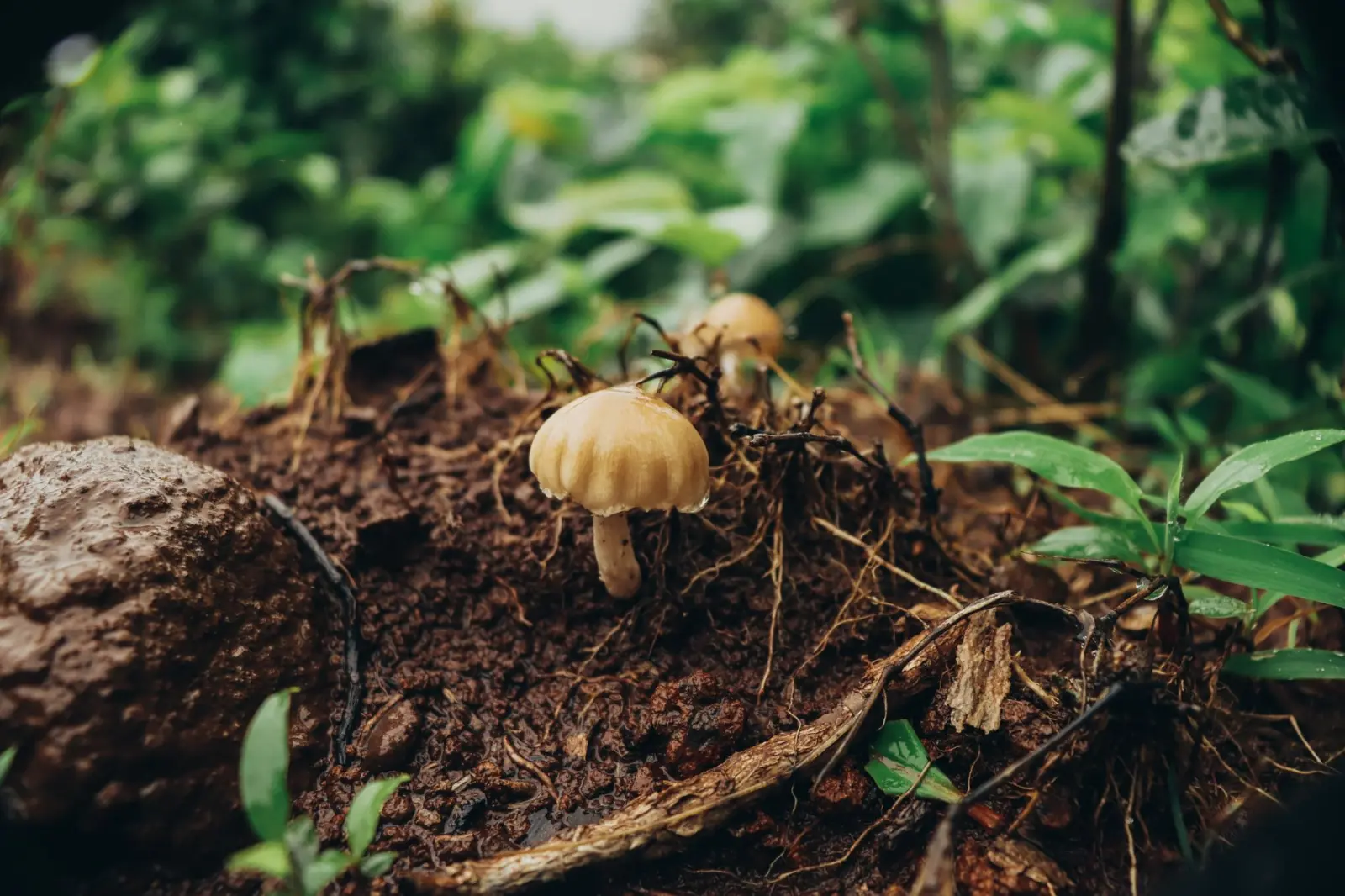
The fruiting bodies – the mushrooms and toadstools – are what most people notice. They’re the reproductive structures, the visible part of a much larger organism. The main body of a fungus is mycelium, thread-like structures that can extend for meters or even kilometers through soil and wood. A single fungal organism can be vast and invisible.
I’ve dug into rainforest soil and seen the white mycelial networks threading through it. They’re everywhere. In a handful of healthy rainforest soil, you might find kilometers of fungal hyphae. These networks are doing the actual work – decomposing, nutrient cycling, forming partnerships with roots. The fruiting body that appears for a few weeks is just the visible tip of a year-round process.
Understanding this distinction changes how you read a rainforest. The absence of visible mushrooms doesn’t mean fungal activity is low. It might mean conditions aren’t right for fruiting, or it might mean the fungi are focused on vegetative growth rather than reproduction. The presence of many fruiting bodies might indicate active decomposition, or it might indicate that conditions favor reproduction over growth.
The role of fungi in rainforest ecosystems is foundational and often invisible. They’re the recyclers, the nutrient movers, the partners to living trees, and the decomposers of the dead. Without them, the forest’s rapid growth and renewal would be impossible. They’re not decoration or background – they’re the infrastructure that makes the rainforest what it is. Once you understand this, walking through a rainforest feels different. You’re moving through a system held together by networks you can’t see but that are working constantly around you.