Spending time in rainforests reveals something that initially seems contradictory. Massive vines wrap around tree trunks, lianas hang in thick bundles from canopy branches, and climbing plants cover entire sections of the forest structure. Yet the host trees often survive for decades with these passengers attached. This isn’t accidental. The plants that climb in rainforests have evolved specific ways to grip and move upward without the kind of damage you might expect from a heavy load pressing against bark.
The first thing to understand is that most rainforest climbers don’t actually damage the tree in the way a rope or cable would. A rope under tension cuts into bark and eventually girdles the tree, stopping nutrient flow. Climbing plants work differently. They use adhesion, wrapping, or gripping mechanisms that distribute pressure across a wider surface area rather than concentrating it at a point. This distinction matters enormously when you’re looking at a tree that’s been supporting the same vine for fifteen or twenty years.
Aerial Rootlets and Adhesive Grip
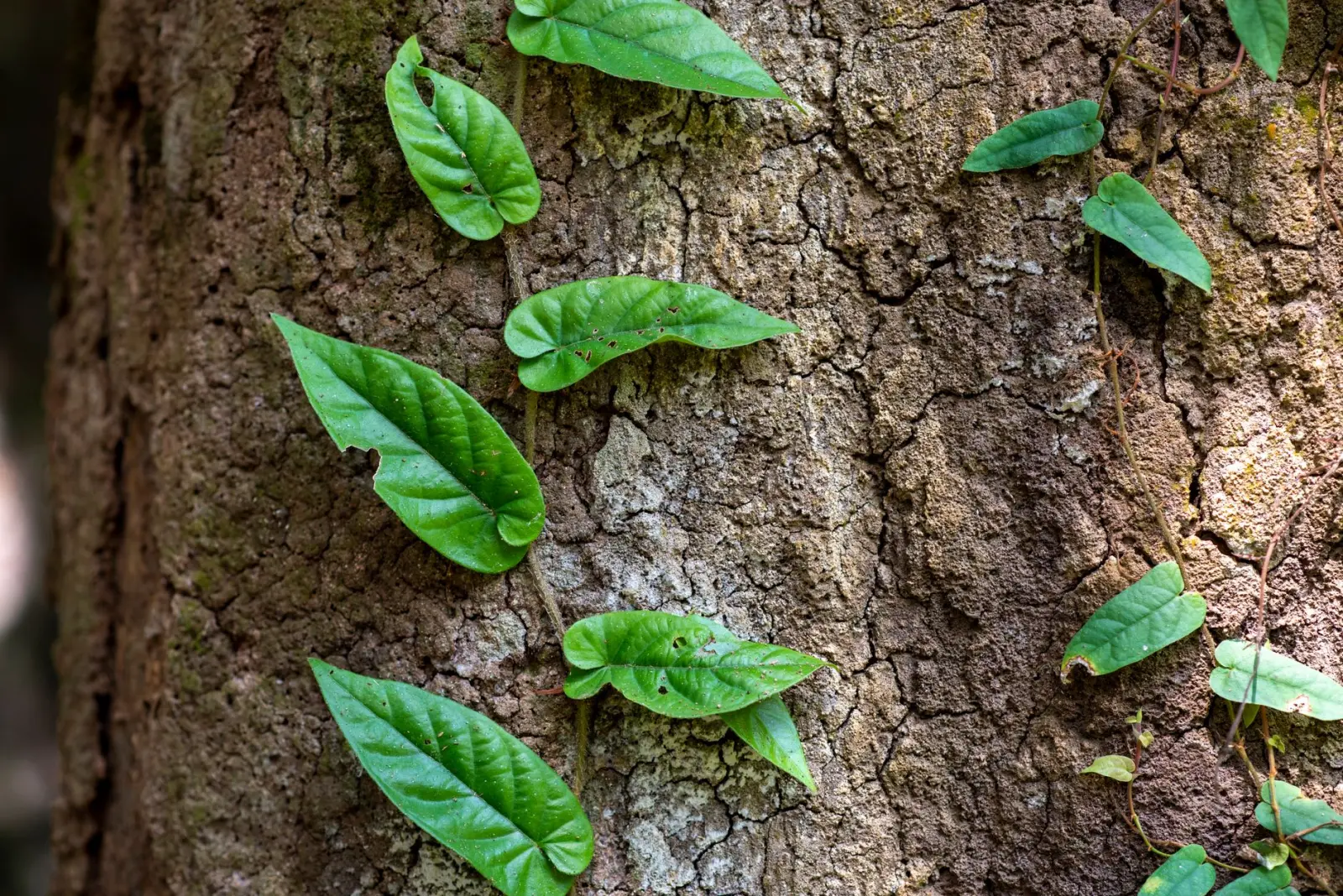
Some of the most efficient climbers use aerial rootlets, which are small root-like structures that grow directly from the stem of the plant. These rootlets don’t penetrate the bark or extract nutrients from the host tree. Instead, they produce a sticky adhesive substance that allows the plant to grip the bark surface. Philodendrons and certain species of figs use this method extensively. When you run your hand over a tree colonized by these plants, you can feel the slight stickiness where the rootlets contact the bark.
What’s notable is that this adhesive doesn’t bond permanently to the bark. The plant can adjust, reposition, and even release sections of its rootlets as it grows. The adhesive is more like a grip than a weld. This flexibility prevents the kind of girdling damage that would occur if the plant were locked in place as the tree trunk expanded with growth. The tree continues to add new bark layers, and the climbing plant’s rootlets simply maintain contact without resisting that expansion.
Twining and Wrapping Without Constriction
Many rainforest vines climb by wrapping around the tree trunk or branches in a spiral pattern. This twining method looks like it should strangle the tree, but the mechanics are more subtle. The vine grows in a helical pattern, and because it’s living tissue, it has some elasticity. As the tree grows in girth, the vine stretches slightly rather than cutting deeper into the bark. The contact is distributed along the entire wrapped length rather than concentrated at pressure points.
I’ve observed vines that have been wrapped around the same tree for what appears to be thirty or forty years, and the tree remains healthy. The key is that the vine’s growth rate roughly matches the tree’s radial expansion. If the vine grew much faster than the tree expanded, you’d see girdling. But most climbing plants have evolved to grow at a pace compatible with their host’s growth. There’s an equilibrium.
Some vines also develop grooves or channels in their stems where they contact the tree. This isn’t intentional on the plant’s part, but rather a physical adaptation to the pressure. The grooved surface distributes load more evenly and reduces the likelihood of a sharp edge digging into bark. It’s similar to how a rope with a flat, woven surface causes less damage than a thin wire under the same tension.
Hooks, Tendrils, and Distributed Support
Another common strategy involves hooks or modified leaf structures that grab onto branches rather than wrapping around trunks. Passion vines and many climbing palms use hook-like structures that catch on twigs and smaller branches. These hooks distribute the plant’s weight across multiple contact points rather than loading it all onto one stem. A vine might have dozens of these hooks engaged with different branches, spreading the mechanical stress throughout the tree’s architecture.
Tendrils, which are modified leaves or stems that curl around supports, work similarly. They’re thin and flexible, and they grip rather than constrict. A tendril can wrap around a thin branch without applying significant pressure because the plant’s weight is supported by the collective grip of many tendrils working together. This is mechanically efficient and causes minimal damage to the host.
The distribution of support points is critical. A vine that relies on a single thick wrap around a trunk creates a single line of stress. A vine that uses multiple tendrils, hooks, or rootlets spreads that same stress across a network. The host tree’s bark and vascular system can accommodate distributed stress far more easily than concentrated stress.
Bark Texture and Plant Selection
Not all trees are equally suitable hosts, and climbing plants seem to have preferences based on bark characteristics. Rough, deeply furrowed bark provides better grip for rootlets and hooks than smooth bark. Trees with rough bark also have more surface area for adhesive contact. Over time, you notice that certain tree species in the rainforest tend to support more climbing plants than others, not because they’re more hospitable, but because their bark structure is mechanically compatible with climbing mechanisms.
Smooth-barked trees like some of the fig species are actually climbed less frequently, even though they’re common in rainforests. When they are climbed, the climbing plants tend to use different strategies, often relying more on wrapping than on rootlet adhesion. The plant adapts its climbing method to the available surface.
The Question of Real Damage
Damage does occur, but it’s usually minor and localized. If a large vine is suddenly torn away from a tree by wind or falling debris, it can strip bark and expose wood. Vines that grow too densely in one area can shade out the host tree’s foliage, reducing photosynthesis. A very heavy vine can sometimes bend or break branches, though this is less common than you might think because the vine’s weight is usually distributed across many branches.
The most significant damage happens when a climbing plant girdles a tree, cutting off nutrient flow. This occurs occasionally, but usually only when a vine has wrapped so tightly that it doesn’t give way as the tree expands. This is more likely to happen with fast-growing vines on slow-growing trees, or when a vine encounters an unusually narrow section of trunk and wraps multiple times around it.
What I’ve observed repeatedly is that rainforest trees and their climbing plants exist in a kind of coevolutionary balance. The plants have mechanisms that minimize damage, and the trees have bark and growth patterns that can accommodate climbers. It’s not perfect, and individual trees do sometimes die from vine damage. But the system works well enough that climbing plants remain abundant throughout rainforests, and most host trees survive the relationship.