Australian water dragons spend most of their time in and around freshwater streams that cut through rainforest canopy. I’ve tracked them across several northeastern Queensland river systems over the years, and what strikes me most is how poorly they tolerate disturbance. They’re not aggressive animals – they’re nervous. A person walking along a creek bed will flush them within seconds, sending them either into deeper water or up into overhanging vegetation. This immediate flight response is their primary survival strategy, and it shapes everything about how and where they actually live.
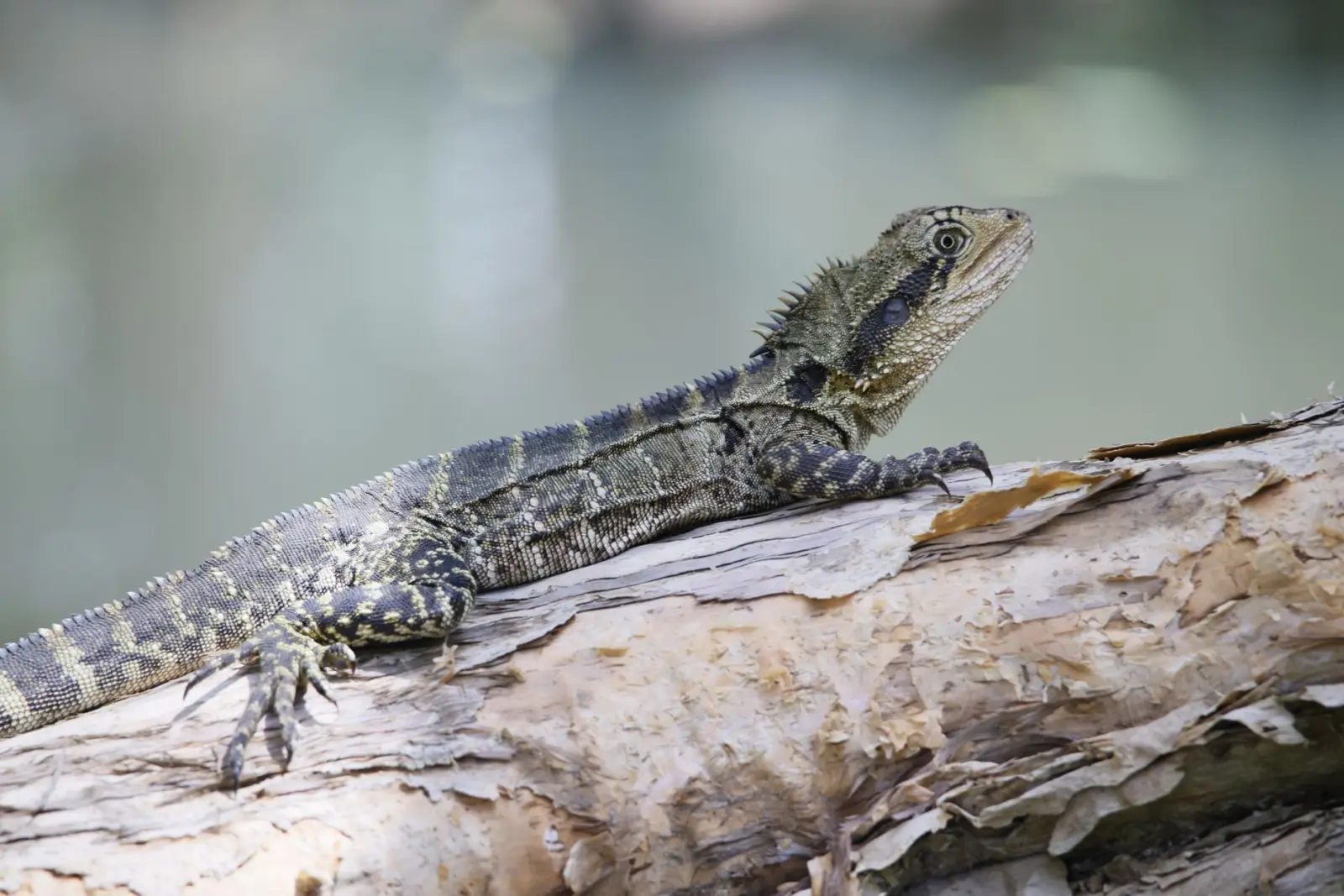
The species most commonly encountered in rainforest settings is Intellagama lesueurii, the eastern water dragon. They’re medium-sized lizards, typically 60 to 90 centimeters from snout to tail tip, with males noticeably larger and more robust than females. Their coloration tends toward olive-brown or grey-green on the back, which provides effective camouflage against wet rocks and submerged logs. The underside is usually lighter, sometimes with faint yellow or cream tones. Males develop more pronounced dorsal crests and larger femoral pores than females, though these differences are only obvious once you’ve seen several individuals side by side.
What people often misunderstand is their actual lifestyle. They’re not fully aquatic like water snakes or crocodiles. Water dragons are semi-aquatic opportunists. They haul out on rocks, logs, and banks for extended periods, basking in dappled sunlight that filters through the rainforest canopy. They’re thermoregulating – absorbing warmth to maintain the metabolic rate they need for digestion and activity. In cooler months or during extended cloud cover, they become sluggish and spend more time in sheltered spots beneath logs or in root systems along the bank.
Feeding and Daily Movement Patterns
Water dragons hunt primarily by sight, and their diet reflects what’s available in and around their stream. Aquatic insects, small fish, tadpoles, and crustaceans make up the bulk of their feeding. I’ve observed them taking prey both in water and on land. They’ll snap at insects hovering near the surface, and they’ll also move into shallow margins or onto banks to hunt small skinks and other lizards. Juveniles eat more invertebrates proportionally; larger adults take more vertebrate prey. The availability of food varies seasonally and by location. Streams with higher invertebrate density support higher densities of water dragons, though the relationship isn’t linear – overcrowding still triggers territorial behavior and stress.
Their daily movement is constrained by the stream corridor itself. A water dragon will occupy a home range of perhaps 50 to 200 meters of stream, depending on habitat quality and population density. They’re not wanderers. They know their stretch of water, the basking spots, the shelter locations, and the feeding zones. If you return to the same section of stream over weeks, you’ll often see the same individuals in the same general areas. This site fidelity makes them vulnerable to habitat disturbance. Clear a log they use for basking, or alter water flow, and they don’t simply relocate – they abandon the area or become stressed and more susceptible to predation and disease.
Breeding, Nesting, and Seasonal Behavior
Breeding occurs in spring and early summer, typically September through November in Queensland. Males become more territorial and aggressive during this period, though aggression between water dragons is usually ritualized rather than violent. They’ll perform head-bobbing displays and body flattening to establish dominance without actually fighting. Females move away from their usual basking areas to find suitable nesting sites, usually in sandy or soft soil banks near the stream, often at a slight elevation above the high-water mark. Nesting females are more exposed during this time, and their behavior changes noticeably – they’re more active, more visible, and more vulnerable.
Eggs are laid in burrows or shallow excavations and left unattended. Incubation takes roughly 8 to 10 weeks depending on soil temperature and moisture. Hatchlings emerge in late summer or early autumn, typically 12 to 15 centimeters in length. They’re independent from the moment they hatch and immediately face predation pressure from birds, snakes, and larger lizards. Juvenile survival rates are low, which is why females lay multiple clutches and produce relatively large numbers of eggs. Despite this reproductive output, population growth remains modest because of high juvenile mortality and the territorial nature of adults.
Habitat Requirements and Sensitivity
Water dragons require specific conditions that are often overlooked in casual observation. They need clean, flowing water with adequate oxygen content. Stagnant pools or heavily polluted water support few or no dragons. They need basking sites – rocks, logs, or branches that emerge from or overhang the water. They need shelter: overhanging banks, root systems, fallen trees, and dense vegetation provide refuge from predators and harsh weather. They also need relatively stable water levels. Streams subject to extreme fluctuations or complete drying are unsuitable. In rainforest settings, these conditions are usually met naturally, but they can deteriorate quickly when land use changes upstream – logging, agriculture, or urban development that increases sedimentation or alters flow patterns.
The presence or absence of water dragons is often a useful indicator of stream health. If a stream that historically supported dragons no longer does, something has changed in the environment. It might be water quality, habitat structure, predation pressure, or a combination. I’ve seen streams recover water dragon populations after riparian vegetation was restored and flow patterns stabilized, which suggests the species is resilient to some disturbances but only if the fundamental habitat structure is restored.
Observing water dragons in rainforest requires patience and a slow approach. Early morning is best, when they’re active and basking. Moving quietly along the stream bank, pausing frequently, and scanning the water and surrounding vegetation will reveal more individuals than hurried walking. They’re not rare in suitable habitat, but they’re elusive. Their wariness isn’t stupidity – it’s an effective survival strategy in an environment where predators are constant and disturbance is often harmful. Understanding their behavior means respecting their need for space and accepting that the best observation is often from a distance, watching them live their lives without interference.