
Spend enough time in a rainforest, and you begin to notice that bird activity follows the fruit. Not the other way around. This observation, repeated across seasons and years, reveals something fundamental about how rainforests actually regenerate: birds are not passive consumers of fruit. They are the primary mechanism by which seeds move through the forest canopy and reach the soil where they can germinate.
The relationship is straightforward in principle but complex in practice. A bird eats fruit, travels some distance – sometimes hundreds of meters, sometimes much farther – and deposits seeds in a new location through defecation. The seed lands in soil, often with a small amount of nutrient-rich droppings attached. Germination follows. Over years and decades, this process, repeated millions of times by thousands of bird individuals, determines which plants establish where and how the forest structure evolves.
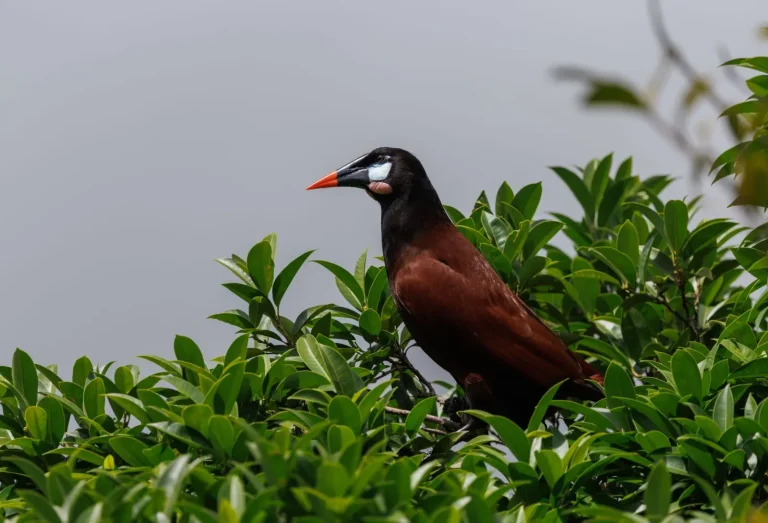
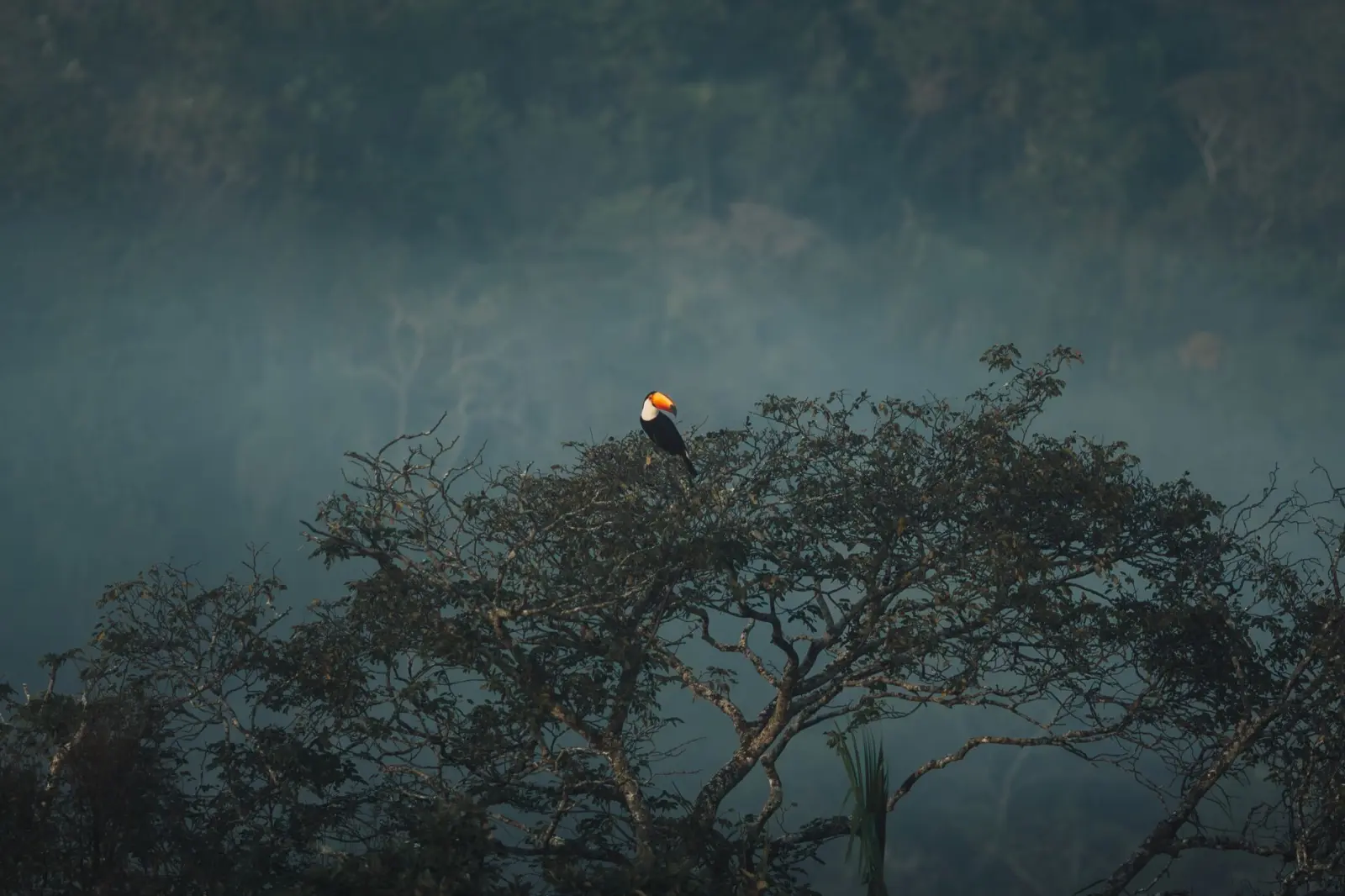
What makes this process ecologically significant is that it is not random. Birds do not distribute seeds evenly across the landscape. They deposit them in specific microhabitats based on where they perch, rest, and feed. A macaw defecating from a high branch creates a different dispersal pattern than a thrush feeding in understory shrubs. A toucan moving between fruiting trees in the canopy spreads seeds differently than a ground-feeding quail. The forest that emerges is, in part, a reflection of bird movement and behavior.
Fruit Availability and Seasonal Constraints
The timing of seed dispersal is not uniform. Rainforests produce fruit in pulses. Certain tree species fruit heavily in specific months, creating seasonal abundance followed by scarcity. Birds respond to these pulses. When fruit is abundant, bird populations concentrate in fruiting areas. When fruit is scarce, birds either move to other regions or rely on stored fat reserves. This creates a bottleneck: seed dispersal is most efficient during peak fruiting seasons, and less effective during lean periods.
I have observed this pattern repeatedly in Central and South American rainforests. During the wet season, when many canopy trees fruit simultaneously, bird activity is intense and dispersal distances are often longer. Birds move rapidly between fruiting sites, consuming large quantities of fruit and traveling farther between feeding sessions. During drier months, fruiting becomes patchy and unpredictable. Birds concentrate on whatever fruit is available locally, reducing dispersal range. Some seeds simply do not move far from their parent tree because the birds that would normally carry them are either absent or focused on other food sources.
This creates a real constraint on forest regeneration. Tree species that fruit only during lean seasons may have seeds dispersed less effectively than species fruiting during peak abundance. Over time, this can shift forest composition toward species that fruit when birds are most active and mobile. It is not a deterministic process, but a probabilistic one shaped by the intersection of plant phenology and bird behavior.
Seed Size and Bird Morphology
Not all birds disperse all seeds. There is a basic mechanical constraint: a hummingbird cannot swallow a seed the size of a plum. A macaw can. This matching between seed size and bird mouth size determines which species can actually consume and disperse particular fruits. Small-seeded fruits are dispersed by numerous small bird species. Large-seeded fruits depend on fewer, larger bird species.
This creates a vulnerability. Large-seeded fruits, often produced by ecologically important canopy trees, rely on a smaller subset of bird species for dispersal. If those birds decline in population or move to other areas, dispersal of those seeds becomes inefficient. I have seen this in regions where large macaws and toucans have been hunted or displaced. The large-seeded fruits that depend on these birds still ripen, but seeds remain in the canopy or fall to the ground beneath the parent tree, where germination is suppressed by shade and competition. The forest’s ability to regenerate large-seeded species diminishes.
Conversely, small-seeded fruits have a dispersal advantage. Many bird species can consume them, creating redundancy. If one bird species declines, others fill the dispersal role. Small-seeded species tend to regenerate more reliably across disturbed and recovering rainforests, which is why secondary forests often become dominated by small-seeded pioneer species rather than the large-seeded species of old-growth forest.
Distance and Direction of Dispersal
The distance a seed travels before being deposited matters enormously for forest recovery. Seeds dropped directly beneath the parent tree face intense competition and heavy predation pressure. Seeds dispersed hundreds of meters away face lower competition and higher survival probability. Yet dispersal distance is not infinite. Most birds deposit seeds within a few hundred meters of where they consumed the fruit, with some species traveling farther than others.
Frugivorous birds that make long daily movements – such as large parrots and hornbills in Asian rainforests – tend to disperse seeds farther than sedentary species. Nomadic birds following fruiting patterns across the landscape create long-distance dispersal events that can establish seedlings in entirely new forest patches. This is particularly important for forest recovery after disturbance. A clearing created by a fallen tree or human activity can be recolonized by seeds carried by mobile birds from surrounding forest. Without these mobile dispersers, recovery would be slower and less diverse.
The direction of dispersal also matters. Birds do not move randomly. They follow established flight corridors, perch in favored trees, and rest in particular locations. This creates directional bias in seed deposition. Seeds tend to accumulate in areas where birds concentrate – near fruiting trees, along forest edges, in areas with dense perching structures. Over time, this directional bias shapes forest structure. Certain areas become seedling-rich while others remain relatively barren, not because of environmental differences but because of bird movement patterns.
Seed Viability and Digestive Processing
Eating a seed does not guarantee its survival. Some birds crush seeds with their beaks, destroying them. Others swallow seeds whole, and the seed passes through the digestive system intact. The stomach acid and enzymes of the bird can actually enhance germination in some cases by scarifying the seed coat, making it easier for the embryo to emerge. In other cases, digestive acids damage the seed, reducing viability.
Different bird species have different digestive effects. Macaws and parrots tend to crush large seeds, which is why they are poor dispersers of the seeds they consume – they are primarily seed predators. Smaller tanagers and thrushes swallow seeds whole and are effective dispersers. Toucans occupy a middle ground: they consume fruit and excrete seeds, but the seeds often pass through their system so quickly that they are deposited relatively close to the fruiting tree.
I have examined droppings from various bird species in the field and found that seed viability varies considerably. Some seeds emerge from bird digestive systems with germination rates equal to or higher than seeds that fell naturally. Others are damaged or killed by the passage. This variation is not trivial. It means that the effectiveness of a bird as a disperser depends not just on how far it travels, but on whether the seeds it carries actually survive to germinate.
Predation and Post-Dispersal Survival
Dispersal ends when the seed is deposited, but the seed’s journey to becoming an established plant is far from over. Seeds on the forest floor face predation from rodents, insects, and other seed-eating animals. They face competition from leaf litter and other seeds. They face fungal infection and desiccation. The bird’s role is to move the seed away from the parent tree and into a location where germination is possible. Whether germination actually occurs depends on conditions the bird cannot control.
This is an important reality that is often overlooked. A bird dispersing a million seeds does not result in a million new plants. It might result in a few hundred, or a few thousand, depending on predation pressure, soil moisture, light availability, and competition. The bird’s contribution is necessary but not sufficient. The forest’s recovery depends on the entire system: fruiting trees, mobile birds, suitable microhabitats, and the absence of excessive predation pressure.
In heavily hunted rainforests where rodent populations have exploded due to reduced predator diversity, seed predation can be so intense that even well-dispersed seeds rarely survive to germinate. I have observed this in areas where large predators have been eliminated and hunting pressure has reduced bird populations. The dispersal process continues, but the post-dispersal survival rate plummets. The forest regenerates more slowly, and its composition shifts toward species whose seeds are either less palatable to rodents or produce seeds in such abundance that predation cannot consume them all.
The role of rainforest birds in seed dispersal is ultimately a story about movement, timing, and probability. Birds move seeds to new locations, but not randomly. They respond to fruit availability, which varies seasonally. They disperse seeds of different sizes based on their own morphology. They deposit seeds in specific microhabitats based on their behavior. The seeds that survive do so because they landed in the right place at the right time, and because post-dispersal conditions allowed germination. The forest that emerges is shaped by all of these factors working together, with birds as a central mechanism but not the only one.