
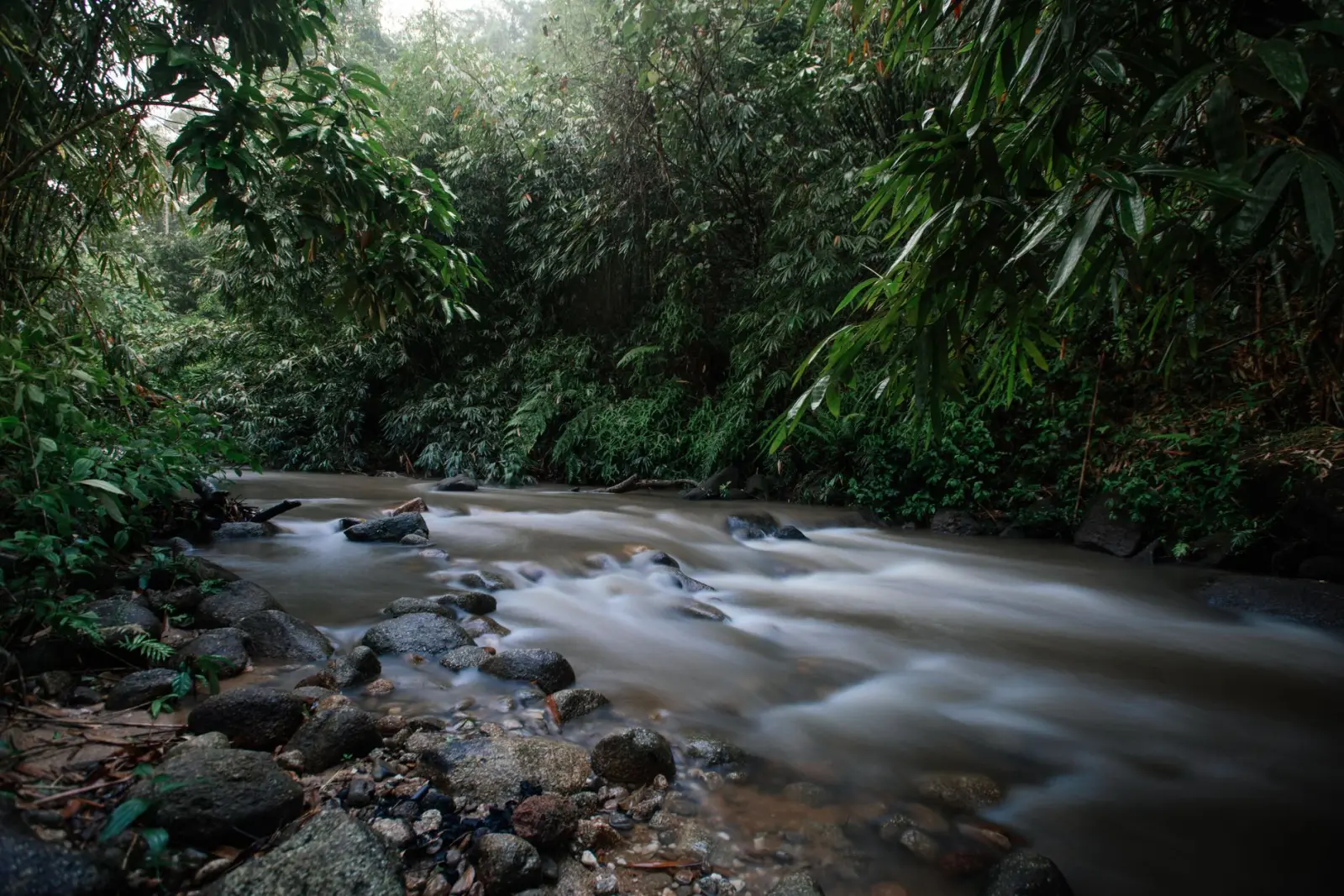
Spend enough time moving through rainforest, and you begin to notice that the creeks are not incidental features. They are the skeleton of the forest itself. I’ve walked through dozens of tropical rainforests across Central America, Southeast Asia, and the Amazon basin, and the pattern is always the same: wherever water moves, life concentrates. The creeks are not just drainage systems. They are highways, nurseries, and gathering points that sustain an improbable density of species in an environment where resources are often scattered and competition is fierce.
The immediate observation is simple. Step into a rainforest creek and you are entering a different world from the forest floor around you. The water temperature is cooler, the air is visibly more humid, and the sound changes. More importantly, the density of visible life shifts. Fish dart between rocks. Insects cluster along the banks. Amphibians call from overhanging vegetation. Crabs move across the streambed. This is not random congregation. The creek creates conditions that are fundamentally different from the surrounding forest, and those conditions support species that cannot survive elsewhere.
Why Creeks Concentrate Life
Water in a rainforest creek serves multiple functions simultaneously. First, it is a direct source of hydration in an environment where moisture is abundant but often locked in vegetation and soil. Many rainforest animals cannot access water from plants or dew alone. They need flowing water or standing pools. This is especially true for amphibians, which require water for breeding and must maintain permeable skin that loses moisture constantly. A creek that flows year-round provides something the forest floor cannot guarantee: reliable access to liquid water.
Second, the creek is a nutrient corridor. Rainforest soils are notoriously poor in available nutrients. The heavy rainfall leaches minerals downward, and the dense canopy intercepts much of what falls from above. The creek concentrates nutrients that wash in from the surrounding watershed. Leaf litter, insect bodies, and dissolved minerals accumulate in pools and slow-moving sections. Fish and invertebrates feed on this accumulated material. When those animals die or are eaten, their bodies become food for other species. The creek becomes a point where nutrients, which are dispersed thinly across the forest, become accessible in usable concentrations.
Third, the creek provides shelter and refuge. The water itself offers protection from predators for aquatic and semi-aquatic species. The banks, rocks, and overhanging vegetation create microhabitats that would not exist in open forest. Crevices in rocks provide shelter for crabs and fish. Dense root systems along the banks create nesting and hiding sites for small mammals and birds. The constant water movement creates oxygen-rich conditions that support species requiring high dissolved oxygen levels.
The Breeding Imperative
Many rainforest species depend on creeks for reproduction. Amphibians are the most obvious example. Frogs, toads, and salamanders cannot complete their life cycle without water. Eggs must be laid in water or on vegetation overhanging water. Tadpoles develop in the creek itself. The timing of breeding is often tied to the creek’s water level and flow rate. During dry seasons, some creeks shrink dramatically, concentrating breeding populations into smaller pools. During wet seasons, water spreads across the forest floor, creating temporary breeding habitat. Species have evolved to exploit both conditions. Some breed in the main creek channel, others in tiny pools that form only during heavy rain.
Fish species show similar patterns. Many rainforest fish are small, specialized species that breed in specific creek habitats. Some lay eggs on rocks in fast-flowing sections. Others breed in quiet pools. The creek’s physical structure – its gradient, its rock formations, its vegetation – determines which species can breed successfully there. A creek that has been altered by landslides, logging, or dam construction loses its breeding habitat for species that require specific conditions. The biodiversity collapse that follows is often attributed to habitat loss in general, but the specific loss is reproductive habitat.
Invertebrate Communities and Food Webs
The invertebrate life in rainforest creeks is extraordinary and often overlooked by visitors. Aquatic insects – mayflies, caddisflies, stoneflies, dragonflies – form the foundation of the food web. These insects are sensitive to water quality and flow conditions. A healthy creek with good oxygen levels, stable temperature, and appropriate substrate (rocks, sand, wood) supports dozens of species. Each species occupies a specific ecological role. Some are shredders that break down leaf litter. Others are scrapers that feed on algae and biofilm. Predatory insects hunt smaller invertebrates. This diversity of feeding strategies means that the creek processes organic material efficiently, recycling nutrients back into the system.
The invertebrate biomass in a productive creek is substantial. During certain seasons, mayfly hatches can be so dense that the air above the water appears to shimmer. These emergences are feeding events for fish, birds, and other predators. The timing and intensity of these hatches is a signal of creek health. I’ve noticed that creeks in protected areas with intact riparian vegetation tend to have more predictable and abundant insect emergences than creeks in disturbed areas. The difference is not subtle. It translates directly into food availability for downstream species.
Connectivity and Movement
Rainforest creeks are connectors. They link isolated patches of habitat across the forest landscape. For aquatic species, the creek is a dispersal corridor. Fish and invertebrates can move upstream and downstream, colonizing new areas and maintaining genetic diversity. For terrestrial species, the creek provides a path through dense vegetation. Many mammals and birds follow creeks as travel routes because movement is easier along the water’s edge than through the closed canopy.
This connectivity becomes critical when the surrounding forest is fragmented. In areas where rainforest has been cleared for agriculture or settlement, remaining forest patches become isolated. Species that cannot cross open ground are trapped. But if creeks remain intact and connected, they can serve as lifelines, allowing populations to persist and interact. The loss of a single creek in a fragmented landscape can sever these connections and lead to local extinctions.
The vertical connectivity of creeks is equally important. Rainforest creeks flow downslope toward larger rivers. Species move along this gradient. Fish that breed in small headwater creeks may migrate to larger pools downstream during dry seasons. Invertebrates drift downstream and accumulate in deeper pools where predators can feed. The movement of nutrients, organisms, and genetic material along this gradient sustains biodiversity across the entire watershed.
Vulnerability and Change
Rainforest creeks are sensitive to disturbance. Even small changes can have cascading effects. Sedimentation from erosion in the watershed clouds the water and smothers the streambed, eliminating habitat for invertebrates and fish. Temperature increases from canopy loss stress cold-water species. Pollution from agriculture or settlement degrades water quality. Dams or diversions interrupt connectivity and alter flow patterns. The loss of riparian vegetation removes shade, increases water temperature, and eliminates the leaf litter that feeds the food web.
What I have observed repeatedly is that creeks in protected areas with intact riparian forest maintain their biodiversity and function far more reliably than creeks in disturbed landscapes. The protection does not need to be absolute. Even a buffer of forest vegetation along the creek can make a significant difference. But once that buffer is removed, the creek’s ability to support biodiversity declines rapidly. The recovery, if it happens at all, is slow.
The role of rainforest creeks in sustaining biodiversity is not dramatic or visible from a distance. It is not the kind of thing that appears in wildlife documentaries. But it is fundamental. Remove the creeks from a rainforest ecosystem, and the entire system collapses. The species that depend on them disappear. The nutrient cycling slows. The forest becomes quieter, less diverse, less resilient. Understanding this dependence is essential for anyone trying to protect rainforest ecosystems. The creeks are where the work of conservation actually happens.