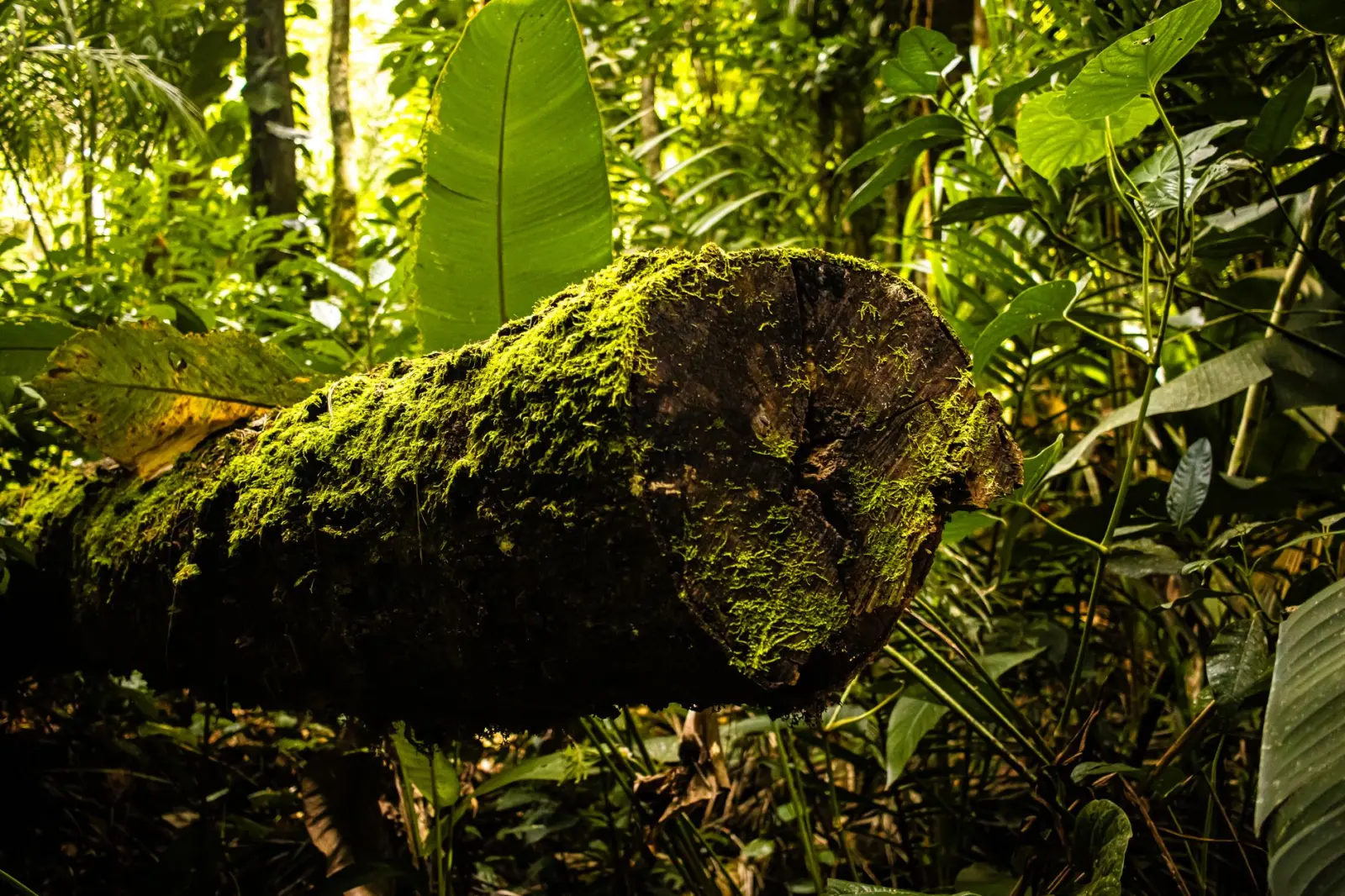
A fallen tree in the rainforest doesn’t stay dead for long. Within weeks of hitting the ground, the log becomes a scaffold for colonization – a three-dimensional surface where hundreds of species begin their lives. I’ve spent enough time in tropical forests to recognize the pattern immediately: the moment a canopy tree crashes, the race begins. What looks like simple decay is actually an intricate sequence of biological events that transforms dead wood into a functioning ecosystem.
The initial colonizers arrive almost before the dust settles. Fungi establish themselves first, often within days. They don’t wait for the wood to soften or rot. Pioneer fungal species penetrate the bark and begin breaking down the cellulose and lignin that give the wood its structure. This isn’t a slow process – certain fungi can visibly spread across a fresh log surface within a week under humid conditions. The mycelium network loosens the bark, creates pathways through the wood, and fundamentally changes the chemistry of the substrate. Without this fungal work, what follows wouldn’t be possible.
The Epiphyte Advantage
Epiphytes – plants that grow on other plants without parasitizing them – are among the most visible colonizers of fallen logs. Orchids, bromeliads, ferns, and mosses accumulate on the horizontal surface in a way they never could on a standing tree. On a vertical trunk, these plants would slide downward or struggle against gravity. On a fallen log, they settle into crevices, accumulate in the bark’s fissures, and establish themselves with minimal effort.
The advantage is straightforward: a fallen log offers stable real estate with less competition than the forest floor. Seedlings that land on the log face less fungal pressure from soil-borne pathogens. They also avoid the dense shade cast by herbaceous plants and smaller woody vegetation at ground level. I’ve observed seedlings on fallen logs growing noticeably faster than their counterparts on the forest floor just meters away. The difference isn’t subtle – it’s often the difference between survival and suppression.
Moisture retention is another factor that works in favor of log colonizers. The decaying wood holds water like a sponge, creating a consistently humid microenvironment even during drier periods. Mosses and lichens thrive in this condition. They form a living carpet across the log’s surface, and this carpet becomes the foundation for everything else. The moss layer traps dust, leaf litter, and organic matter. It creates pockets of soil-like material that ferns and small herbaceous plants can root into. Without the moss layer, the colonization sequence would be slower and less diverse.
Seedling Establishment and Root Development
Tree seedlings colonizing fallen logs face a specific challenge: they need to establish roots in a substrate that is actively decomposing. Early-stage seedlings often send roots downward into the log itself rather than toward the forest floor. This works because the decaying wood, enriched by fungal activity and accumulated organic matter, provides nutrients and moisture. The seedling essentially uses the log as a nursery bed.
As the seedling grows larger, however, its roots must eventually reach soil. This is where the three-dimensional geometry of the fallen log becomes critical. A log lying across the forest floor creates a bridge between the decaying wood above and the mineral soil below. Roots can grow downward through the spaces beneath the log, or they can grow laterally along the log’s underside until they find a gap where they can penetrate the soil. Trees that establish on logs often develop distinctive root systems – flattened, spreading roots that hug the log’s surface before diving into the earth.
The timing of this transition matters. If a seedling becomes too dependent on the log’s resources and the log decomposes too quickly, the seedling can collapse. If the log takes decades to decompose – as large hardwood logs often do – the seedling has time to establish a robust root system. I’ve seen saplings that began on logs decades ago, their root systems now completely independent of the original substrate. The log itself has become invisible, incorporated into the soil, but its role in launching that tree’s life remains evident in the root architecture.
Fungi and Nutrient Cycling
The fungal network that colonizes fallen wood isn’t just breaking down the substrate – it’s creating a nutrient delivery system. Mycorrhizal fungi associate with the roots of seedlings and established plants, forming symbiotic relationships that enhance nutrient uptake. The fungal hyphae extend far beyond the root surface, accessing nutrients locked in the decomposing wood and transferring them to the plant.
This relationship is particularly important in tropical rainforests, where the soil is often nutrient-poor. The thick canopy intercepts most rainfall before it reaches the ground, and heavy rains leach nutrients from the topsoil. A fallen log, by contrast, is a concentrated nutrient source. The wood contains carbon, nitrogen, phosphorus, and trace minerals accumulated over the tree’s lifetime. As fungi decompose this material, they make these nutrients available to colonizing plants. It’s an efficient system – nutrients that would otherwise be locked in dead wood are recycled into living biomass.
The decomposition timeline varies dramatically depending on wood type and environmental conditions. Soft woods like cecropia can decompose significantly within five to ten years. Dense hardwoods like Brazil nut or mahogany may take fifty years or more to fully break down. During this extended timeline, the log functions as a nutrient source and growing platform for multiple generations of plants. Early colonizers may die back and be replaced by larger species. Seedlings that germinated on the log may grow into saplings, then mature trees, while the log beneath them continues its slow transformation into soil.
Competition and Succession on Logs
The surface of a fallen log is not a peaceful settlement. Competition for space is intense. Moss and lichen colonizers can be overrun by faster-growing ferns. Ferns can be shaded out by climbing vines or young trees. The sequence of colonization isn’t random – it follows predictable patterns based on growth rates, shade tolerance, and nutrient demands.
In my experience, the most successful colonizers of fresh logs are those that can establish quickly without requiring deep root systems. Mosses and liverworts arrive first and persist longest. Ferns establish within weeks and can dominate a log’s surface for years. Tree seedlings arrive later, often as seeds dispersed by birds or bats, and they grow more slowly initially but eventually outcompete other plants through shading and resource monopolization. By the time a log is substantially decomposed, it may support a dense stand of young trees, some of which will eventually emerge as canopy-level individuals.
The heterogeneity of a fallen log – its varied surface, different stages of decay, exposure to light and shade – means that multiple ecological niches exist simultaneously. A single log might support shade-loving ferns in its shadowed underside, sun-loving herbaceous plants on its upper surface, and moisture-dependent mosses in its crevices. This spatial complexity supports far greater plant diversity than a uniform forest floor would.
What strikes me most about this process is its efficiency. A fallen tree, which represents a loss of canopy structure and a disruption to the forest, is rapidly converted into a platform for regeneration. The nutrients remain in the system. The space is recolonized. The forest doesn’t pause – it redirects. Fallen logs are not failures in the rainforest system; they are essential components of it, driving nutrient cycling, supporting plant diversity, and launching the next generation of forest structure.